I guess it’s a misnomer to say that the club is on it’s own will…I guess what it means to me is that I don’t sense that corrections have to be made in motion once the action starts from the top.
Kinda like this I guess…if we are building a wall with 16" center studs and if the first stud is off by an 1/8" from where it should be…when we get to the end of a 15 foot span the measurement will be off by inches. So for me if that first move from the top is fractionally off and either OTT or too far inside, etc…by impact the degree of incorrectness will be greater.
Thats’s why I have always believed that the ball is hit within the first inch of motion… regardless of method because once we start that dynamic process it’s going to sail “on it’s own will” on it’s initial path, or be a combination of “own will” and subconscious corrections.
Really enjoyed your comments about the line drawn down from the nose and nothing crosses it…hadn’t thought about it that way before…real cool…that’s what’s nice about these threads…lots of nuggets.
Like the idea of a swing thread…thought about that before and wondered if it would be appropriate, but I see that SB944 recently posted videos on Hackers Unite so maybe it’s ok to do that. Should probably check if us outsiders can do that…it would be a great adventure for sure.
I would have to really figure out how to do that…what camera to buy…how to get it to post, etc. I’ll check with some computer people for advice. Time is running real short for me…range opens April 1 and still have a few more honey-do things on the plate, plus wrists almost healed and I’m going to spends some time with Form 1 templates real soon. So I’ll have to combine honey-do with form 1 and see who wins before April.
Maybe late spring I’ll be able to post a video. RR
It would be a hoot to post some videos of us at the range. It looks about the same or worse than the range Tin Cup worked out of in the movie- but it’s home. Will talk to the guys and see what happens.
Heck, on rainy days we even pull off the same shot that The Cup did in the movie when he was in the bar- remember that knockdown that hit the pole with the bird on it Owners aren’t to thrilled but we have fun doing it. Just an old mom and pop operation but we get quite busy.
In Michigan the economy is so bad the last few years…golfing addicts have a choice to make: spend $100.00 for a day at the course–or spend $5.00 for a large bucket. Heard last year from alot of golfers that spouse will only allow them to hit balls. Some days it’s almost like the customer robs the kids piggy-bank before coming in. One day we took in $53.00 in quarters. RR
Bom: Just had one of those lightbulb moments regarding Padraig and the inward force of CP- and it kinda goes along with the line drawn from the nose thought.
I’ve done this before to show the expansion of motion. I take an iron and address it normally…then at full speed without cheating I try to make the toe of the club just miss the ball ( 6:00 as you look at it from address )- that’s where I am directing my attention and eyes. At full speed I’ve never been able to miss it----there’s contact as a result of expansion of forces and the subconscious override. Just had to get that out before it was lost to old age RR
RR
Double vocab mix up… I was meaning your thoughts on ‘swinging’ in terms of the ‘swinging vs hitting’ idea as seen in your guys terms… like your thoughts on the different protocols required for letting the club fly or driving it with the pivot, arms, and hands… not a big deal…
I switched into your language without telling you… sorry about that…
I’ll get back later…
Well…at this point I’m starting to really think that the pure pivot is the way to go: less timing and no significant compression loss. Not all that difficult to execute but the movements are, I think Lag said this, either not commonly understood fully or basterdized in counterproductive ways. Hope I’m not misspeaking.
With the way you understand motion…this pivot stuff paying homage to the 4:30 line is the real deal. Tried it out today and one time earlier and the results were consistent which says alot versus a method with more timing invoved. Only thing that concerned me was long irons…a little thin but I’m sure it is a pivot related problem for some reason. All other irons were max compression and fun- no dispersion problems.
I’m going to have to bend my clubs I guess and maybe those long irons will come around…we’ll see. I wrote about this test today on another thread. By the way, as I was watching different people at the range today I was taken by the numbers of movements that were inconsistent with travel on the 4:30 line----even from one of the PGA guys that was there.
It’s hard to say why your long irons were thin, but it’s an interesting discussion. It’s important to ask yourself what plane of energy is your pivot working on… what do you think? When you activate your pivot, what direction/directions is it activated towards? What is your pivot? What side of your body governs it? Both? One side more than the other? Upper more than lower? Legs or torso? Where to you feel it’s power? There are a lot of important questions to answer when we think of the pivot…
Plane of Energy- Seems to feel more vertical than rotary from the top to until the shaft returns to the 4:30 line and then a turn occurs, but I not sure what is activating the turn to be honest…maybe just a reaction… brain says "ok, you’ve dropped enough, time to go through it. Pivot- To start, I turn my shoulders/torso until the shoulders feel equidistant to the ground about 1/4 of the way back. At that point they feel parallel to the 4:30 line with the wrists fully set. Everything kinda stays right there with a little fuller wind-up, but it feels like I’m looking down @ that 4:30 line. Governs- I feel that both sides are working in unison going back and to just past the ball, then I feel my arms leaving for a higher elevation. Upper or Lower- Upper body going back with firm underneath…While the upper body seems to hold it’s relationship to the 4:30 line, the lower body starts down but more vertically with increase knee flex-- but R knee is holding and L knee is pulling away from it a little. Really feel alot of vertical down pressures in the feet when starting down. Feels like I’m in a dropping down a little in an elevator with the club along for the ride. Pretty hard to put into words. Power- seems process sets up a better sequence to hit harder with the right hand.
Have only done this twice—once a few weeks ago and today. Seems like it’s pretty consistent strike and compression.
I think next time, I’m going to unload my R arm more when making that drop from the top- to straighten it out a little more. I think today it may have been tucked a little too long.
The more I thought about it today. It reminds me of a Faldo type pivot…I think my execution of his swing before today may have been a little off…as I was previously going to rotationally from the top instead of the initial vertical dropping into the legs before the rotory aspect. RR
Cool post, RR… from the moment you said ‘more vertical’ on the start down the first thing I thought of was Faldo funnily enough, then the right side hold thing really solidified that picture in my mind, then you referenced him at the end… you know your shit…
Questions… do you really think your shoulders start you back? Upper body going back with firm underneath is subjective imo, which is fair enough since I asked you your personal thoughts. When you say that both sides work in unison, what do you mean? 4:30, 4:29, 4:33, does it really matter in specifics? Should it be specifically 4:30? I take it this is a conceptual line? I’m not asking to be pedantic, just to be precise.
Where do you feel your pivot activate when it turns on the power? It’s interesting that a lot of your thoughts are concerned with the backswing, or the start down. It fits in with your thinking that the swing is governed by the early moves. That’s not a critical assessment since I’m not saying that you’re wrong, but it’s interesting to observe. IMO the swing is affected by the backswing but more in a positional or locational sense… if we’re too deep or too shallow then it’s gonna be tough…
Torrance talks about the importance of the first few inches of the swing similar to the way you do, but I haven’t fully grasped that concept quite yet… I know how important it is, but maybe not enough… some would say that the backswing is irrelevant, but I don’t agree with that idea at all…
Lots of thoughts…
Will follow up more fully tomorrow…but the 4:30 line is the ABS term, maybe Hogan’s too But I see it as a 45 degree angle to the target line, with the ball on one end of the line and the line going way past your right side.
I think I’m going to bend the snot out of my gear. The more I think about it…flatness will help with the travel on that line. Lag mentions essentially fitting to impact dynamics and the body will adjust to that. The more I think about that-----gosh, I’m thinking alot lately----not sure if Tom Kite plays flat gear but I know that at one time he said that when he gets fitted he gets into an address posture without club in hand and says to the fitter…“fit this”. Makes sense 'cuz Kite said he knew he could find that posture every single time----so he had the club fitted to that posture.
Not quite what Lag says about fitting to impact dynamics but it’s consistent with the premise of fitting to a dynamic RR
Top shelf strikers like Tom Kite can feel where they need to be… and I would guess he was feeling more his impact hand height…
It’s the best way to do it… but you have to know where your best spot is… you can’t take a clubfitters advice ever… just have THEM bend the clubs… not make the decisions for you… they are not you…
Going to bend a boatload of range clubs to varying degrees and see what happens. Alot of fun stuff happening over here in Small World.
BOM:
I guess I just have it in my noggin that the backmove is critically important so I can arrive at the top in the proper postion for the selected motion. E.M. Prain said something like…“golf is like marriage, begin as you mean to carry on.” That’s kinda how I see it…but Furyck is certainly the antithesis to that premise Kinda like this I think, involves baseball.
A batter can stand at the plate with the bat in any postion they want…resting on their shoulder, or positioned in myriad ways. But when the swing commences it seems like, regardless of starting position, the bat will pass through a point in which it is kinda vertical to the ground just before it drops to the plane to hit the ball. So why not start vertically instead, versus resting the bat on the shoulder- in which case they would have to lift the bat first in order to get a vertical relationship to the ground before going through. Seems like it just adds another timing element. I think we are on the same page cuz you said:
The vertical-dropping down aspect from the top of the pivot motion is same as the baseball analogy: the key word being VERTICAL - the bat has to be vertical to the plane of attack before dropping onto or into the attack plane if he started with the bat resting on his shoulder, or any other myriad positions other that the bat being precisely in-line with the flat plane. I don’t recall ever seeing a ballplayer holding a bat that way: perfectly horizontal to the ground.
I don’t know if I can describe this…vertically going down first with the pivot as I described before is essentially like bringing the bat to vertical, however, we don’t see the club as being vertical. Why? It’s on an inclined plane- it can’t be vertical- but for all practical purposes it is because of the plane its on. Baseball= flat plane…golf=angled plane
Once the ballplayer gets the bat vertical regardless of what position he started from…he is then set to move through the ball to hit it using the pivot in conjuction.
Once the movement from the top begins with a golf club, the lowering aspect is like the ballplayer that has to find vertical first, then is set to swing. Once the dropping with the club happens it first goes vertical ( but as seen on an incline ) then it drops farther down to the 4:30 line—from there we can hit it. Having a hard time not rambling on here so I’ll take a break. RR
I would argue that they don’t start with the bat in a lot of different ways- it seems to me that they all have it at least between the ear and the shoulder, but the height of the bat or the extension they’re in would differ. Thats the way it seems to me anyway.
I think they utilize gravity by having it over the plane of attack in the same way the getting the club across the line is a good way to hit the ball from the inside. I get the sense that feeling the weight of the bat is very important to a hitter. They also have a cup in their left wrists which is a lag power position. Hitting in baseball I reckon would be power production primarily and then accuracy… to an extent.
There’s a lot of power in not being in the position you want to be. I think golf suffers from a little bit of that thinking. Backswing production can be too oriented towards the downswing imo. Furyk makes a lot of sense to me as a result. When you’re thinking of motion, you often have to look to the opposite of what you want in order to create the thing you do want. This is why keeping the cup in the left wrist, or the club outside the hands etc etc is so important in the backswing, this creates the opposite coming down. But in reality, if you think about it, it’s the inside leading all the way. There’s a lot to be said for the energy built up in that change of direction. In my opinion golf is primarily about propulsion, and then accuracy. If you learn to propel it correctly you can then direct it. That’s how I view it…
Well said there: Again on the same page…just having difficulty at times saying things correctly
I think I agree! Will have to look for some old pictures…like Dick McAullife from the Tigers in the 60’s. Don’t watch baseball anymore since the strike- learned to live without it
How true…however with this Faldo type pivot I found that I can keep the club outside the hands- which is the way I used to do it- or set them early…same result. Nice to see you mention about the cup in the wrist…that’s precisely what I do at address with my wrists…L wrist cupped and R wrist bowed a little so that they can invert themselves.
Perhaps baseball’s gravity- which is vertical I think- is the passive drop from the top into the legs I’m executing so that I can travel on that 4:30 line. Still real intrigued by the vertical aspect between the two. I gotta learn how to post pictures and video so life will be easier for me. Good Stuff Bom…liked what you said about the strike board–bingo!!
I think the more vertical or downward journey at the start of the downswing is very important and at the same time hard to convince yourself to do. Because it’s not directly towards the ball it stresses a lot of people out. We’re not fully mentally connected to the fact that our arms go ‘upward’ off our initial takeaway plane, we tend to think that it’s a straightish angled line similar to the one our clubhead is on. But the journey of our arms is different to the journey of the clubhead to a degree. That ‘up’ of the arms has to be ‘downed’ before we can go at the ball.
The irony of OTT or steep impact is that it’s caused by the club actually traveling too flat to start down. An outward move from the top, thinking in terms of plane, is actually flat. The compensation for that is a steep dive back in towards the ball, or the classic OTT action. The vertical or steeper downward start down encourages and outward more shallow journey of the club towards the ball later on. It’s similar to the ski jump I posted in this thread a while back… the angle is obviously different, but as a conceptual picture I find it’s quite helpful…
I don’t like the term vertical though, because it’s so concrete and has no pure truth within the golf swing in my opinion.
What helps me is to think of the degree of right elbow bend as determining the flattness of my entry into the ball. However, the more elbow bend the more the right shoulder has to move downward. So the steeper the right shoulder’s downward path (with the appropriate elbow bend)the flatter my entry into the ball! Does that make sense to anyone, if not DISREGARD!
This is similar to a discussion going on in another thread with BPGS1. IMO, you can’t hold everything back, something has to go. In this case, as you say, holding the elbow will make the shoulder go. I speculate that this is a feel vs real scenario because as a general rule, if you hold the angle too long in the right elbow then it’s a real OTT situation due to the right shoulder being too active, or just general early unwinding and the club heading outside the line. A reconnection between the right elbow and your side could be what’s being produced by your feeling of maintaining the elbow bend, since you’re talking about the right shoulder going downward, and this would be a good thing IMO. But I can’t really speculate about what you’re doing since I can’t see it, though often feelings aren’t indicative of reality. But that doesn’t make them bad by any stretch of the imagination! It’s your game and it’s your swing, and thats all you need to know at the end of the day. I’m sure some of the best players in the world have ridden ‘inaccurate’ feelings to big paychecks, so you go with what produces when it comes down to it. Monitoring is important with feelings though because they can lead you down difficult paths. That probably contradicts the former conclusion in a way, but that’s golf I suppose…
Do you think Furyk oversdoes the right elbow bend? I think OTT is largely a result of the right arm being “out”, not simply the right shoulder riding high. You right in suggesting that I may be dealing in a feel, but a golfer’s fingerprint to me is the degree of right elbow bend he/she has at impact, Nobody had a more right elbow bend than Trevino, as well as a lower right shoulder. hogan was close in Power Golf days. The right shoulder syncs the power package (arms) and the body (pivot) seeing that it is part of both. I bend the right elbow…then take the bend to and through the ball by using the pivot. The right elbow at impact and post impact is a golfer’s signature!
If you’re looking for simplified truths like that, then I’m not your man… I don’t think a golfers signature is easily definable, particularly in those terms…
As far as the right shoulder/right elbow goes, I think you’re looking for easy answers… I don’t have them…
Golf is not as complicated as people think, but it’s not maddening insanity either… If you’ve got specific questions then maybe I can answer them…
Re: Trevino- what do you mean? Are you comparing his impact elbow bend to his backswing elbow bend? He has, IMO, one of the best right arm straightening actions I’ve ever seen… you shouldn’t judge impact from the perspective of set up… it’s a fluid ‘position’…
BOM
The truth is simple, application is the complexity! If Trevino’s right arm is the best straightening action you have ever seen it is because he did not straighten it prematurely? I observed that he had a great deal of elbow bend compared to many other players. I guess I buy TGM’s 1F. The mystery of the mechanics of the golf stroke fade away when right arm participation is understood. By signature I mean the rate of clubhead overtaking (rhythm) and clubface rotation. Trevino, Hogan, Furyk, Mahan (thought I would throw in a young gun!) have a very quiet face i.e. angled hinge. If you straighten the elbow too quick you lose clubface control. Golf is a game of face…how is that for simple? I was making the connection between the right shoulder (pivot) and how the right arm functions.

 RR
RR
 Kinda like this I think, involves baseball.
 RR
RR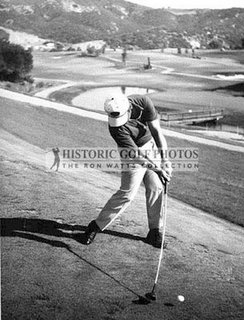 I guess I buy TGM’s 1F. The mystery of the mechanics of the golf stroke fade away when right arm participation is understood. By signature I mean the rate of clubhead overtaking (rhythm) and clubface rotation. Trevino, Hogan, Furyk, Mahan (thought I would throw in a young gun!) have a very quiet face i.e. angled hinge. If you straighten the elbow too quick you lose clubface control. Golf is a game of face…how is that for simple?
  I was making the connection between the right shoulder (pivot) and how the right arm functions.