Bob,
I was being a bit smart arse-ish yesterday, apologies for the tone in that post… re-reading it it sounded off…
I’ll get to some of those ideas later on…
Cheers…
When I think about right arm straightening I’m thinking about it’s action from the top down. It’s a journey that it’s on and on the backswing the elbow bending takes place near the end of the backswing, thinking in simple sequential terms. Not only does it bend but it also lifts a bit. I don’t know Lag’s thoughts on this but he seems to talk in terms of upper arm connection throughout so I don’t know if his ideas would have that lift in there. If nothing else the right elbow does come away from the body to varying degrees from player to player.
Because this happens last in the journey of the backswing, it basically has to be first on the downswing. There’s obviously lots of other stuff going on at the same time, but taking a simplistic view of the right arm, this is what happens.
If you fold the right arm and don’t unfold it at all then it’s going to be very difficult to have the club low enough at any point to make contact with the ball, so there can be lunging and all sorts of other stuff that isn’t great. The straightening of the right arm is better seen, or at least thought of, as a blending of the arms back into the action of the pivot. And you’re not really trying straighten it as such, the reality is that you just have to get rid of some of the angle in the arm in order to bottom out your swing. In very simple terms, you pivot, the right arm bends, the pivot waits a second while the right arm unbends, and then you pivot on through. The unbending is a small moment in the swing but a very important one in terms of your coordination and ironically in terms of using your pivot. IMO and experience, if you don’t unfold your right arm a bit to begin with, you tend to activate the pivot too soon because there aren’t many other options to bring the club down. It took me a long time to appreciate that move, and I learned it the hard way.
That photo of Trevino needs to be seen from the rear to be understood. You can’t have your hands ahead of the ball in a purely linear fashion, they also have to be proportionally left. I’m sure that’s understood but IMO it gets missed, at least in delivery of TGM principles. The reason I think Trevino’s right arm action is so good is that he blends his arms back into his pivot better than most, and then, like he says, uses his legs to hit the ball. If you’re using your legs/pivot to hit the ball, the club is traveling away from you. Some would see his right arm as thrusting, but it’s not, it’s holding on and working the club inward. He talks about keeping the club on line through impact and I think he did that by getting really low through the ball as opposed to doing it with his hands. He kind of chased it in a low lateral knee flex sort of way.
I completely agree that understanding the action of the right arm is huge in the swing. It’s really only thing that changes it’s form in a drastic way so reforming it during the swing is vital.
Does anyone want to talk about what’s going on in these photos? Suffice it to say the yellow lines have nothing really to do with it. I brought them over here because they’re key to the conversation about Harrington and the sidecars…
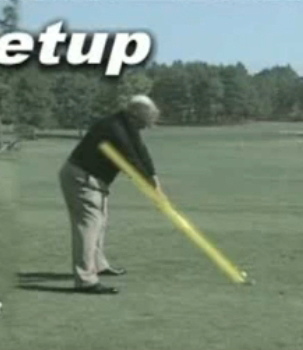
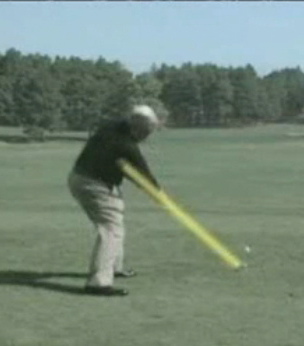
The first picture is address, the second one is just after impact…they look very similar, but you can see the ball leaving and a few other signs( like lower body action). I am thinking that this demonstrates that he has straightened his right arm as you discuss in your preceding post.
Maybe start a new Moe thread?
Got it Bom:
The letters seen: E T U P means- expanding transversely using physics 
Seriously, when it comes to Moe I haven’t a clue. I fooled around with it a few years back but when I read that the R wrist/hand had to go to a “sub-abduct 45 position” at address that was enough for me!! No way, no how. But I would like to read what others have to say. It seems like every picture of him has that thing in his R pocket…Lag, you were up close…what was it? did you ever ask? I would have…I would have said…“hey Moe, no fair using balancing or routing aids in your pocket, what’cha got there.”
Kinda like Larry Loretti using a cigar to keep his shoulder move under it…instead of across it.  RR
RR
His spine angle is more erect at impact than at set up, and he’s got more knee flex too- traits of some very fine strikers. Shallower angle of rotation on the way down, stronger structure for an inward pull, he’s not sending energy directly to the ball, etc. etc. lots of good stuff.
A Moe thread would be cool…
These two photos give an interesting perspective on what it means to have the hands ahead at impact. Obviously they’re from different shots but they’re in pretty much the same position in the motion…
This, I believe, is one of the major failings of TGM. Because G.O.L.F is such a convenient acronym it’s easy to become smitten with the linear aspect of the motion, but the linear aspect comes from a much different place than the hands…
For some reason 2 photos keep coming up in the first one but no worries, it’s not such a bad image to look at!
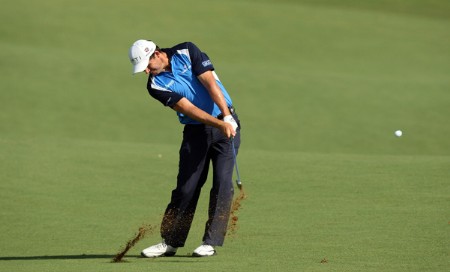
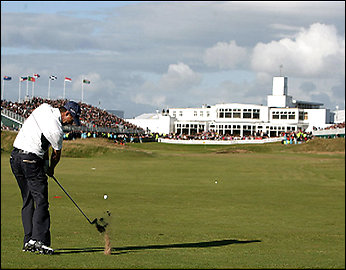
BOM: Great pictures of Padraig…Is it safe to say you are from the same country?
Great left arm and angled hinge. I especially like looking at the “puffs of dirt”…it almost looks like the angle of the dirt explosion nearest the ground and the launch angle of the ball form parallel lines…wonder why that is?  RR
RR
I thought about putting this in the Instructional Book section but since it’s not a golf book I figured I’d post it here…
Laura Stamm’s “Power Skating”…
I picked this book up a few years ago when I first started digging into some stuff and a lot of the thoughts are coming back into my mind lately with my thinking and analyzing the legs and feet in the swing. I could see the golf swing in how Hockey players powered around the ice so I wanted to see some of the thinking behind it. I found a lot of relevant stuff that isn’t necessarily thought in general golf theory. I figured I’d throw together some of the key ideas… I personally see Hogan and the likes in a lot of this stuff…
General-
The faster you skate, the deeper the edge you must apply to the ice, and the more you need to bend your knees and press your body weight downward above the engaged edge…
Centripetal and centrifugal forces are at work; they must be equalized and in proportion to your speed in order for you to balance over the edge…
The skate blade travels as if it were on the outside rim of a circle. The body rides slightly inside the rim…
Keep your body weight on the back halves of the blades which are from the middle to the heels…
Never lean on your stick for balance or support- it is not a crutch or a third leg…
Even minimal inside edges provide more stability that flats of blades…
Explosiveness Through Greater Force Application-
Every sport requires precise and controlled application of force. Explosive force, well timed and properly executed, results in movement, either of an object(such as a puck or ball), an opponent, or yourself. Certain principles must be followed to produce optimum force. Although the result in each sport may vary, the principles of force application are basically the same.
Every stride consists of a push-glide sequence that involves the transfer of body weight… Precise timing of the weight shift is necessary for a smooth stride and effective application of force.
Terms such as wind-up, follow through, coil, recoil, spring, release, drive, thrust, and explode are commonly used throughout the sports world. These same terms effectively describe the basic components of hockey skating.
The coiling action is achieved by digging the edge of the thrusting skate at a strong angle to the ice, bending the knees, and pressing the body weight down over the gripping edge.
There can be no traction without a strong thrusting edge or without the body weight pressing down over it.
The release is the actual thrust.
Many hockey players are unaware of just how hard their legs must push to get maximum speed.
During the release, the pushing edge, with the body weight concentrated over it, pushes powerfully, explosively, and directly against the cutting edge, which is wedged solidly into the ice.
Each push must be executed so that the thrusting leg pushes directly against the entire length of the blade which is digging into the ice… The leg must exert it’s force in a line perpendicular to that described by the blades length- in other words perpendicular to the grip(parallel to the intended line of direction)
Thrust directly against the gripping edge, using the entire blade length to push. Start the push with the heel of the inside edge and finish it with the toe of the inside edge. The body weight shifts from the back to the front of the inside edge during the push.
Although the leg performs the actual thrust, the purpose in pushing is to drive your total body weight against the blade edge that is gripping the ice.
The thigh muscles provide the main source of power for the thrust. If they don’t feel the strain of each push, they are not being fully employed… explode off the pushing leg.
Remember that when thrusting you are actually pushing your entire weight against the cutting edge… To accomplish this your weight must be balanced over the thrusting leg for as long as possible. Only at the midpoint of the push should the body weight shift from the pushing skate to the gliding or front skate.
Thrusting the legs without following through is like swinging a baseball bat and then halting the bat as it meets the ball. The thrusting leg is fully extended away from the body with the hip, thigh, knee, ankle, and toe locked. The gliding leg must maintain a deep knee bend as the thrusting leg extends. Only when fully extended, with the toe of the thrusting blade just barely off the ice, has the thrusting leg followed through to it’s completion.
Continue thrusting until the leg reaches it’s full extension. At the completion of the thrust, the hip and knee of the thrusting leg should snap into a locked position. This instant coincides with the toe flick(the final thrust from the front of the inside edge)
It is important to understand that the longer the pushing edge stays in contact with the ice, the more powerful the thrust will be.
Keep the skate and knee of the thrusting leg in a turned out position. “Toeing down”, or pushing straight back with the tip of the toe instead of the inside edge of the toe(caused by a loss of turnout of the knee and toe) results in the heel kicking up in a walking or running motion and prevents the toe flick.
As the thrusting leg extends and becomes the free leg, the knee of the gliding or front leg should remain bent. If the gliding knee is straight or only moderately bent, the COG will be too high- this hinders both stability and speed. The amount of knee bend in the gliding leg determines how far you can thrust the pushing leg against the ice and away from your body.
At full extension there is a straight line of force from the shoulders through the thrusting hip, leg, ankle, and toe.
The One Third, One Third, One Third Principle…
For the purpose of generating power we may think of the skate blade as being divided into thirds: the back third or heel, the middle third, and the front third or toe. When skating at speed, power is equally generated from each third.
The First Third of the Push- The heel of the blade generates thrust only when the skate is directly under the COG.
The Second Third of the Push- The middle of the blade generates thrust when the leg has already begun to push and is already partially extended. Almost everyone manages to get this second third push.
The Third Third of the Push- The toe of the inside edge generates the final third of the thrust, but only when the pushing leg is fully extended with the accompanying toe flick. Players who do not fully extend their thrusting legs or don’t get the toe flick may lose up to two thirds of their power on every push.
Moving the legs overly fast is a common error that deprives the legs of the ability to reach full extension- the pushing leg MUST go through it’s full range of motion… Players whose strides are incomplete rarely reach their potential for speed and tend to tire more quickly. Their legs may go fast, but they don’t- I call this ‘going nowhere fast’…
BOM
I have not fully digested that but it is interesting . I had always wondered why some hockey players turned out to be good golfers…Allen Doyle for example. I had figured it was the stick and the strike…upper body stuff.
Now I am thinking it is just as much what their lower bodies have “learned”, and their balance, or a combination of all of it.
Thanks for posting that. You have good stuff.
eagle
No worries, Eagle… it’s not all literal to the golf swing but I think it’s very interesting and helpful(for me anyway) to see how force is produced in other motions…
Something that’s bugged me for a long time in regards to gripping the ground is something that a good friend of mine said who’s a Kung-Fu master and has studied at the Shaolin Temple in China(a lot of his stories remind me of the movie Batman Begins- if you’ve seen that) I was talking to him about power production and using the ground etc and his take was that the ground shouldn’t matter if your body is functioning correctly. In his opinion he should be able to punch or kick just as hard standing on ice as he can when he’s on the ground. His/Their view is that power comes from the middle(Dantien/Tanden) and not from the ground. All of his training is done barefooted so as not to cheat. I guess since we have the ground we may as well use it but it’s something to think about- and I suppose good body functioning PLUS the ground, packs a pretty solid punch.
It’s what annoys me about some of the ‘new discoveries’ that these body motion machines claim to have made and claim to be the only things that can detect true motion… these martial artists have been doing this stuff and passing it on for 1000’s of years- so they have a pretty good handle on things and have pretty good eyes to judge too…
BOM: Great stuff as usual
Don’t have the book anymore, but I seem to recall in Golf in the Kingdom that someone (forgot who) was telling Shivas in the dark of the moon something about the midsection area…Damn! I wish I had the book to look it up.
Anyway, maybe that’s what he was referring to…RR
yep…I don’t take it literally either. …but I do wonder about the crossover/ connection. Many look at the brain circuits kinda like electrical circuits…with proper training can be used, enhanced, modified as needed for new tasks.
Here is something interesting on balance and surfing. I have wondered if Greg Norman’s surfing experience had a positive influence on his lower body action and balance.
eagle
That’s very interesting, Eagle. How that guy drops down there on the board is very much like the ‘horse stance’ from martial arts- I’ve done a lot of training with my buddy that I mentioned, and that seems to be what that guy is doing. The goal in the action is to lower the centre without tipping forward- the hips basically go under as the legs drop down. It’s very impressive to see that guy do it so fluidly let alone standing on that board. That is not easy! I’ve got no doubt that Norman’s surfing aided him in his golf- half the battle is having consciousness or even some awareness in the lower half. It appears that surfing would really help that. It makes me wonder why Adam Scott is so rigid seeing as he’s supposedly a good surfer. I wonder how many of the other good Australian golfers are good surfers- Twomasters, did you do much surfing when you were younger?
As an aside, I try to move my movement awareness into my legs as often as I can throughout my normal day- it’s very beneficial. This may sound weird but even brushing your teeth or rinsing your face in the sink can help. Instead of tipping over at the waist, try lowering yourself down with your legs. It’s that kind of stuff in our daily lives that we do SO un-athletically that really does destroy our natural ability to move in a powerful and natural way. A little mindfulness goes a long way…
I reckon these are interesting photos of good players at the same point in the backswing and downswing. It’s interesting to see the different state of relationships between the club, arms, hands, body, etc. at different points in the journey…
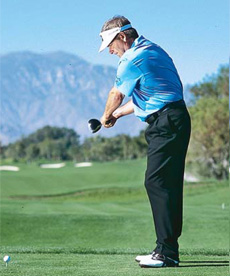
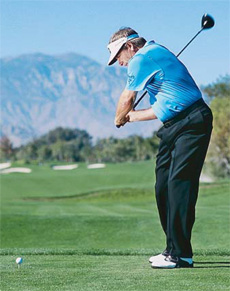
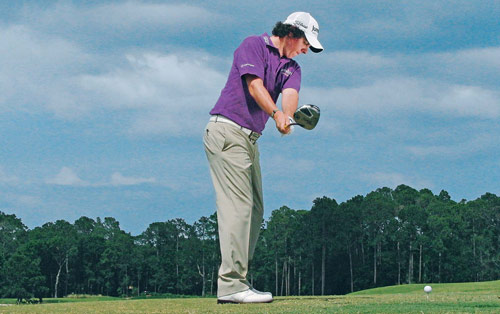
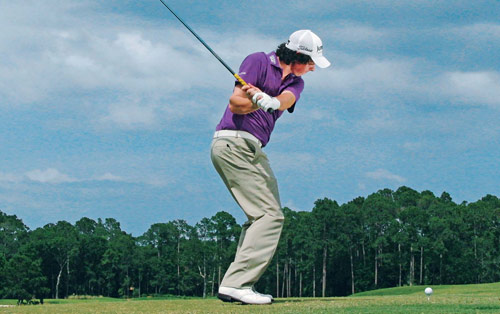
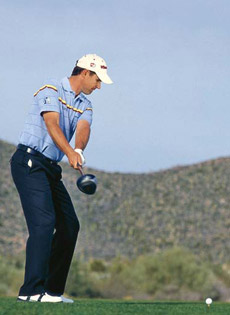
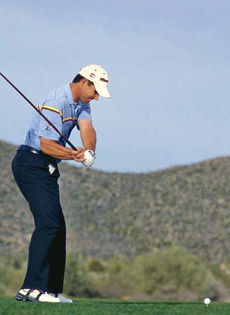
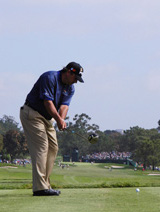
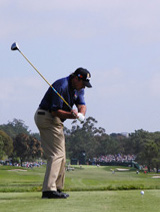
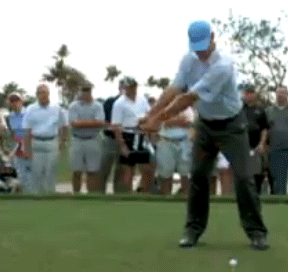
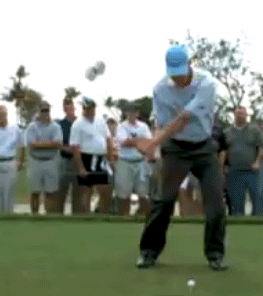
Hey Bom…neat pictures…feeling alot of that stuff now.
We had that discussion before about “fighting” CF or “creating” CA. The more in touch I’m becoming with saving R arm, the more I’m starting to feel that if more CA is the intent…the more one feels the fight with CF.
Almost home with this new approach…finding the more the right arm is saved, the straighter the ball flight. It’s almost like the pivot from the top sets the stage for the motion to “get to” the left instead of “go to” the left post impact. It feels like I’m pulling the ball down the left field line in baseball, without the R side/arm getting out and over.
Playing around with the arms a bit…they feel bowlegged to a small degree by intent…but seems to have them working as one…and the R arm itself doesn’t fully straighten until P4…the arm itself is the P4 postion. RR
Nice one, RR… I reckon this is a great feeling because you’re intentions and actions align with the physics of it. I think great golf arrives when you switch from effect to cause and align yourself with the opposite as the thing you do. Like when we jump, all we have to do is think ‘up’ and our body takes care of the pushing down. Good golfers do that instinctively but it’s definitely learnable. If bad golfers used their golfing brain to jump their knees would probably hit them in the chin, or maybe their arms would just go up in the air. That’s a pretty funny image…
BomGolf,
That sounds very much like the Alexander technique.
Mandrin,
What’s the Alexander Technique?