Didn’t I just say stop this stuff…you guys are killing me! 
Prediction…up and under…trees right!
Didn’t I just say stop this stuff…you guys are killing me!
Prediction…up and under…trees right!
Cause… with some assist… then result…
edit: its not just the feet…
Very telling side-by-side of Tiger. Doesn’t light gear also make one get tip-toey? Look at Tiger’s right foot on right hand pic. I remember something Moe Norman said when Tiger first joined the Tour, that he would get better once he learned to move that right foot toward the target and not up. Didn’t really understand it then, but do now.
Just wanted to post an additional observation on Bom’s Hogan v. Woods side by side.
The left arm is really fascinating to look at between the two. Not speaking to cause or effect, it looks like Woods’ left arm almost seems to block to pivot…like he’s running into the L arm. I was looking at Hogan’s sweater buttons and a similar line on Woods if he did have buttons all the way down his shirt. Quite interesting I think, that in similar points in time along the journey that Tiger’s L arm transverses that line…whereas Ben’s L arm seems to parallel that buttom line as it is pinned to the pivot. 
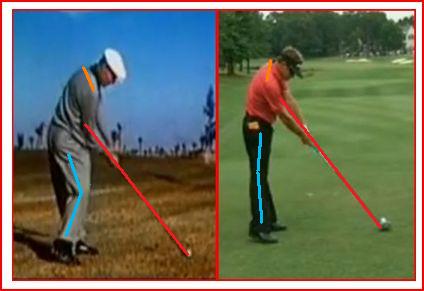
This is a major observation I see with the different swings of the eras
Using Hogan and Gay as an example again-- we see the shoulder difference- steep versus turning-- we see the distance created between the butt of the grip in relation to the body-- we see the right arm thrust versus right arm bent/saved difference-- we see the knee bend difference-- and we see the shaft difference where Hogan’s grip/shaft line continuation is centered on his navel and Gay’s shaft continuation line goes way up high towards the chest
Again this is a big cause of club weight and lie angle in my honest opinion…swinging a feather versus swinging a broom- the lighter more upright stuff is going to contribute and point you more towards the right hand picture style…that’s where it is all wrong by pushing people into lighter equipment…it alters their swings … and in the case of Tiger…the lightweight graphite woods have really hindered his swing… most of the times with his irons he is actually close to being good but he is using a 130gram shaft in a steel headed club…get a driver in his hands with a 70-80 gram shaft in a lightweight 'metalwood ’ head and it’s a different scenario … it makes it easier for him to swing more consistently with his irons as he has some mass to swing with
This why it may sound like a broken record but we harp on about equipment- – when you have equipment designed by Nasa scientists or physics majors and not designed by good golfers who understand the correct golf motion and feelings prescribed to swing correctly you are getting incorrect equipment in your hands that doesn’t allow you to receive feedback and doesn’t point your swing in the correct sequence of events to help you be more consistent.
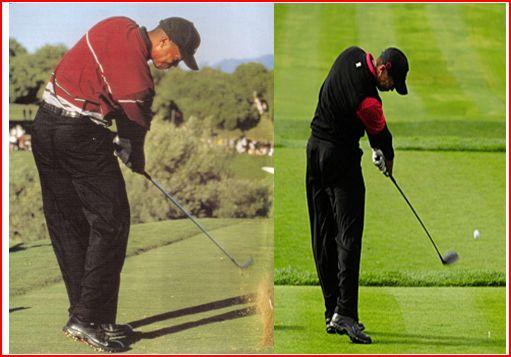
This pic on the left is the one I originally thought of with Tiger that I was trying to find and post…It is from around 1999-- textbook really
The driver swing on the right is graphite, lightweight that has just helped taper his swing over the years into an entirely different process of events… quite disappointing because in 99 and 2000 with his steel shafted smaller Titleist driver and 3 wood- he was virtually invincible…driving it well and giving himself more opportunities to stick his irons with much less struggling for pars from crazy wild positions on the course.
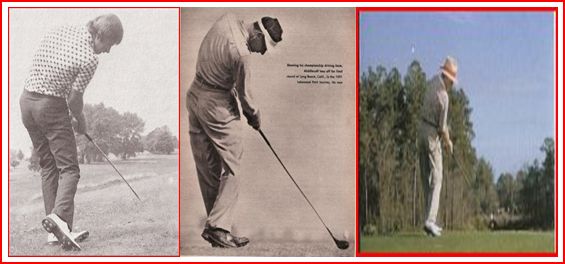
And instead of just using Hogan as an example we can show Faldo- Middlecoff and Kite in basically the same impact positions discussed
Shoulders turning level/open thru impact…right arm bent/saved at impact which limits clubface roll through the hitting arena…and beautifully balanced right knee bend to provide support for the rotating body
these are all great examples of the consistent way to ball striking through a correct sequence and the correct equipment set up to help achieve the sequence
That shot of Tiger with the steel-shafted driver looks a lot closer to Middlecoff at impact. T’s current swing, nothing like it–quite striking. Twomasters, you mentioned somewhere in passing in another post, that players today could play the modern gear more effectively (paraphrasing here) if they practice with stiff, heavy and flatter gear. How do you go about that b/c you’re living in two worlds? Do you find you hit the modern driver better b/c you’re working with persimmon?
Reviewing all these wonderful images of preserved right arm from the classic hitters really reminds me of the time I was first introduced to this concept.
Lag had explained another image he used for how he imagined the hands tracking along an inverted cone and I extrapolated this imagery to really get that right arm preservation…in trying to imagine the feeling, I imagined standing in an inverted cone, like some large pottery vase built in the shape of an inverted cone, and having my right elbow track along the inverted cone from p3 to p4.
It really helped me to preserve right arm and wristcock…had kind of forgotten all about that but its definitely time to dust that imagery down and re-employ it!
P.S. I posted about it on the lightbulbs thread and plenty of references will still be there including some diagrams which Lag provided.
2)Absolutely
aiguille,I didn’t see the post with reference to your image…I will check it out in the lightbulb thread
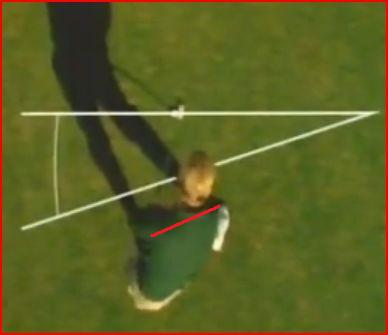
These overhead shots of Johnny Miller and of Jack Nicklaus really highlight the shoulder position to be strived for to promote a body turn release to help keep the face squarer thru the impact arena…a great birds eye view…I don’t know if anyone has any modern swings from overhead to compare to…that would be interesting for comparison
I particularly like these two shots because Miller and Nicklaus were both perceived as ‘upright’ players…I think these photos tell an entirely different story… especially looking at Nicklaus’ club approaching from an inside path
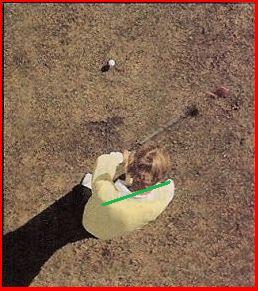
Eagle of the great questions!
I think they’re physically both, but they’re an effect of intent. I was thinking about this recently and what’s interesting is that flexing the knees is a removal of pressure in many ways, or giving the legs spring. The pressure increases through correct leveraged acceleration because you’re essentially pulling/thrusting out of the ground. Straight legs are no legs at all because they’re spent.
I was thinking about it in terms of jumping and landing. When you jump, you flex into your legs and then push down to go up. If you try to jump straight legged, all you have is your ankles and toes for power- interestingly that also corresponds, in golfing terms, to only having the hands to power the club. That’s probably not a coincidence anatomically, but that’s just my own speculation.
The thing that got me thinking that the knee flex is a removal of pressure, is when you land from a jump or height, your goal is to soften the landing, or remove impact pressure on the legs and body. We do that by flexing the legs as a shock absorbing action. It’s almost a moment of weight reduction that then becomes an increase in weight or ground pressure. You’d never land straight legged because it would very jarring- even thinking about doing it gives me the creeps.
So I think the pressure is a result and a cause of a good action, but it’s a result of in the initial intent of doing it properly. I think the pressure increase during acceleration actually comes from the leveraging out of the flex and not from the flex itself. It’s a subtle moment but I think it’s right. There is a point when the pressure begins to decrease again, and that’s as the legs straighten into ‘lift off’ as it were. When that happens early like the hand slappers do it’s a mess. Does that make sense?
Interesting post Bom…Lag talks about this concept in that we de-weight and then re-weight ourselves using the legs. Has been discussed many times in Let’s Talk Lag’s Golf Machine Thread and many others I am sure…
I will let Lag discuss it farther as I don’t want to overstep any boundaries…  ABS students will understand fully…
Great post Bom…I fully agree! Speaking of the creeps…something like this?
[youtube]http://www.youtube.com/watch?v=PHCXNt4P8Xg[/youtube]
Bradley, the inverted cone discussion started here on the lightbulb thread…page 5.
Twomasters–I asked a similar question today in the Advanced Ball Striking forum–Knudson thread. If you get a moment, would like to get your and Lag’s insights. So in these pics can you get to his open shoulder position bowing to the 430 line with closed shoulders?
PaulC,
Yes because from everything I have seen the flatter you can get coming in from 430 the flatter you can get coming out on exit… it just screams at the pivot to do something instead of just sitting there waiting for the hands to take over
Aiguille,
The right arm pin is a fantastic way to keep the club under control…keep it bent for longer then the less roll you get on the face…it’s OK to straighten the right arm but we want to do it later in the swing…near P4 if possible…anything earlier than that encourages some club roll as witnessed by the modern era swings I have posted which show the face moving all over the place a split second after impact
If it takes a cone visual to help achieve it, I am all for it
This Hogan video is fantastic…many have seen it…but well worth posting again… it may be one of the most telling videos around
[youtube]http://www.youtube.com/watch?v=G4DCZuAj5Mg[/youtube]
Great video Two…the right elbow and the club shaft remain glued to the plane line from p3 to p4.
Absolutely…pretty hard to hit it far off line when you do such a move…if you want to thrust and straighten your arm early and not use your pivot and just use your arms and hands in a slapping motion then bring plenty of balls in your bag and a hot putter…because you’ll need both of them
Or get a range plan at your club and beat balls all day long in the hope you can time your straightening arm at impact…daily