The Nautilus, the Golf Swing, Golden Ratio, Fibonacci seque

Sounds pretty good to me Teeboxman.

I don’t think anyone would reasonably argue that there isn’t some degree of axis tilt, but I believe it to be more a product of being inside the back of the ball, and forward of the shaft, through the zone AT THE SAME TIME. It is this not ‘lunging’, or moving laterally forward, while going inward to control the outward, but in front of it, that produces, or fosters, the tilt depending on degree of skill, as an overall view of the process.

I like the cone idea you presented. I wonder if the same relationship holds true with the R leg only inverted. It seems, as I ponder weak and weary, there may be some of the same notions that could apply, and possible captured via diagram.

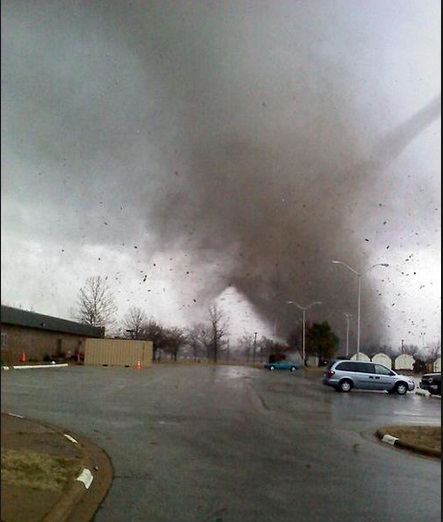
Found this on tornadoes. Looks like a primary, and secondary vortex doing a number, only inverted from each other.
twister.jpg

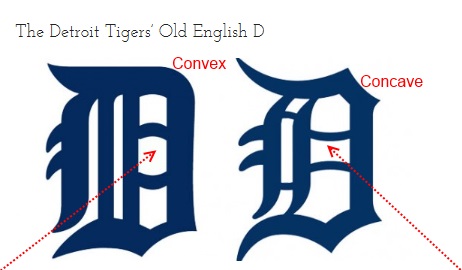
This is interesting relative to concave and convex. The Tigers use 2 different style ‘Old English D’s’ on their uniform. The shirt design is the convex, and the hat is the concave design. Also interesting how the those properties are inverted, or opposed, to one another in the meat of the design. Just some stuff as fall ball is in the air.

Go get em’ Tigers… :slight_smile:
tigers.jpg

Curious what you’ll find about that tornado.


A side note to readers regarding the word ‘axis’: I am using this meaning, “a straight line about which a body rotates.” On the surface, this definition seems straightforward and is useful here. This can be more involved but that is not explored now. For the most part, axis and pivot have the same meaning to me. Do they mean something different that might confuse this exploration?


If I understand your description of axis tilt it seems to fit Hogan and Player who were shown in earlier posts for illustration in this exploration, but I could be missing something. But if it does fit, I think we both seek to establish a tilted pivot similar to theirs, as much as that is possible, before the hands move much below hip height in the down swing, and we do not want swaying/lunging during impact. A tilted spine pivot for impact, instead of one from the lead hip socket to C7, might work well for other golfers but it has not for me. I believe the spine centric tilted pivot severely strained my low back and sacroiliacs, so I do not want torque in my tilted axis to be focused in my lower spine any more. The spine axis tilt was too random during impact and I never resolved it despite diligent study and effort. How much fault was with my lack of talent or with the spine pivot axis? Probably with both is my guess. Lack of athleticism is a given for me. On the other hand, I believe the anatomical location of the tilt axis is a choice we can make if we discern it. Switching to the lead hip socket to C7 as the tilted pivot instead of the spine has been worth exploring so far. But without instrumentation that conclusively shows there is a significant anatomical and practical difference in advantages and flaws between a spine centered and a lead hip socket to C7 tilted pivot axis, exploration through discussion may remain inconclusive without references to scientific research translated clearly into day to day language. I hope to find research about this but it may take added time before a report on it is made.

I am learning the role of both legs for powering the tilted axis rotation and for stabilizing the position of the tilt through impact. I look forward to readers’ descriptions how they use the trail and lead legs for those purposes with their own tilt.

Good area for discussion, but ya’ lost me by just a smidge. By a ‘tilted spine pivot’ are you referring to having more forward lean from the hips with the torso at impact then what was established at address. The ‘C7 style’ you refer to will still have some degree of being more forward because I can’t think of a style which would promote being further away with the torso at impact then what was established at address. If I understand your premise correctly, the only thing that changes is the delivery corridor- the C7 variety would attack from a higher elevation versus the tilted spine pivot which would be more the ‘pocket to pocket’ variety. That term- ‘tilted spine pivot’- still confuses me a touch.

Can you expand on that, either verbally or with pictures.

Didn’t get far with the tornado search as I was corralled into a vortex of illusion and mystery again that I have seen before, and thought about before in terms of being a secret in the dirt, but it didn’t become clear until I saw the connection between the these two images. It is actually not only a secret in the dirt, but a secret in the sky too, and disposes of the idea that DNA is a primary helix.
mushjet.jpg

Thanks for your questions RR.
I will be working with your questions and aim to clarify and post a follow up.
I will look into improving some pictures posted previously and using new pictures.

Good Teebox, take your time. Mow-towne will be busy for the next few days and I might have to venture downtown and visit with a few fellow rats in the underworld. :laughing:

I see flaws in my presentation that impeded adequate communication regarding the following questions:

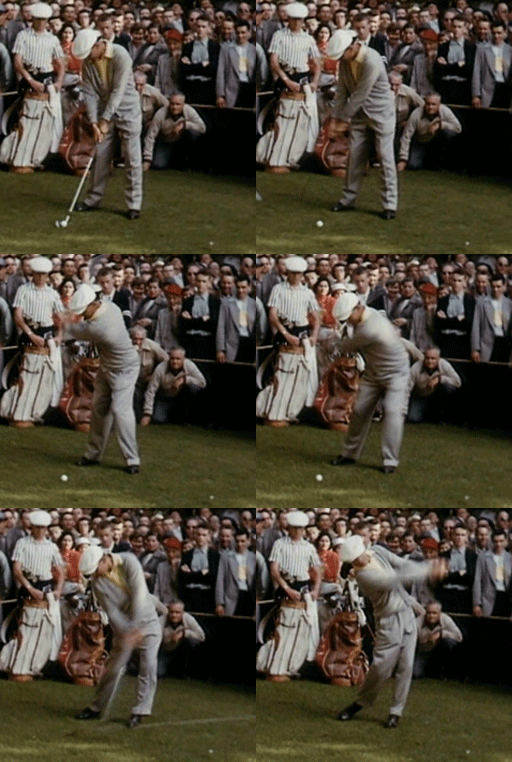
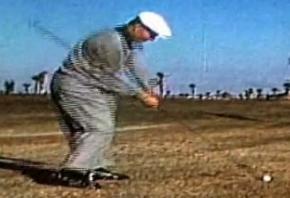
  1. While Ben Hogan’s hands move from hip high to hip high through impact, why does it appear that the base of his spine does not simply rotate but changes location?

  2. If the base of Hogan’s spine appears to change location more than the lead hip socket, why does it?

  3. Is the location of Hogan’s axis of torso rotation through impact not actually the spine but is instead in the region from his lead hip socket to the base of his neck?

  4. How stable an axis is that region compared to other possible locations in Hogan’s torso?

  5. If the lead hip socket is not wobbling, swaying, or changing location as much as the base of his spine, why is it not?

  6. How soon does Hogan position his axis for impact rotation and how long does it persist?

  7. How can I ask other golfers about these questions? And so on….

With the aim to expand communication about these questions and resolve presentation flaws in previous posts from me I will be looking into how it can be done better.

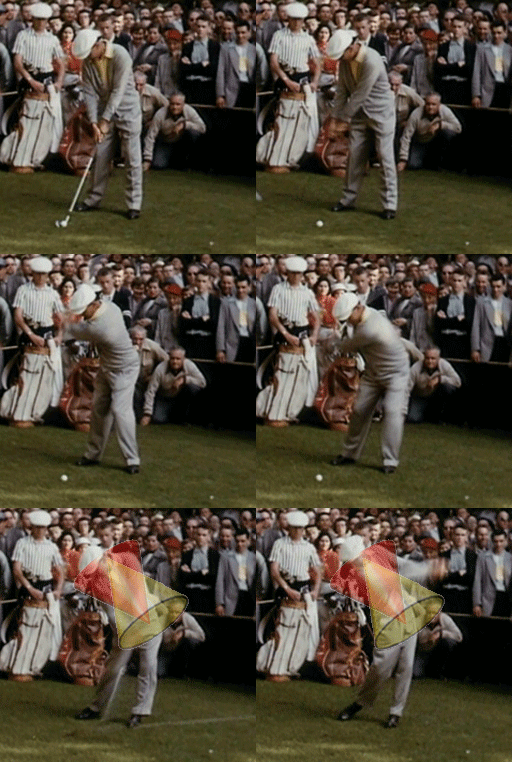
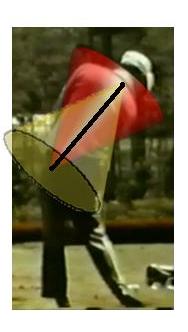
BH-FO430-04-1-RY-Cones.gif

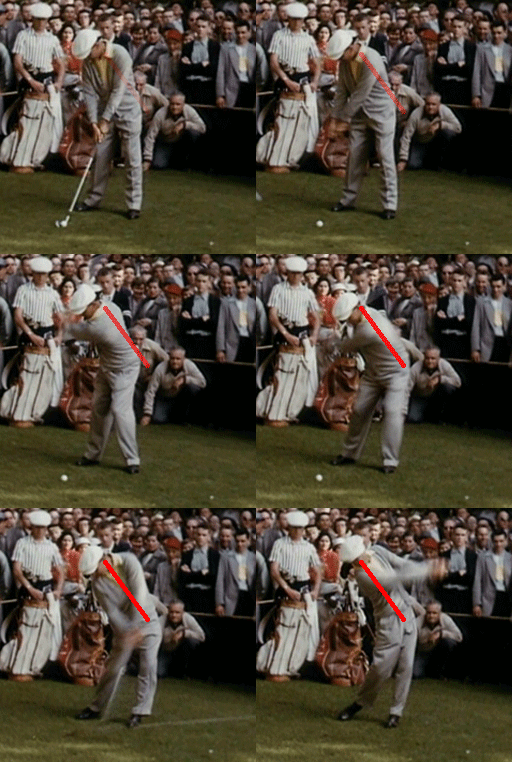
From P3 beyond P4, a pivot axis through the lead hip socket to base of the neck.
BH-FO430-04-1-RedAxis.gif
BH-FO430-02-1sec.gif

[youtube]http://www.youtube.com/watch?v=8x-nQ-vPw5k[/youtube]
For all those who did not get tipped for their effort in 2013, better luck in 2014.
Thanks eagle for first posting this a long time ago.

BH DTL P5 01.JPG
BH DTL P4 01.JPG
BH DTL PostImpact 01.JPG
BH PostTrans2Impact 198.JPG

A promised land beginning at its end, a champion hitter’s assertive post-impact pivot, earned.

[youtube]- YouTube

A student emailed me this link to the above documentary and suggested it relates in many ways to some of the concepts that have been presented here at ABS.

The idea of probability has been a big hallmark of my approach toward playing golf. As we improve our technique, and improve how our gear is set up, we increase the probability of a successful result. Golf is not about hitting every shot perfect. More about controlling the degree of negativity in the mishits.

Gary Player said “” The more I practice, the luckier I get"

Could be an explanation of it in the documentary.

On the subject of quantum theory, I am desperately hopping with a mental pogo stick on a greased high wire through swirling Niagara Falls mist. I find some relief from Albert Einstein who had strong objections about quantum theory and Richard Feynman who worked with it but mused, perhaps suspicious, at why the deepest levels, the smallest parts, are understood, so far, only through severely intricate explanations.

But lagpressure’s statement I get, “Golf is not about hitting every shot perfect. More about controlling the degree of negativity in the mishits.”

A CORRECTION: The phrase “From the caddy view,” is added (with red underlined bold italics) to the quote below to correct my post of September 17, 2013 2:10 pm. Also for the record, my exploration posts with the cones never should have seen the light of day. They work for me, but their meaning is very hard to post clearly without more skillful drawing and better writing.

Also for the record, my exploration posts with the cones never should have seen the light of day. They work for me, but their meaning is very hard to post clearly without more skillful drawing and better writing.

Pooey! I like reading what you put out Teebox, as one never knows where the next inspiration, truth, knowledge will come from and how, albeit at times abstract, those images may mesh with their own sense of self and doing, or at least be cause for contemplation- which is a good thing if you ask me.

Is the right elbow on the surface intersection of both cones or even inside it, the orange diamond volume, during impact?

I would say inside the diamond pattern.

Good players may not need any of this at any point and the exploration may irritate other students but did Ben and some others work through this sort of stuff as they developed their swings? I don’t recall seeing this stuff from Ben, for example, but that does not rule out that he thought about it and chose not to pester anyone with it. Hunch says some players worked through it and extracted whatever was useful, if anything; meaning, it’s doubtful any of this is original.

I have no doubt the man from Texas’ hardpan explored several areas from the simplest to the most off the chart stuff one could image. Can it be proved? No, but common sense prevails in this regard. It’s all good Teebox, keep those cards and letters coming.

Interesting tidbit here as it relates to your cones. Our digits basically produce a circular-cone action since they are ‘pinned’ at the knuckle. If we take two opposing fingers cones and place them against one another there is a little space between the fingers called Schamroth’s Window- and it is the same diamond pattern created by those two cones along the black axis.

Now what does this have to do with hitting a ball. Maybe something to some, nothing to others, and totally irrelevant to the rest, but it is interesting how continually recurring shapes paint the landscape. Beauty is always in the eye of the hurricane…ooops, beholder. :slight_smile:

Thank you RR.

I like to believe the image of Ben was enough to make the yellow cone’s axis tilt obvious, but the yellow cone remains ambiguous. The surface of the base of the yellow cone can seem to change and look like we see it either from above or from below.

Seeing the yellow cone from above changes the tilt of the yellow cone toward us, but the intention is to show the yellow cone from below and tilted away from us with the black axis congruent with both the yellow and red cones.

BH RY Cone LHipSocktoNeck 02.JPG
Studying drawing might help eventually. Time to move on.

The quantum theory video was strenuous fun. I am not qualified to discuss quantum theory and do not imagine that I will ever learn. I’ve messed around with metaphors and naïve joking but that was immature curiosity and whistling in the dark. The paragraph following next is an example of struggling to work out an honest question or two about the video on quantum theory and potential practical application. The struggle merely to ask takes absurd amounts of time and leads to the old knowledge that it can be hard to learn whether something is true, incomplete, honestly confused, or professionally packaged smoke and mirrors. About quantum theory, I have no way of really knowing, no matter how sincere, smart, and wise the presenter may be. At one level, that is a similarity, that trying to ask a decent question about quantum theory is much like asking about the golf swing.

Some questions about the video: “Toward the end of the video about quantum theory and its potential practical application, Anton Zeilinger reports that his test proved that entangled quantum particles were linked across about 144 kilometers, and that action on local entangled particles “teleported” the affect to distant particles and changed them. I do not know if Zeilinger proved the entanglement affect was instantaneous. There seemed to be talk about spooky instant action across vast reaches of, perhaps infinite, space, that the limitations that prevent other media communicating faster than the speed of light do not apply to quantum entanglement. Is that what the video said? If that is more than conjecture, what kind of testing mechanism could prove it and explain it to regular folks without resorting to unsatisfying metaphors and spookiness?”

That is where I ran out of gas.

If I look at quantum theory beyond this point, I suppose I should first try to learn what I can from the Feynman Lectures on Physics, and before that a chunk of math that proved to be a brick wall when I was young a half century ago. But really, I already have my hands full trying to hit a ball straight enough.

For those who got this far and are still curious about physics, here is a link to the Feynman Lectures on Physics: http://www.feynmanlectures.caltech.edu/.

Hey Teebox…just got down from climbing to the world’s tallest summit and thought you might like to see what I saw from on high.

Two cones, with a common middle, but not inverted contained within a lenticular formation…just think it’s a cool picture.
everest.jpg

What the…?
Never seen anything like that.