Regarding the hip to neck pivot axis, when I am able to practice and play again here is the approach I plan to use.
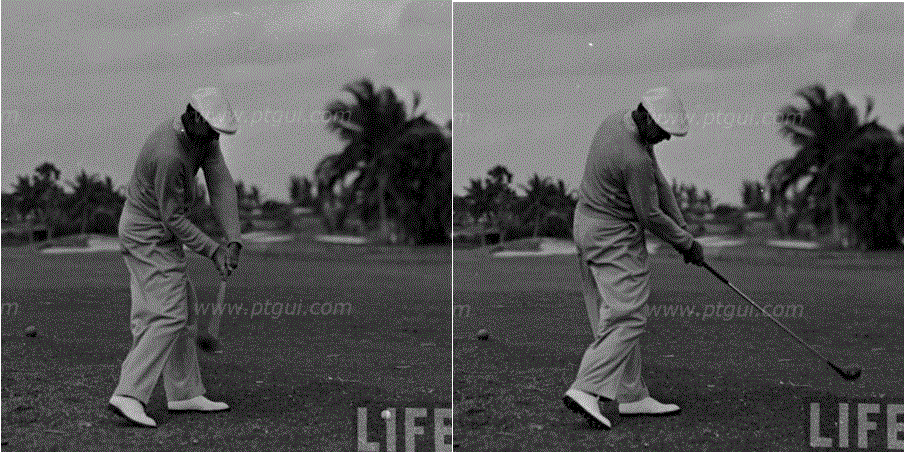
During the transition I will strive to position the lead hip joint socket for the pivot axis tilt I want, into and through impact, using a pivot axis in the region between the 7th cervical vertebra (C7) and the lead hip socket. I will strive to hold the shoulders ‘closed’ until the impact pivot axis is established and ready to begin accelerating through and beyond impact. The pivot axis tilt must be sufficient to accommodate the lie of the club shaft and to allow the lead and trailing elbows to orbit through the vertical space above the lead hip joint socket.
The intent after transition, as the hands reach hip height, will be to accelerate the pelvic lever around the lead hip joint socket and accelerate both shoulders’ rotation around C7, and continue accelerating both the pelvic lever and shoulders until the lead and then trail elbows pass above the lead hip joint.
The above conditions will be sought to enhance accelerating the lead and trail elbows with efficiency and precision, bringing them as near as possible to the pivot axis, with a minimum path length from the top, through impact.
The red and yellow cones will be a mental crutch to encapsulate and obscure the preceding details to reduce distraction: the red cone is the upper body action position, and the yellow cone is the lower body contribution. After sufficient training, the cone imagery may fade away safely. If difficulties arise, the cone imagery can be recalled. If that does not resolve difficulties, details can be consciously retrained and cycled through the cone imagery fade away.
Other important factors about an effective hitting golf swing are absent to focus more on exploring a neck to hip joint pivot axis. Recent pivot exploration derived because substantial posts by several contributors and ABS training so far have overthrown what I believed coming into ABS.