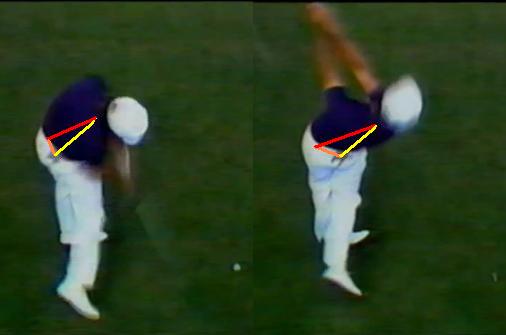
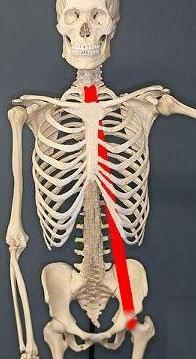
Let’s imagine that the pivot axis inhabits the interior region of the body from the base of the neck to the left hip joint where the leg attaches. Through impact this pivot axis is observed in some very good players, or so I believe. Through impact, in the Hogan video posted August 20 above, the base of the spine is moving in an arc or orbit around the left hip joint, in my opinion. Also, the ‘line’ or interior pivot axis from the base of the neck to the left hip joint appears to wobble relatively little if any, and most of the body appears to revolve itself around that region of the body. The video below may show all this better. Please notice the path of the dark transmitter at the belt line, attached to the backside, below the spine.
In the 20 odd years before ABS, I tried to twist the spine as my pivot axis. I believe that was a serious mistake for me and it would have been more effective to use a pivot axis more like Gary Player’s or Ben Hogan’s through impact.
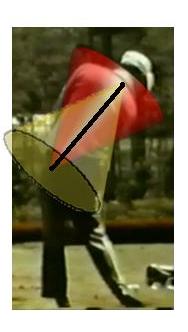
Efficient description of what these cones may signify is not in my reach yet.
The image comes from questions rattling in the brainbox dustbin.
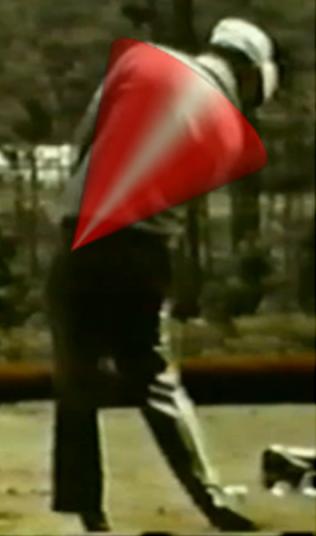
Imagine both cones sharing the black pivot axis and rotating around it counter clockwise, the yellow cone representing action generated by the lower body and the red cone representing “something” about the upper body. Video seems to demonstrate the orientation of the black pivot axis is established when or before the hands arrive at P3 in the downswing and the orientation is sustained beyond impact to P4 or later.
In some of the swing the left arm and elbow move very near the surface of both cones especially from the caddy view at impact and beyond for a time.
From the caddy view, the right edge of the red cone is mostly verticle into the left pelvis hip socket where the upper leg fits into the hip socket.
Is the right elbow on the surface intersection of both cones or even inside it, the orange diamond volume, during impact?
Is the shortest distance and max efficiency into and beyond impact related to the intersection of the cones?
Is this somehow a semblance or analagous to rangerat’s rhumb lines? How?
Did the old timers who said “Swing in a barrel,” forget to say a barrel “tilted” both forward and rightward off the left hip socket?
Good players may not need any of this at any point and the exploration may irritate other students but did Ben and some others work through this sort of stuff as they developed their swings? I don’t recall seeing this stuff from Ben, for example, but that does not rule out that he thought about it and chose not to pester anyone with it. Hunch says some players worked through it and extracted whatever was useful, if anything; meaning, it’s doubtful any of this is original.
.
You are too close to the truth, but your feedback is encouraging.
It’s a stealth “proof of concept” for my next scam: “Retro Lampshade Golfwear”.
With Ben in the lineup we are targeting only serious yet dapper investors.
’
Good players may not need any of this at any point and the exploration may irritate other students but did Ben and some others work through this sort of stuff as they developed their swings? I don’t recall seeing this stuff from Ben, for example, but that does not rule out that he thought about it and chose not to pester anyone with it. Hunch says some players worked through it and extracted whatever was useful, if anything; meaning, it’s doubtful any of this is original.
Nonetheless, in my estimation a good discussion Teebox.
I think it interesting to note that some forces appear ‘invisible’ to our senses until confronted by an unrelated medium. A tornado’s system is usually quite visible prior to the vortex forming and extending downward in contrast to a whirlwind. In that case, winds are forming, or acting in an invisible way, so that when the formation catches matter we are likely to see what it really looks like.
That is how I see the formation of spirals within motion, not as one big one necessarily but many small ones all tied together but related to the whole…almost like passing your hand through water, the vacant area left behind is replaced by displaced water and I would think under close examination the water pouring into the ‘vacuum’ left behind would contain ‘many spirals’ or ‘water whirlwinds’ so to speak acting within a larger process.
…and with Hogan’s motion I sense one way in, one way out, and upon some nice firm ground a whirlwind being created.
Thanks for some great thoughts and discussions about this topic Teebox. Even led to a signature
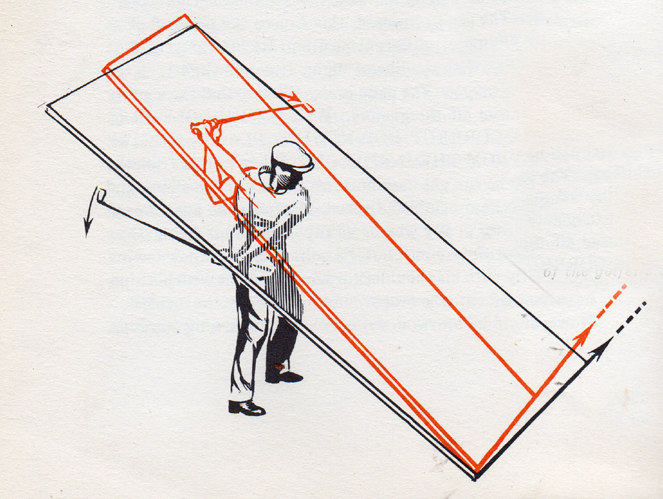
Not sure I totally understand your points 1T, but I reckon Hogan may have been telling us some of what you are talking about in his rotated plane diagram??
.
I believe I never really “got” the tilted plane as Mr. Hogan may have intended, but the meaning of it and its value may be coming into focus better now because of exploration here. The fact is I have been thinking about Mr. Hogan’s tilted plane through much of the exploration. It is disturbing and embarrassing this did not come to mind in my ramble about Mr. Hogan at the end of my post September 17. (I could lay the fault to my numerous character flaws that will soon enough burn to lifeless ash in Hades.) Maybe buried beneath everything I did not want to lay out what might appear mistakenly as a challenge to Five Lessons. As far as I know Mr. Hogan was satisfied with the tilted plane image in Five Lessons, and in any case I am not in a class worthy to challenge him.
Until recent months, I failed to see I had to get rid of torso wobbling between both hip joints at least between p3 and p4. For more than the last decade I thought the pivot axis was about spinning the hips around the spine using the spine as an axis while shifting the spinning spine axis and weight to the left/lead side through impact. I now believe at least three big problems came from that. First was unhealthy pressure and distortion on the spine, hip sockets, knees and associated muscles and connective tissue. Second was unpredictable wobbling of the torso and consequent magnified erratic ball flight. Third was less distance than was possible. Those problems appear to reduce by setting the ‘left hip joint socket to base of neck pivot axis’ before the club reaches p3. Setting this ‘neck to hip socket’ pivot axis is only a split second in the transition, but that split second is crucial. My belief now is that once the ‘neck to hip socket’ pivot axis has been set up, we can accelerate the torso around it with greater efficiency and stability than around a wobbling spine centric axis between two gyrating hips.
I suspect healthier and more athletic types can naturally get over to the left hip joint early enough and properly without confusion. Yet Mr. Hogan was able to do it after his car accident ravaged his body. Inspiration rises from Mr. Hogan’s example and from ABS lessons, the ABS Vault, and fellow students.
.
.
In my Sept 17 post, there’s a booboo where I wrote, “Did the old timers who said “Swing in a barrel,” forget to say a barrel “tilted” both forward and rightward [size=150]OFF[/size] the left hip socket?”
Here’s a mulligan:
It should have said, “…“tilted” both forward and rightward [size=150]FROM[/size] the left hip socket?”
.
1T,
For starters, your initial ‘Ben’ or ‘Hogan’ description is far superior to the ‘Mr. Hogan’ you employed in the later posts… Maybe that’s just my disdain for title and pomp
Secondly, I really love your enquires on this thought, but I don’t think the axis you’re looking for can be a static axis without a point of contact on the ground. It’s more likely to be a right toe, left hip, left shoulder combination, or something to that effect, if a single axis exists at all. I do think one does exist, but not until the moment of maximum acceleration, that’s the only time there’s a definitive single axis, imo, because it’s required to facilitate Hogan’s ‘unbroken thrust from the beginning of the downswing’… though, as I said, not until max acceleration is there a defined single axis. Having it in mind doesn’t hurt though!
.
I believe the pivot axis forms up from contributions of both the lower and upper body. What we are thinking might correspond more than not.
I am working at seeing how you mean a single axis “… does exist, but not until the moment of maximum acceleration, that’s the only time there’s a definitive single axis, imo, because it’s required to facilitate Hogan’s ‘unbroken thrust from the beginning of the downswing’.” I had written to the effect I would position my axis to begin ramping its spin after I set its location during transition. It seems like this corresponds with what you mean but I am not sure.
My images, questions, and guesses have been focused about when the pivot axis forms up and about what may constitute significant anatomical landmarks of the pivot axis when it has formed for swinging or hitting into and through impact. I have been keying on the region between the ‘lead hip socket to base of neck’ because only recently do I believe I see use of this region as a pivot axis in good golfers such as Ben Hogan and others.
I suspect even if the ‘lead hip socket to base of neck’ pivot axis might be generally true, I suppose good golfers vary from it to some extent, perhaps intentionally for specific conditions. The axis might even be from the corner of the greater trochanter of the thighbone to the 7th Cervical for some good golfers or maybe most. I do not know for sure.
The intention with this exploration is meant to be like “This is how this appears to me but I can’t prove it; what do you folks see?” I would like to look at Kelvin Miyahara’s stuff again before posting much more because I wonder if the axis I am trying to explore might be the chi line that he talks about. I think Dave Maves addresses something about Ben Hogan and the hip socket. It likely would have helped if I had thought of them and gone through their work again before I started the recent posts.
.
In Dave Maves’ terrific book “The Secret in the Dirt” there is a ton of insight and explanation done really well. Dave’s message is good medicine to cope with obsessive attempts to understand the golf swing.
There was much more to learn by reading Dave’s book again. Though I studied it hard before ABS, I did not entirely understand his message then. On re-reading passages today, it is evident Dave provided tools that helped me work into the ‘exploration’ here. Fortunately the exploration has helped me see Dave’s meaning better now, or so I believe. It’s too bad I did not re-read his book before this exploration began.
.
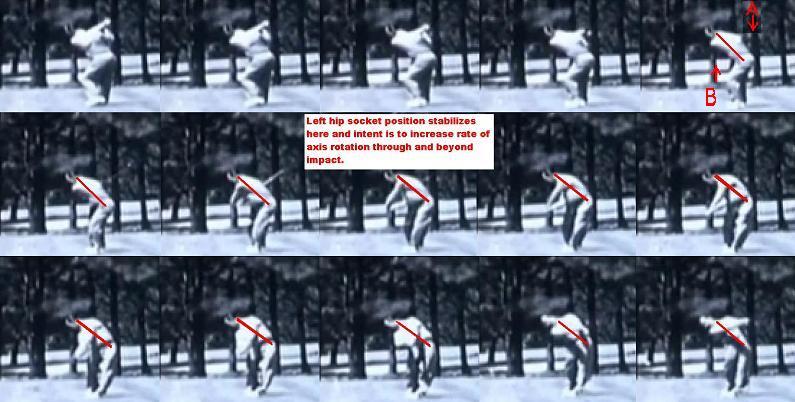
This post attempts to depict the position of a pivot axis forming into the moment of its maximum rate of angular rotation near impact and possibly beyond impact. This depiction may correspond with or support BOM’s message he posted Sep 22:
“…if a single axis exists at all. I do think one does exist, but not until the moment of maximum acceleration, that’s the only time there’s a definitive single axis, imo, because it’s required to facilitate Hogan’s ‘unbroken thrust from the beginning of the downswing’… though, as I said, not until max acceleration is there a defined single axis.”
The lower end of the red line is meant to show the location of the left hip socket. Notice the socket moves toward the tree trunk labeled ‘A’ until the hands are approaching impact and then during the period of maximum acceleration the socket appears to maintain its location through impact and beyond. Also, the tilt of the red line seems relatively stable as Hogan approaches impact and beyond, at least in this vantage point. The base of the neck, where the 7th cervical vertebra is located, appears to have a relatively stable position near the tree trunk labeled ‘B’ throughout the entire sequence.
The skeleton below demonstrates location of the left hip socket and 7th cervical vertebra and a possible internal pivot axis between them, the red line.
This sequence shows the vertical edge of the cone intersects with the lead hip socket where the head of the thigh bone is attached, and it shows the tilted axis of the cone intersects with the backside of the base of the neck, the 7th cervical vertebra.
During the downswing after the lead shoulder and then the lead elbow moves into the cone’s vertical edge, my impression is Ben strives to sustain his tilt and continue accelerating the rotation around his pivot axis at least until his trailing elbow also passes above his lead hip socket pivot point, the cone tip. The arc of Ben’s trailing hip path is a clue that his lead buttock orbits around the lead hip socket’s relatively stable location, as shown in recent posts with other views.
The tilted cone geometry and the ‘neck to hip joint pivot axis’ together are a mental crutch, a model, to imagine and explore movement toward consistency, accuracy, and distance. The model seems to fit some good golfers, more or less. I would like to apply science to explore value and flaws in the model but science is not a strength of mine. Unless other contributors provide science or engineering and a way for it to be readily understood, intuition and fooling around with the model in practice and play is where the fun is anyway.