Hey Bom, et al: Working my butt off with these “honey do” projects and I’m ahead of schedule so I have some time to jump back into the water…as long as I finish before April 1st the wife will be happy.
When I found this site I first thought it was primarily for people who already had command of their action(s) and were only interested in discussing different ideas and techniques that perhaps don’t address the status quo- hence the word “Advanced”. Needless to say, I found out otherwise.
You should move to Michigan as you would love what we do at our facility…we have a group of guys, PGAers included, that go off on the wildest tangents you could could ever imagine. Now we all each have our own stock swing and hit protocols for playing purposes, but sometimes its just downright fun to try the absurd while practicing…and sometimes we stumble on some cool ways to do things as a result.
I might add a component of Homer’s; with a component of Watson’s; with a component of Moe’s; with a swing thought of Couples, all while using a hickory shaft and all within a swing or hit motion to see if we can groove it…and that’s on maybe Tuesday. Wednesday?–something totally different. You’d be surprised, as we are, at the results sometimes.
Ideas are cool and I don’t think the ABS people have any problems with different ideas. Maybe they are so involved with what they are doing that they don’t always have the time to venture onto other avenues of thought…which is fine.
Maybe you and me can start our own thread called “How Many Ways Can You Spell Golf” and just go crazy…Here’s and idea for you Bom…have you ever tried to rotate the shaft counterclockwise from the address position to halfway back ( left arm @ 9:00 and the shaft set on plane )? If done properly, the top of the shaft will, at that point, face the target line versus where it normally faces…your body. Try that…hit that spot and all you need to do is hold on for dear life and let 'er rip.
Wasn’t it Thomas Edison who said he found 2000 ways not to make a lightbulb before he finally found one that works.
Wrong doesn’t necessarily suck…I love wrong…because sometimes what we think is wrong is actually correct. Let me give you an example. But lets think abstractly…
What if I were to combine A,B, and C within a swinging motion in hopes of trapping a certain ball flight ( Flight 1) but the result really gave me somthing I didn’t expect (Flight 2) and it gave me Flight 2 every single time. Some may view not trapping Flight 1 as a failure of A,B, and C. However, we now know that we have another arrow in the quiver. If we need Flight 2 simply apply A,B,and C. RR
It is always interesting to hear someone talk passionately about the golf swing. In the end, we really have two types of people learning the golf swing. There are sheep, like myself, and inventors like Lag, Two and yourself. The sheep try to grab onto what is good, and go with it with varying success. I aim to put a lot of effort in, and thankfully, by following what Lag has to offer, I think that will pay off very nicely. I’m active enough to look out for what is good for me and what isn’t, and I’m comfortable on the path Lag is leading us so far, so I’m jut following that path for now.
An inventor is a different beast. They pull apart what is already known and followed, whats put in front of them as fact, but they are never happy while they are following someone’s every word. They want to know the whys and hows, and need to be able to add something special on top of that to feel good about it all. It’s the inventors that breed the most inspiration, and receive the most negative feedback, because they are never scared to question why, even if it seems so futile to others. It’s certainly not a perfect approach, and an inventor will be found battling good concepts with their own misguided ideas. But they’ll also be found unraveling problems in established theories, and possibly solving those problems.
I also like the fact you’ve questioned whether a pivot driven approach is enough for a complete golf swing. You are most likely spot on that using more active arms while pivoting hard can produce something great. It’s not enough to stop me doing Lag’s course, as I believe the added extras Lag brings to the pivot, like the active hands, and cut it left approach are enough to have feel, power and accuracy, and that’s a lot for the average person to have. It may not reach greatness that you are striving for, but I think it gets pretty close.
I think you could certainly do a lot worse than sign up and try out the modules. It’s not necessary to change your beliefs, but there is so much good information in there, it’s hard to imagine it couldn’t help you, perhaps considerably. If not feel free to feel your way around Lag’s approach as much as you can, and if you feel there are problems with what he’s offering, bring it up for sure.
Hi sb944: Thanks for your comments. Just to clarify for a moment–
At this moment I don’t recall questioning this. To me, regardless of method, the arms and hands are always going to be active–they have to be. It’s just a matter of them being primary or secondary within the motion.
I’m just a range rat that has a few tricks, that’s all
I think Lag’s approach is spot on…have no problems with it whatsoever. Now if he says one has to play in knickers while using classic gear then yeah…I would have something to say
The arms don’t need to have nearly the involvement in the golf swing most people think.
The right elbow is of course part of the arm, and it does need to bend on the backswing, and it does need to unbend … but not necessarily fully unbend till well after impact, and you could also argue with reasonable conviction that it never has to actually fully straighten.
The role of the arms in relation to their movement in the shoulder sockets is much more of a concern. We do have a specific protocol for this that we cover in module #3… but the vast majority of golfers over used the shoulder socket action for arm movement, and this greatly limits their ability to properly strike a golf ball.
Arm involvement regarding pushing and pulling CF forces has it’s place, but trying to use the arms in a lateral way across the chest is not beneficial. There are much better ways to swing a golf club.
It’s all a matter of primary or secondary firing…In a Faldo method the lower body is supporting all the assemblies up top and the sequential releasing of those components activates the lower body to support the process. The lower body is responding to what’s going on above…The lower body is secondary and the upper assemblies are primary- which includes the hands and arms.
In a pure pivot driven method the lower body and torso are primary and the torso, arm, etc are secondary --like the “inside moves the outside”. The lower body is active in supporting the intention of bringing the arms and hands to the promised land.
Not sure what you were getting at with a lateral move across the chest Who does that?
The right elbow is of course part of the arm, and it does need to bend on the backswing, and it does need to unbend … but not necessarily fully unbend till well after impact, and you could also argue with reasonable conviction that it never has to actually fully straighten. - Lag
Let me start off by saying ! Geez Lag you sure know how to throw a spanner into my spokes! I am assuming that this is only possible with the best of pivot actions. Essentially there is zero throwout, or CF straightening of the right arm. This is the essence of your hitting protocol (I think of an United Nation’s diplomat with western African garb everytime I say or write protocol…there he is again!) So put your mind in your right elbow! Is there such a thing as too much right elbow bend at impact?
If you don’t mind me inserting a meandering thought here. Watch Trevino (ad nauseam) on youtube etc I noticed something that I may or may not be able to describe. I will try! I am watching him hit out of a divot. His right shoulder thunders down plane in a seemingly steep manner. The interesting thing is the more down he goes (steep) the more elbow bend is able to be saved (shallow) so in my demented mind he going down in an aggressive manner to ensure a flat entry into the ball? Did anybody preserve as much right elbow as Trevino?
Captain: We must be on the first tee together today…I posted something similar about Denny Alberts on the Mac O’Grady hitting topic area about an hour ago. RR
Cool post sb944, there seemed to be some references to me in there regarding the left elbow stuff and some of the other things I’ve been talking about lately. You’ve got some cool thoughts in there yourself. I’m pretty sure we all have a little inventor and a little sheep in us. I would say even by the fact that you’re here working with Lag shows that you’re no pure bread sheep.
I’m definitely on my own search alright, I’m driven by the idea of channeling as much natural motion into the swing as possible in order to make it as instinctive as can be, hence the things in this thread. It helps I think to see movements you want to do in golf take place outside of a golfing context. I think, or at least I’m driven by the idea that given a clear picture, and some training, our bodies will figure some stuff out for us. There are a lot of sport specific movements that differentiate the different actions, but the frame work is very similar.
I wouldn’t for a second suggest that you don’t work with Lag, so I hope that’s not coming across from me- I don’t think you could be in better hands. Like I said back there, I’m here for the discussion and the general good energy about the place. There are definitely some things I’m intrigued by in some of the module references, so who knows, maybe one of these days I’ll sign up and take a look.
Cheers…
I have some “honey do” downtime…what do you want to discuss? Do you want to go off the charts?..like maybe discussing how to actually experience subconsciously the process of expanding CF juxtaposed with conscious intent to do otherwise?
Let me know…you bring the topic…we’ll discuss it…RR
Bom
If one person was to get the most of the modules it will be you because you understand the nuances of movement. Its a cool process because the motion is broken into pieces that you can see and feel and yet is with full force. So the blurr is eliminated over time.
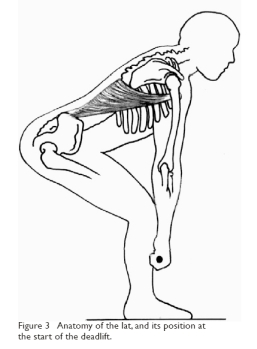
Because I was talking a little about posture in the “Knees, please” thread, I figured I’d put down a little of my thinking about it here. In my opinion the set up is a lot like the dead lift in weightlifting. You want to lift the bar off the ground so you set your body up in the best way possible to do that. Getting the weight off the ground is a form of pull/jump/lift action so it fits well with trying to accelerate a club that’s both below us and pulling away from us. The best players realize, instinctively or otherwise, that heal to toe balance is imperative while in motion. If we’re going to be swinging something around our bodies up to and beyond 100 mph, then we’d better have some sort of counter weighting or ballast on the other side of where that speed will max out. We can’t just rely on muscle strength during that action, we also need mass and a solid frame- these things in turn allow for even more efficient use of the muscles. When standing upright you can basically draw a line somewhere up the middle of the side of our body and there will be an equal amount of you either side of that line. If there is more on one side then you have to activate muscular energy to fight the lean or fall that that imbalance produces. The calf muscles get activated in that instance so they are very important in the golf swing too- as do, and are the rest of the leg muscles. If the imbalance is too great for the muscles alone to take care of, then you have to reposition some of your body to balance things out. The arms are pretty good at playing that role. If you’ve ever tried to walk along a curb for a while then you get an idea of the ducking and diving that you can get into when you lose some balance and you try to save yourself on the curb. If we’re out of balance in the golf swing, and we tend to use our arms to keep us from falling over, and the arms are holding the club who’s path is very important, then without us even realizing it, the club will be deviating from it’s path in a vain effort to help us. Not all imbalance is bad in my opinion, a healthy bit of it from foot to foot in a linear fashion is actually what keeps the swing fluid and powerful. I reckon the imbalance created while loading into the rear leg plays a big part in activating the downswing. You could argue that the left foot replants in order to catch the momentum of the falling body. So I think a linear ‘loaded imbalance’ is essentially imperative to a good swing. On the other hand, a heel toe imbalance is the ultimate swing wrecker- it’s like the stealth bomber of swing flaws.
Our instincts to stay upright don’t switch off just because our brain and ego want to hit a golf ball 300 yards. or even 40 yards. The body’s monitoring system is still preoccupied with one thing only- not falling over. So when we swing a club, the less muscular energy our body has to use to stop us from falling over, the more it can use for accelerating the club. This seems pretty obvious to me.
The dead lift is the perfect builder of a good posture. It activates the legs, it encourages back and rear end ballast tendencies, it trains our bodies to pull a weight from down low in an efficient manner, it encourages great posture, and it forces us to work the weight up in a balanced manner through our feet while maintaining strong heel toe balance. I’ve come across numerous strength trainers in my studying who are completely unrelated to golf who call the dead lift the ultimate weight lifting motion- and it’s a very basic one. I don’t know all of their reasons for this from a weightlifting perspective, but one of the common statements is that it activates every single muscle group in the body. That alone is pretty good.
Somewhere up through the journey of this action is the perfect golf posture. One of the things I’ve observed in the really good athletic golfers is minimal shin slant. Not that the shins are at 90 degrees to the ground, but the body seems to be ready for what’s to come when the club will be accelerating, so a bulk of it is already preloaded to the rear of the center balance line. So much of good striking is about not letting CF win the battle that any advantage to be gained in something as simple to master as posture, has to be used as far as I’m concerned.
This conversation leads on to another idea about the direction and focus of energy but I’ve gone on long enough here so I’ll get to that another day…
I think the correct posture should emerge out of this one here while maintaining that foot/shoulder centre line balance that is present in standing. This photo might be marginally too far into the heels, but you’re better off erring on that side imo. Good players realize that the posture has to be balanced, but that it will also have to oppose a strong pull while in motion. They recognize this while feeling themselves into their set up and shot/swing visualization…
Lag, great to hear that your thinking this way… the overactive swinging of the arms across the torso is one of those things that makes golf very difficult…
Do you contend that there’s no lateral arm swing or arm lagging at all across the torso/body? Is it your belief that the arms maintain their 90 degree relationship to the torso as per set up, throughout the whole motion?
Cheers…
Nice post of the weightlifter…when you mentioned that for the benefit of Bobsccottjnr on the “Knees” thread…I had to try it out 'cuz I never thought about it that way before…but I used a wooden dowel rod instead of a heavy bar or something.
Had a slip on the ice the other day–man talk about acceletation: I was face down on the cement before I realized I was falling. Sprained both wrists pretty good and got a mild concussion so I had to pretend the wooden dowel was very, very heavy but it worked.
Haven’t done much last 2 days…still recovering, but I can still at my desk and type away…sorry guys for all the posts lately…it’s the only thing I can do…it will be back to “honey do” projects pretty soon.
A question: What’s your take on Duval as it relates to weightlifting…seemed like when he was “pudgy” he played at a higher level then lost it a little after he started to chase Tiger’s weightlifting regime. Now it seems, David might be getting back to his old ways and the old waistline is coming back
That is a c&p (a cut and paster!) It makes a great deal of sense. I have a buddy that is a strength and conditioning coach, and I lift a little (literally!) He was showing me how to squat and deadlift. He is a beast of man and can bench 500 pounds He told me that all I really needed is great intensity with with compound lifts and not to waste my time and energy doing bicep curls for the girls. Squat, deadlift, bench press etc. As he was guiding me through the importance of perfect form…I saw Hogans posture! I tend to see Hogan in tea leaves as well! He demonstrated how not to (weight forward, waist bending) and I saw my posture! I revisited the importance of balance (in the dynamic sense, not static) Our machine is amazing in its ability to maintain a balance. I agree with the notion that multiple corrections might impede the maximum force that can be brought to and through the ball. Great post!


 Who does that?

 I am assuming that this is only possible with the best of pivot actions. Essentially there is zero throwout, or CF straightening of the right arm. This is the essence of your hitting protocol (I think of an United Nation’s diplomat with western African garb everytime I say or write protocol…there he is again!) So put your mind in your right elbow!
  Is there such a thing as too much right elbow bend at impact?
 I tend to see Hogan in tea leaves as well!
  I revisited the importance of balance (in the dynamic sense, not static) Our machine is amazing in its ability to maintain a balance. I agree with the notion that multiple corrections might impede the maximum force that can be brought to and through the ball. Great post!