Absolutely RR and BOM
This is why THIS part of the golf swing-transition- is so important…as it loads the shaft back in closer to the body…so the handle stays closer and the club/bat falls behind into the third dimension and the shaft points OUT and ACROSS the target line-- as it does in a baseball swing
The popular notion of trying to keep the shaft pointing on plane coming down actually moves the clubhead away from the body in transition and downswing so the wide area of the motion occurs coming into the ball and not the narrow / wide that RR is talking about.
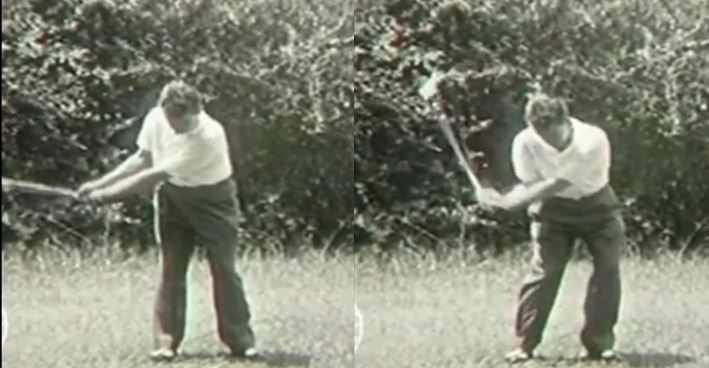
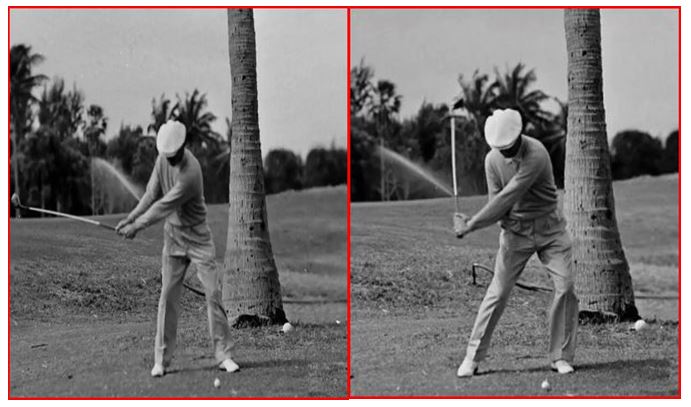
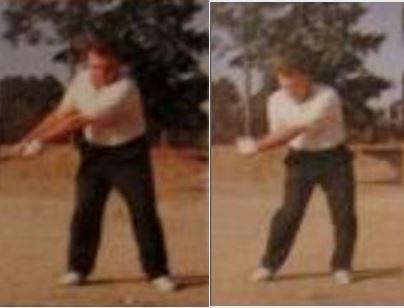
Here is sequence of me in 1989…loading in transition…similar thing
Those are really interesting videos, RR, thanks for those. There’s a bit at 15 minutes in the second one that’s a real disease in the modern game, interestingly, as he also says for baseball, with young and strong players. That early spin out that empties the tank before you need to put the foot down, is a disaster.
The right arm action is a fascination of mine, I see see it as the real spark in the swing that makes the magic. I think the more athletically it operates, the more instinctively and better you can play.
Here’s a photo that I think shows the initial ‘long to’ that, that precedes the ‘short to/long through’ that all great strikers have. If you go ‘short to’, it’s very difficult to then go ‘shorter to’, if you know what I mean. I feel like I’ve entered the Rat Maze!
I’d love to hear you expand a bit on your definition of proper ‘athletic operation’ of the right arm. I’m currently working on Mod6, which deals with backswing and transition, and I’ve been experimenting with this a lot lately. I know you and John got into it a bit over wide vs. tight takeaways and I’m not really interested in arguing that. In fact, you might be surprised that he’s helping me work more width going back, unlike his personal preference for keeping things in close. I have to say, I think it works well to help highlight the inward sensation that corresponds with transition through delivery, and keeping the elbow feeling under and in front of the hands/club, as opposed to wanting to push from behind, the punch elbow thing.
So I guess my question is, what are some of the things on your personal checklist for the right arm working properly. What are the no-no’s?
Yeah, I know I’ve talked a bit about this issue before, and I don’t see it as a debate between right and wrong, certainly not with John anyway. As they say, he’s forgotten more than most ‘experts’ know. But I do think there’s an athletic reality to what the right arm does, regardless of feeling. People who ‘feel’ tight going back probably have a bit of a delay(that not being a bad thing) in sensation. The feeling of tightness in the backswing actually shows up on the downswing. I’m not aware of any really good striker who was wider with the right arm coming down than going back. And since it’s virtually impossible to track the same arc up and down, you do have to be one or the other, so wide to narrow is the one. It’s important to understand that clubhead ‘width’ is only one dimensional, but it does tend to be telling from face on. It’s also important to realize that it’s relative to the centre, not just the arc set against a backdrop. But the right wrist/elbow arc, is, as far as I can tell, always wide to narrow relative to centre.
A key thought that crops up frequently enough in past thinking about the swing, is ‘take it back square’. I think the face direction intention of simpler times had a big bearing on how they swung the club, both back and through, and in how the right arm functioned. If you keep your right hand(for righties) pointing at the ball during the takeaway, it’s considered closed. But if it’s pointing at the ball at the top of the swing, then it’s seriously open. If you roll it away from the ball to open it, there’s a tendency to then go into a palm up, or closed position at the top(I think this is a psychological reaction), which isn’t good obviously- better players go into an elbow out, across the line position in order to reassert some right side dominance- Peter Senior, John Daly etc. I sense there’s something in the hemisphere/opposites idea that makes these sensual things happen, but I’m not sure what. Slotting it to palm up halfway down is pretty instinctive from the palm facing ‘down’ or at the ball, ‘open’ position at the top. But not so easy from the palm up ‘shut’ position at the top. I think it’s interesting that shut at the top tends to be created by opening or rotating away, while the quite open top position tends to be created by the square or non-rotated takeaway. I’m not saying either/neither ever happen, but my question and desire is about a potential optimal way for things to operate. My sense of athletic purity is that compacting the rotation/unrotation into a smaller area, that being from the top, is the optimal and most instinctive/powerful/natural way to go. That’s not say that you just let it go from the slot, you still have to work like hell from there…
I’m obviously not much of a poster here anymore, but I do continue to check in from time to time. I don’t have tons of time right now, but it would be cool to yabber on about this topic over the next while- I’m not sure if I hit on my checklist/no no’s or not in this post, but I will get there.
but it would be cool to yabber on about this topic over the next while-
My sentiments exactly. What if the length of the R arm at address would be the ‘long’, and any folding of the elbow going back, or in, would be the ‘short’ or narrow that we simply hold from the top getting to the front side of things. Have you ever heard the phrase ‘ahead of it in rotation, but behind it in mass’? Not my phrase, but a very good capture of the baseball pivot and golf dynamics in my mind.
[youtube]http://www.youtube.com/watch?v=0BywD4VcyjU[/youtube]
Have some more thoughts on it, but will get back later…here’s another video. I like this one, a vertical hand set ‘across’, or perpendicular, to the shoulder line. Combine that with a little inward rotation and it looks pretty good to me.
Starting to think the entire enchilada is only 1/4 of a circle ( arc segment of 90* ) post impact. Anything before that is just style points, and discussion, just like the logo which is offset by 1/4…interesting to me. Here’s another item from the Rat Lab that kind of fills in with your thoughts on the hand orientations while on the grip and in motion. Left hand higher than Right but holding lowest groove on face, and the lower R hand is holding a higher, or sixth groove. So the lowest hand to the ground controls the upper part of the face
I think the wide/narrow interpretation of this probably isn’t the best way to think about it, it’s really more about relationships and rotation. The second part of your point I quoted is the thing that I’m just not a huge fan of. I think the less you do in the backswing the better, and the less you have to think of it. If you bring your set up relationships to the top pretty much in tact, which I see in my favourite swings, you can then be more reactive and athletic.
On my checklist, as Newman asked, would be the amount of right forearm rotation on the backswing, if you have too much you have to then hold that in place into the slot. I think that’s too conscious, at least it is for me in terms of playing, and is less ‘sparky’, if you know what I mean.
Wow, ok, yeah. That’s already a ton to think about. I’m finally starting to realize my own tendencies and am also looking for that ‘optimal’ solution for me. It definitely involves a long right arm feeling on the way back, as opposed to tucking it quickly like I’ve been doing. Your idea of keeping the set up relationship all the way to the top is something I never even considered. You don’t increase the bend in the right elbow? Or you’re doing it later in transition? I think that idea could really help me maintain nice width for longer, delaying the ‘narrowing’, something I’m gonna experiment with for sure. I tend to get quick, so maybe it’s something that can slow me down a little.
There’s also that huge difference between making something happen and letting it happen. How much muscular effort? How much are we using the momentum of the club head, and for what? Different sets for different releases… I guess it really depends on what we’re trying to do with the right arm on the downswing. All the pieces have to fit together, right?
If you bring your set up relationships to the top pretty much in tact, which I see in my favourite swings, you can then be more reactive and athletic.
I hear what you’re saying I believe. I think it gets back to the notion of ‘the swing’ being one big address position in motion. I know when I do what I call a Mickelson-type move when I get to top I can freeze the hand-arm set, turn 90 degrees to the right so I am facing the club and then once I do that I can drop the club, hands, arms straight down almost and be in an address position again although this time I would be aiming North from that new address position, if I originally started in an address position in which the target is due West.
I used to do a similar drill a lot when I was looking at Penick a little and getting the club toe up and parallel 1/4 way back, or P1. I could literally make a 360 degree circle, using four different P1 positions in a circle, and never leave the address relationship…it was a good drill to show what a person does with the clubface taking it back to P1.
Easy to get off topic and go elsewhere with this, but lately every time I see a rollover post impact, the club is actually NOT getting away from us even though we LET IT GO through the zone. The rollover to me seems like a last ditch attempt to keep the club with us, like one is losing a tug of war and wants to bring everything back toward us. When I sense not letting go of the club, even though the body is letting go, it seems like the club actually GETS AWAY but has an angled hinge. So in essence, if we let things go before, we need to grab them back to us, versus not letting go and it gets away anyway, but the body is so far ahead of the game the roll over is absent.
Like Marty said…‘that’s heavy’…and Doc said ‘is there something wrong with the Earth’s gravitational pull’ :
Got any nice pictures of some nice linksland where you are now hanging your hat. Us parklanders like seeing the gorsey stuff.
Yeah…Bom and I have discussed the long right arm before (in another thread I think)…My long right arm going back MADE my golf swing. Of course I built in a big load of pressure coming back down from that wide back into a narrow down…but that gave me the mindset to say “Go Time”…and I had to be aggressive beyond the strike and really utilize the ground well in my feet to support all that… I really didn’t know what I was doing at the time…It just felt right for me. When I got coached in my mid 20’s I was eventually talked into narrowing the backswing and setting the club earlier…ruined my entire feel for the swing…I became narrow and then wide… had less power and felt like I was dollying the ball around the course trying to hit it straight…whereas the old way I didn’t need to worry…all I had to do was put what ever energy the shot called for into my swing…fast…rip it…half shot…swing shorter
Two, this all feels a little like deja vu I do reckon the right arm has a way to function, and yours and The Shark’s way was the sort of extreme version of it, and savage! But a little goes a long way with this stuff, and as long as the right forearm doesn’t pick and roll away, and stays strong and unrotated until the shaft reaches parallel to the ground on the backswing, then that’s a great step- Corey Pavin is a good example at that position, and one of my favourite takeaways in the game. You and Greg had the shaft almost parallel to the ground up around chest/shoulder height, that’s pretty ridiculous in fairness! The 3rd frame in the second sequence you posted is unheard of in the modern game.
Anyway, I guess I interjected the question because of the baseball stuff you posted, and the pretty standard top/start position they use, and what we may be able to learn from that as golfers…
Edit… btw, is that Jackie Burke in those pics?
No all those pics are me…top one is fuzzy cos it came from a magazine article in Japan and the pics were small and lost pixels when I increased the size.
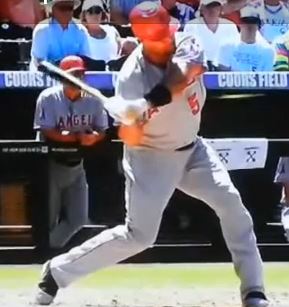
here is Jackie Burke and Hogan and a little bit of Pujols.
Bom, thought I would reply if useful. I agree with you, Two is modest like Hogan. There are many things that I would agree with Two on from personal feel and could do, but there is some of it that is genetics. He can move in some positions I could not, and if off he could redirect into impact. Same reason he was a top Australian football player. You referenced his shaft and right arm in the swing he posted, I would think that he knows exactly how good he is but tries to put it in a form that all of us can use. Try to get in that position and most will not, and if they do the forces will be more than they would like. Not all genetics, he is a worker. He told me he would camp on the range to hit balls when the sun came up, reached about 10,000 hours of practice when he went pro. That is the mark of mastery, research. Add Ben Hogans hours of practice and it is not a mystery how he became great with a goal of figuring the parts. The worlds greatest stock investors are the same way, and in every profession. You outwork everyone, you are hard to beat.
:12 to :24
The body is obviously more open and the rotation more ahead than we’re used to, but check the right arm/elbow going wide to narrow, the footwork, and even the left arm with the high finish
Small world…
[youtube]http://www.youtube.com/watch?v=I1BhPzXfsdE[/youtube]
Interesting to note the hips firing, lead leg (left) landing and bracing/flexing just before right side comes through. Right elbow and hip coming through together with release and momentum continues through to finish.
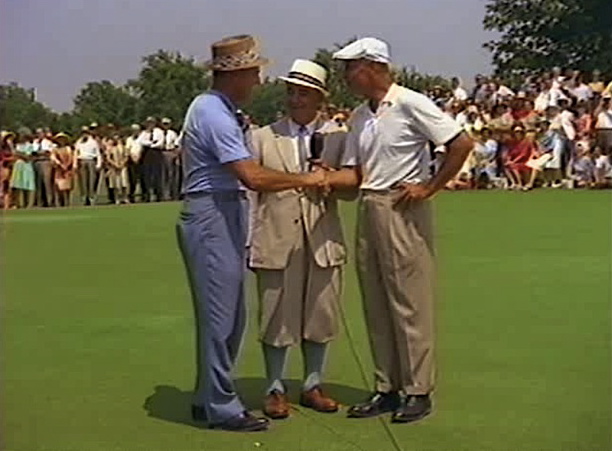
Nice one, Eagle. Reminded me of this one I noticed a while back. Not only did Ben win the match, but he won the handshake too! If you watch the footage of this moment, Snead almost falls over and towards Hogan, it’s pretty funny…
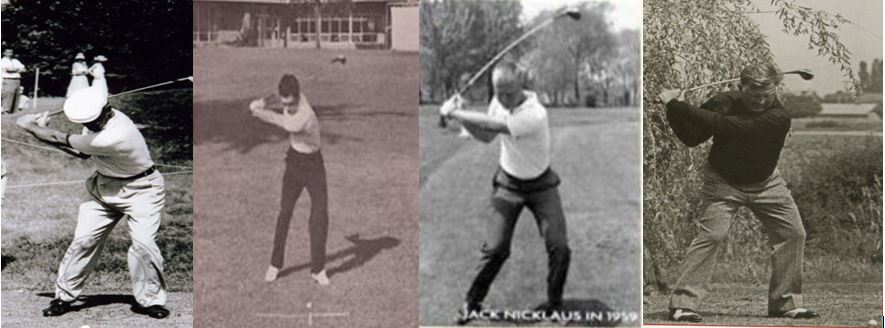
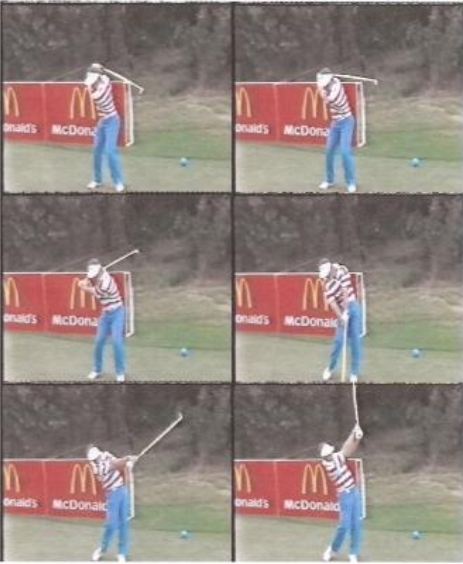
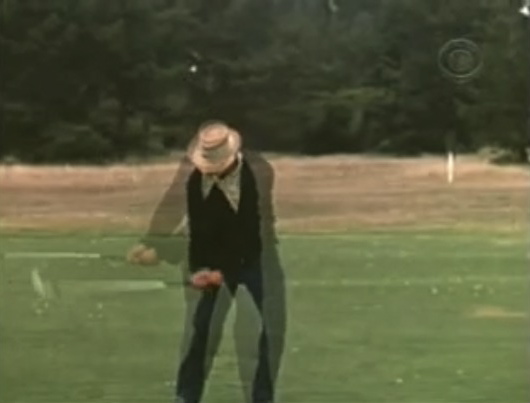


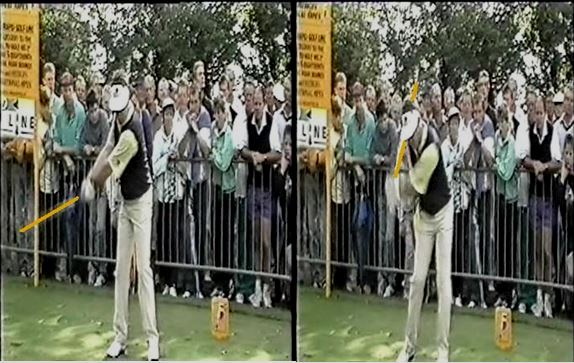
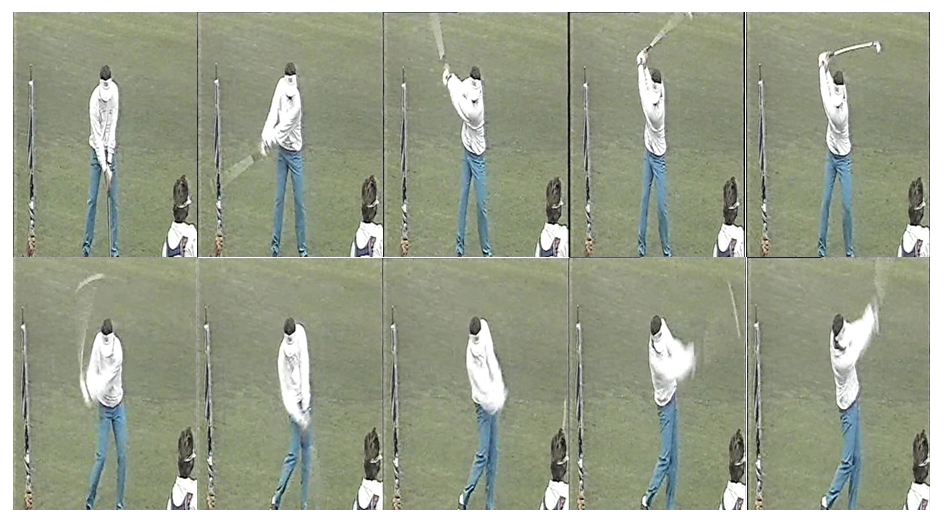
 I do reckon the right arm has a way to function, and yours and The Shark’s way was the sort of extreme version of it, and savage! But a little goes a long way with this stuff, and as long as the right forearm doesn’t pick and roll away, and stays strong and unrotated until the shaft reaches parallel to the ground on the backswing, then that’s a great step- Corey Pavin is a good example at that position, and one of my favourite takeaways in the game. You and Greg had the shaft almost parallel to the ground up around chest/shoulder height, that’s pretty ridiculous in fairness! The 3rd frame in the second sequence you posted is unheard of in the modern game.