Should I or not, put ABS flat lie angles on my collection of playable vintage golf iron sets?

I became part of the ABS community in January 2023, and in the time since have fully embraced the ABS recommendation to play flat heavy clubs. This journey has raised my interest in collecting playable vintage golf clubs especially from the 1950s and 1960s.

I have a couple of my iron sets set up to full ABS specs, heavy, 6 degrees flat (purchased from @Eagle - Thank You!). I play them as my gamers, for the purpose of maximizing progress in ABS swing skill:

  • 1969 Hogan Bounce Sole

  • 1962 MacGregor CF4000 black ceramic face

But…. I have 15 other (beautiful) sets of vintage iron sets. With only a couple of exceptions, I purchased the irons to play them, not just to look at them. The issue is that while most of them have flatter lies than today’s modern clubs….. but these sets generally have standard lies that frankly are too upright for my ABS swing. I’ve played them the way they are…. it’s clear that ABS teaching is right on….. flat lies are much better. These sets with the standard lies, I have to watch my face control much more to make sure I don’t miss left, it doesn’t feel like I can reliably not miss left. I would like to play these clubs, but clearly the ABS swing skill that I am slowly developing, is not helped by playing clubs that are too upright for my nascent ABS skill set.

So I have this conundrum and questions for the ABS community…..

==================

  1. Should I pursue setting up a few more, a lot more, or all of my iron sets to ABS specs? (is it really reasonable to set them all up to ABS specs?!? I fear I will break hosels here and there, thus causing new problems to replace a hard-to-find club.

  2. Should I go “part way” and set them all up “a little bit flatter” (like 2-3 degrees flat) so as to minimize chances of breaking these older clubs?

  3. Should I take it slower, perhaps do ABS treatment to one set at a time, and see how it goes? (this seems wisest option?)

  4. Or is it wisest just to stay with my current situation of two gamer ABS sets (MacGregor CF4000 and Hogan Bounce Sole) and regarding my other vintage iron sets, I don’t really play with them as they’re too upright, I just admire them? (this seems least desirable option)

I ask you ABS students, what have you done, or what would you do, in my situation?

==================

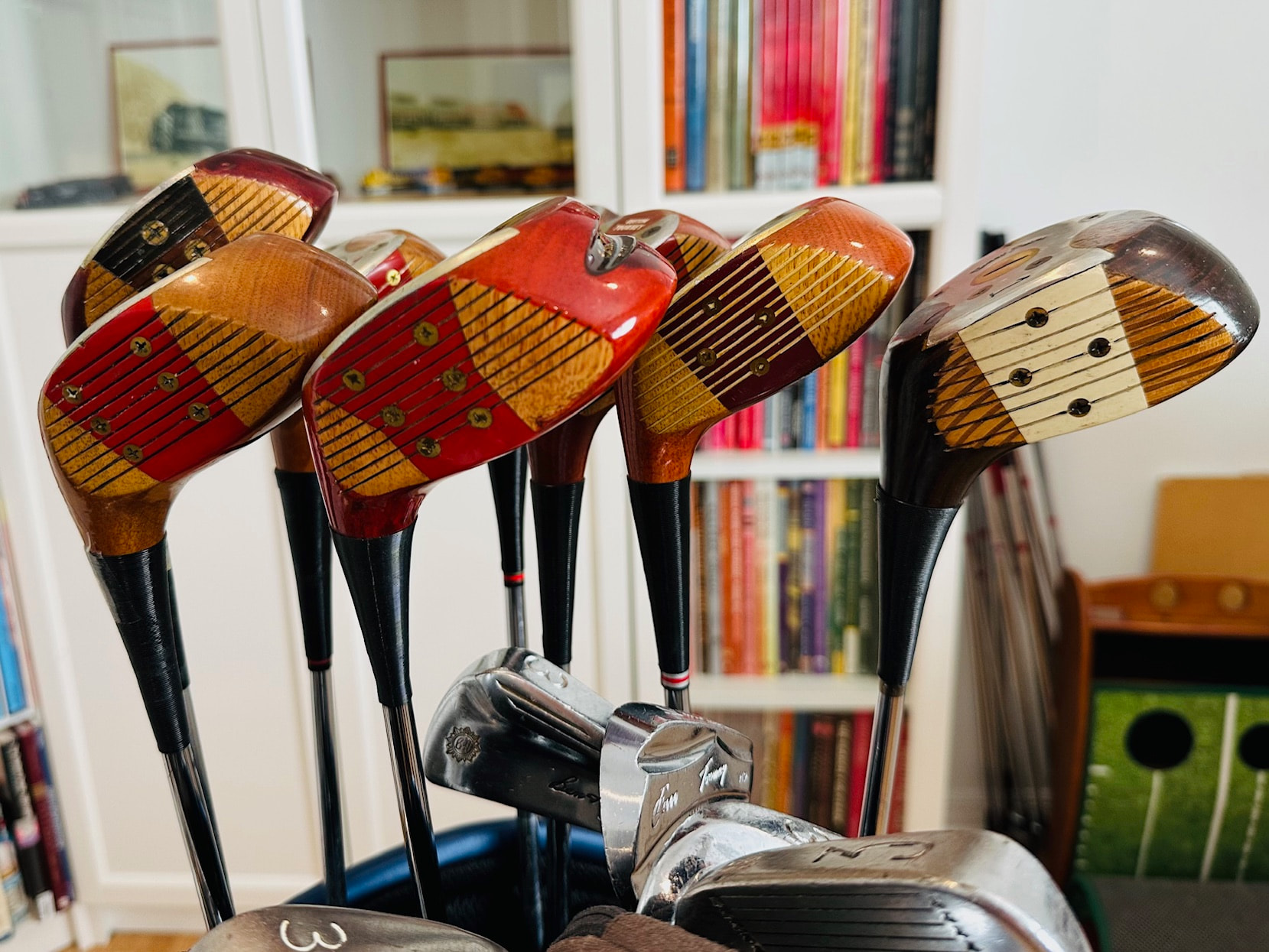
Here is a picture of my “Vintage Example Bag”, which I use to share with my golfing buddies a selection of the beautiful vintage golf clubs, if they are interested. (Most of my buddies just shake their head. The few who ARE interested, of course are the smart ones who appreciate what they’re looking at).
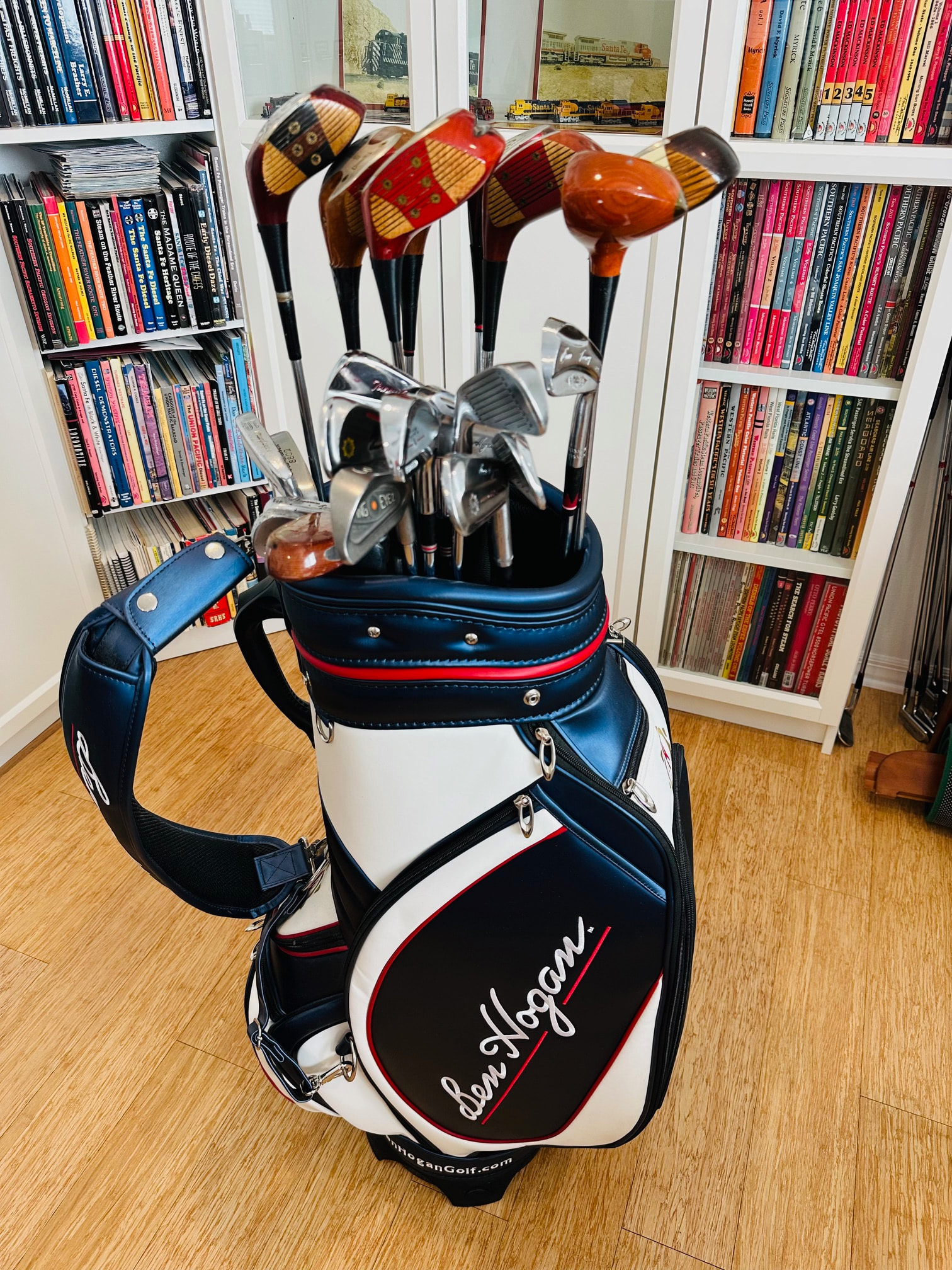
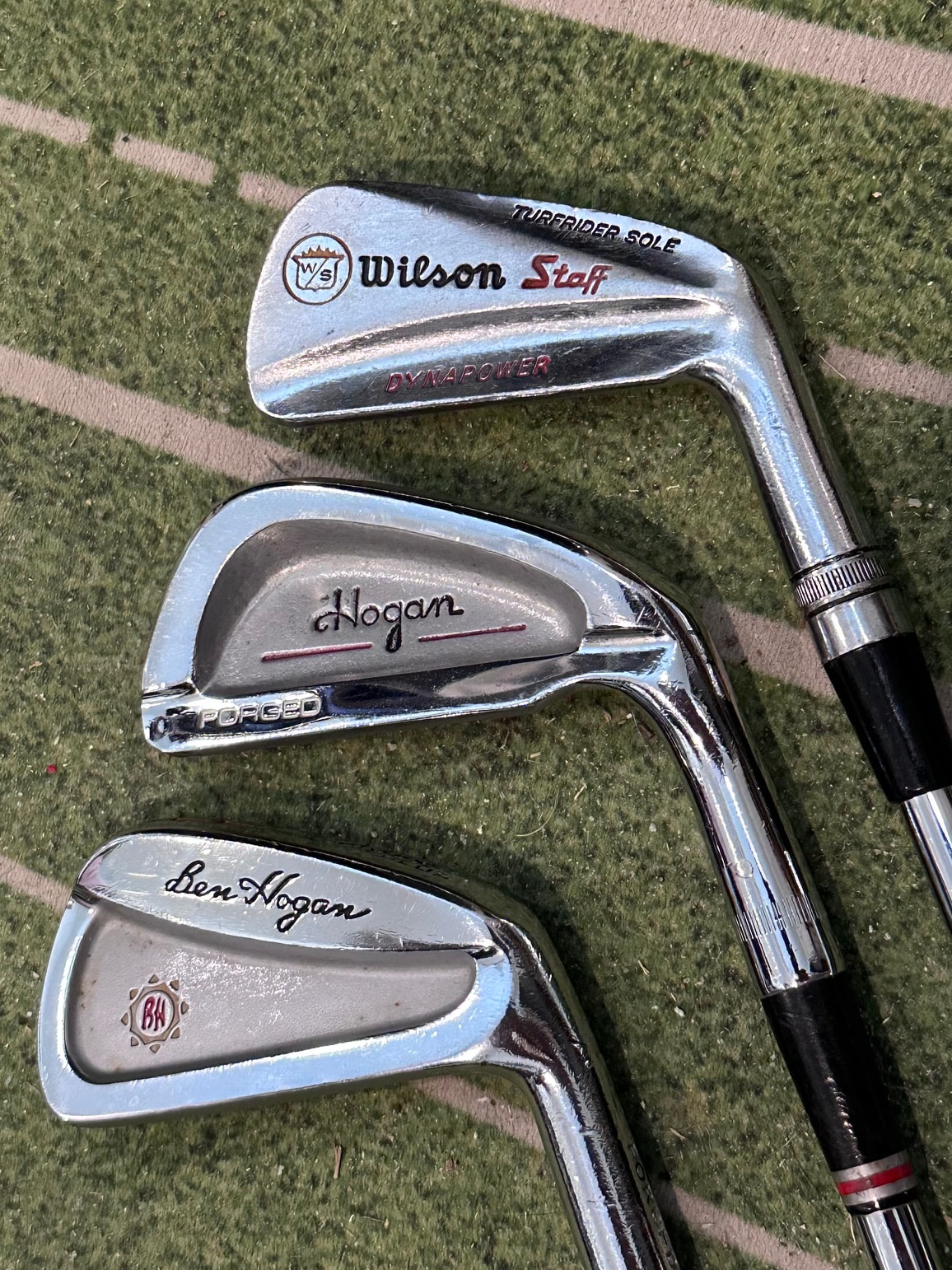
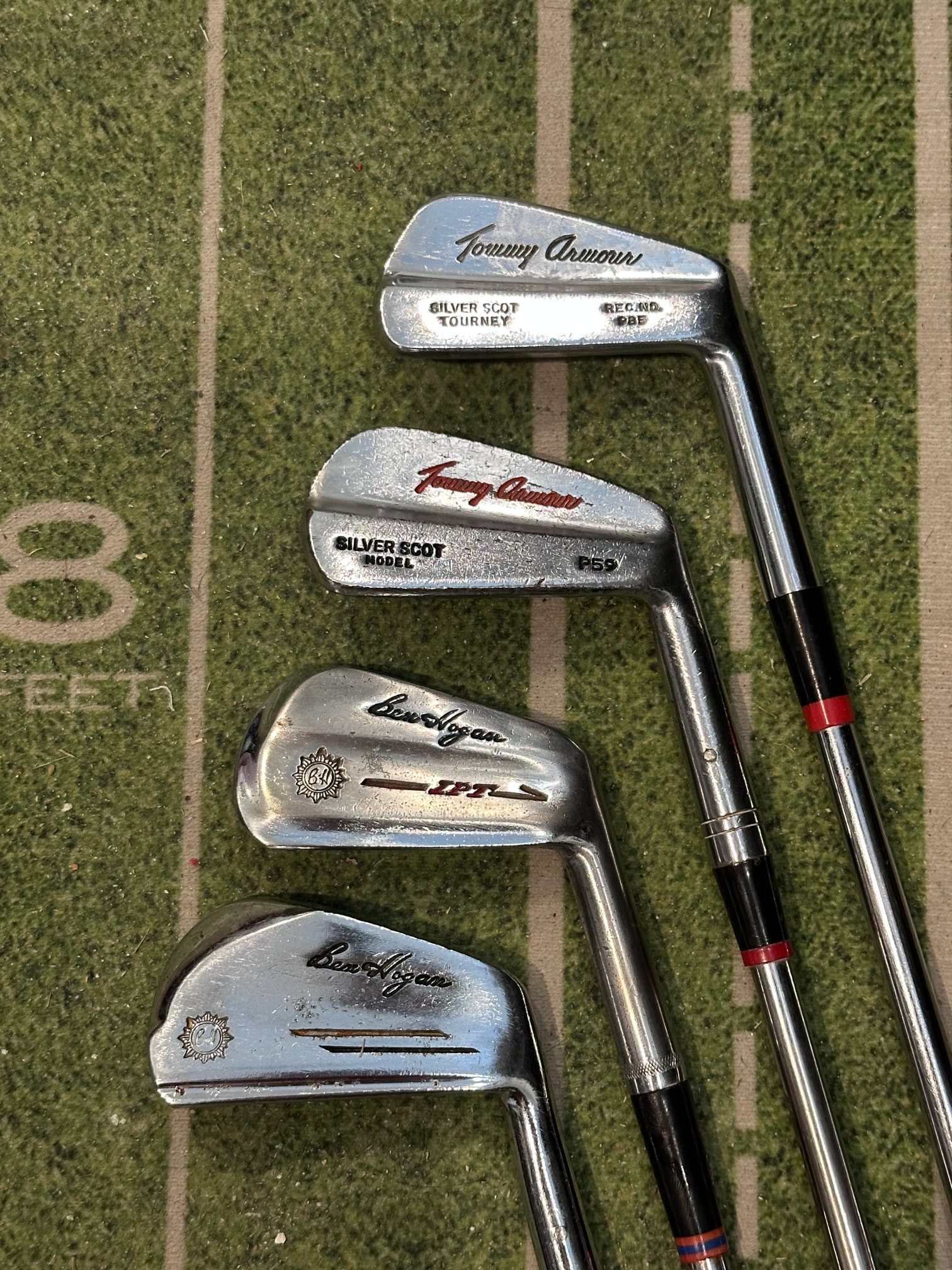
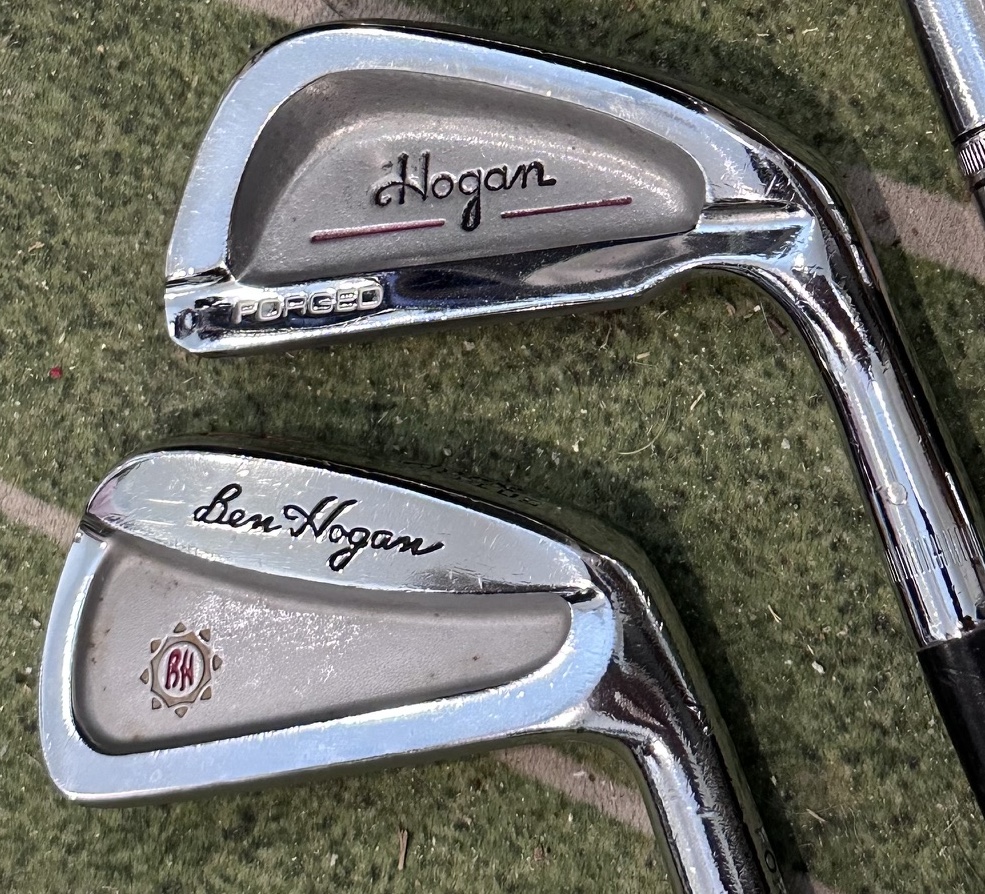
The irons in the bag represent a selection of the long irons from my collection of 17 iron sets, I have played with all of these vintage irons, thx to ABS I can hit them. IMHO vintage irons are meant to be *played*! :
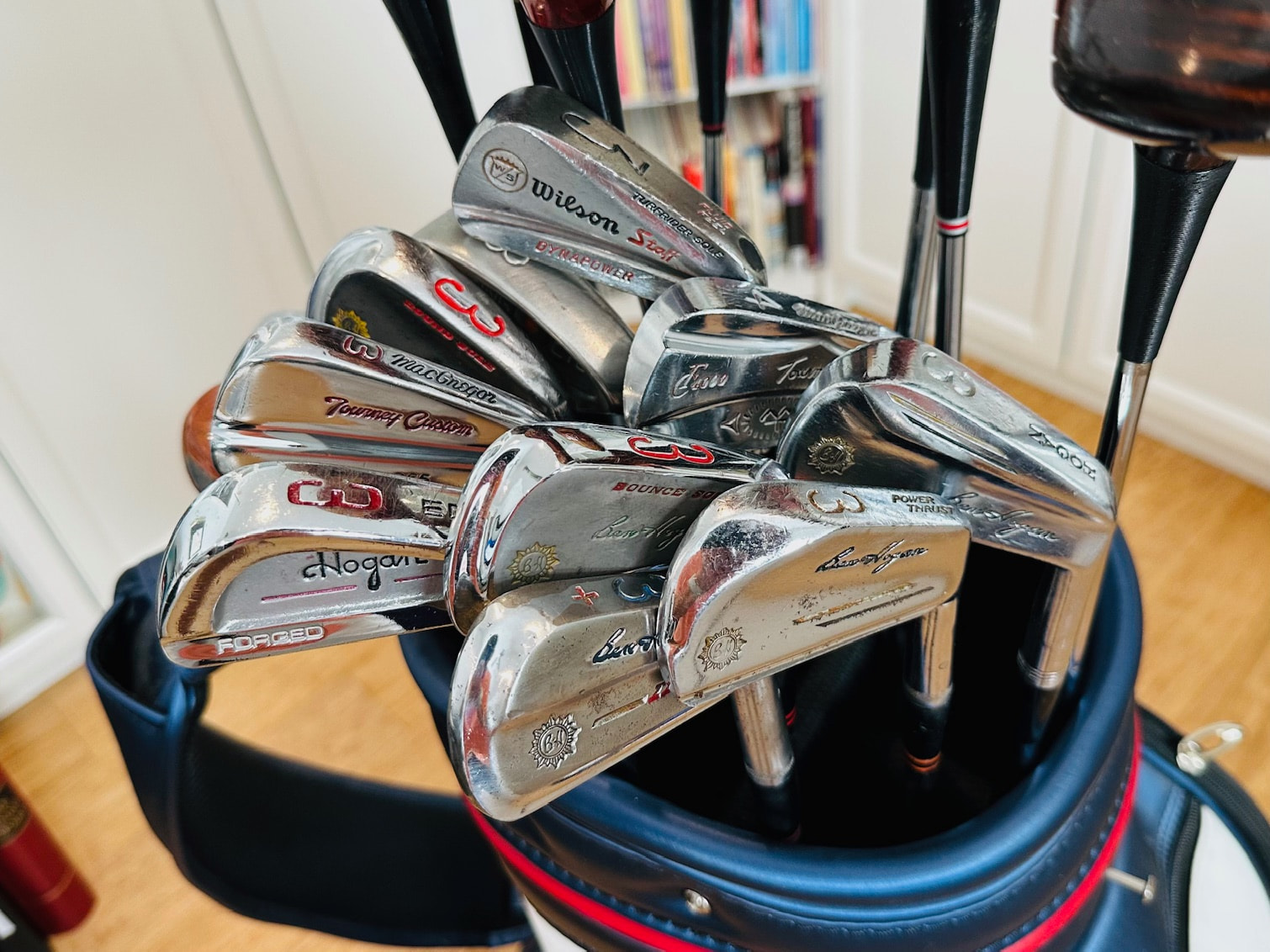
Not all shown in the picture, but what I have is:

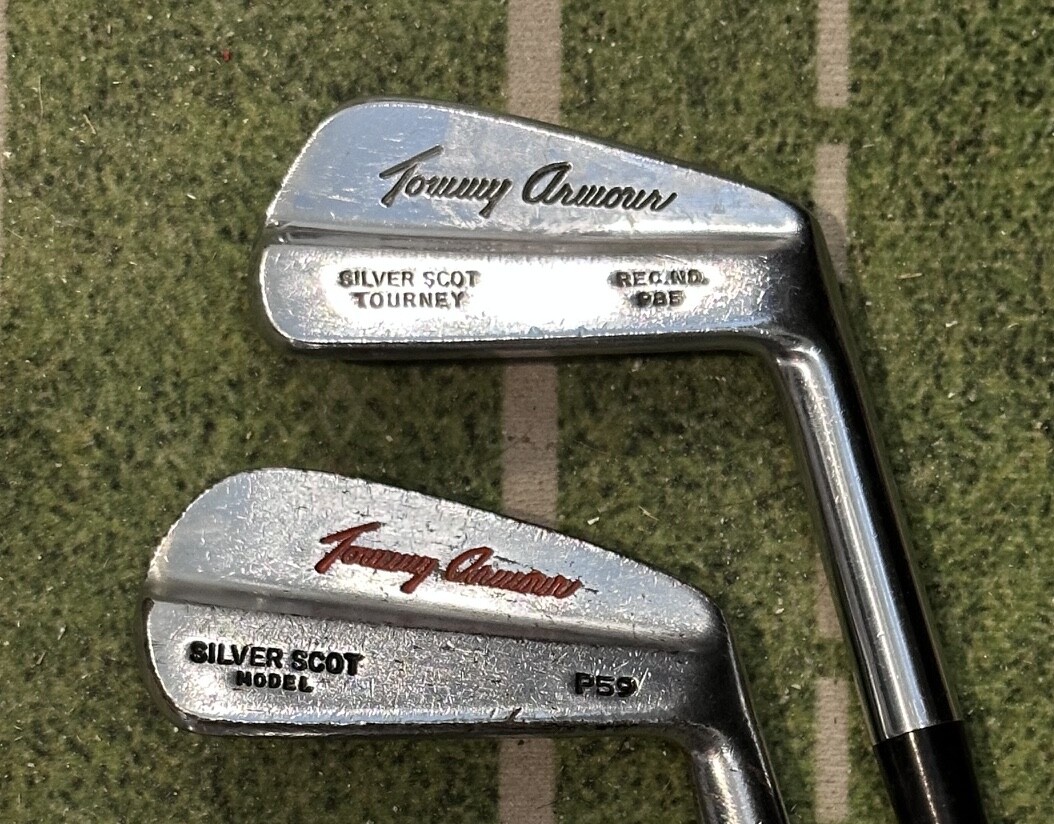
1956 MacGregor Silver Scot P59

1958 Hogan Starburst

1960 Hogan Power Thrust

1962 Wilson Dynapower Turfriders

1962 MacGregor CF4000 black ceramic face - full ABS and plays great!

1963 Hogan Improved Power Thrust

1965 Hogan PC5

1967 MacGregor Silver Scot Tourney 985

1969 Hogan Bounce Sole (3 sets) - one of these sets is full ABS and my gamer set.

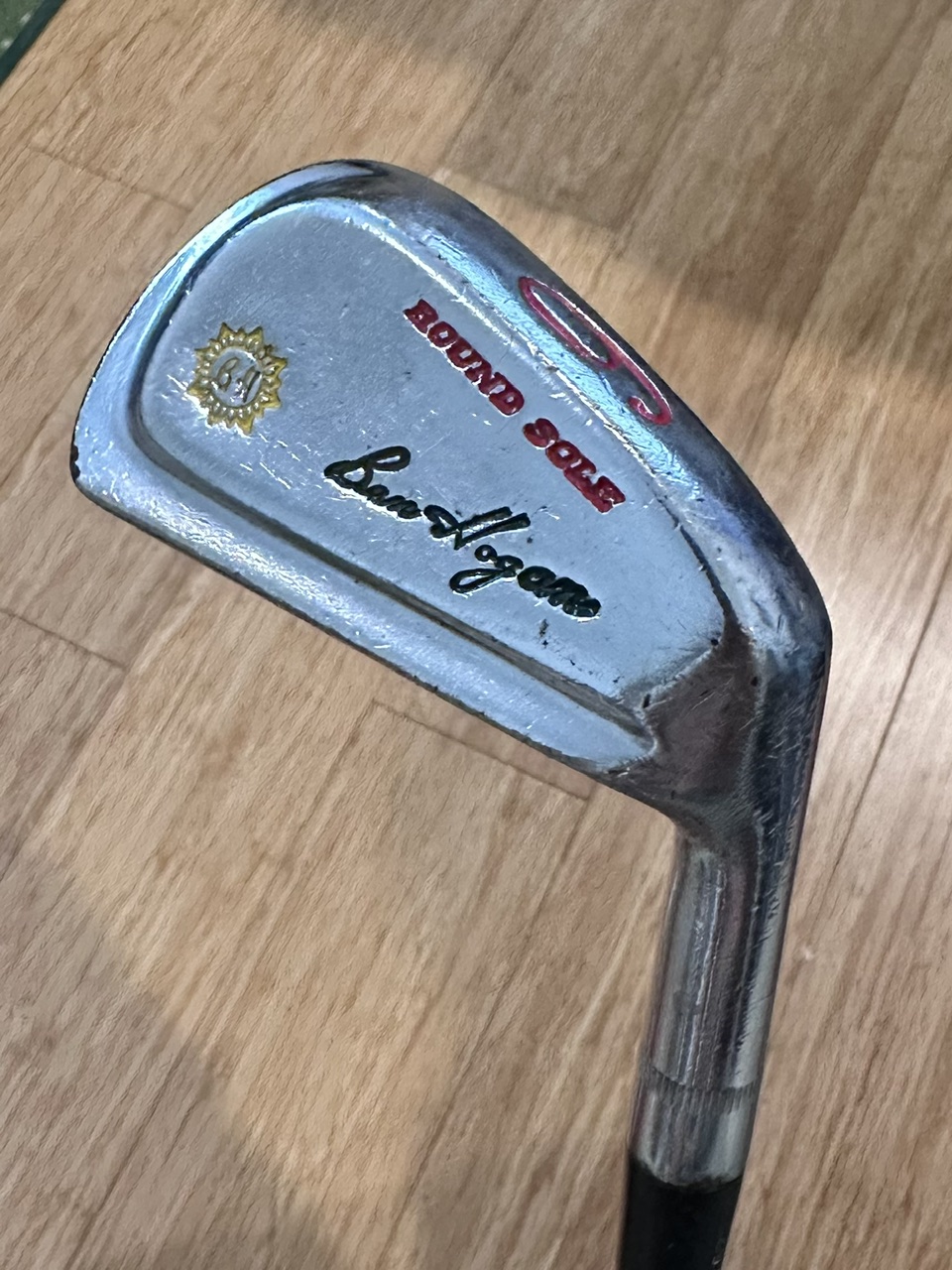
1971 Hogan Round Sole

1978 MacGregor Tommy Armour “The 985” Tourney Custom

1983 Ping Eye2 Orange Dot (2 degrees flat)

1989 Hogan Edge (2 sets)

2000 Hogan Apex Plus

(Just to be clear, I am not a luddite, I do have some modern clubs):

2017 Cobra Original One Length Irons <= cast, can’t modify lies

2019 Cobra F9 One Length irons setup same lie angle across the set at 61 degrees <== my ‘modern gamer set’, as flat as the cast clubs would allow

2021 Wishon EQ-NX1 One Length irons setup 61 degrees

==========

Regarding vintage woods, I have a couple of separate sets of ‘hittable Hogan persimmons’ that I purposely set up to be hit. I don’t feel any need to modify the lie angles on the hittable persimmons.

My gamer ABS driver is already setup to full ABS:

2000 Titleist 975D Titanium driver <== setup to full ABS, by Neil Gascoigne

The woods in the photo below represents some of my other vintage drivers, most of which I DON’T play, because they’re so beautiful and I don’t want to mar the finish on these drivers from:

MacGregor

Toney Penna

Hogan

Hogan Apex

PGA

George Izett (Philadelphia area custom club maker)
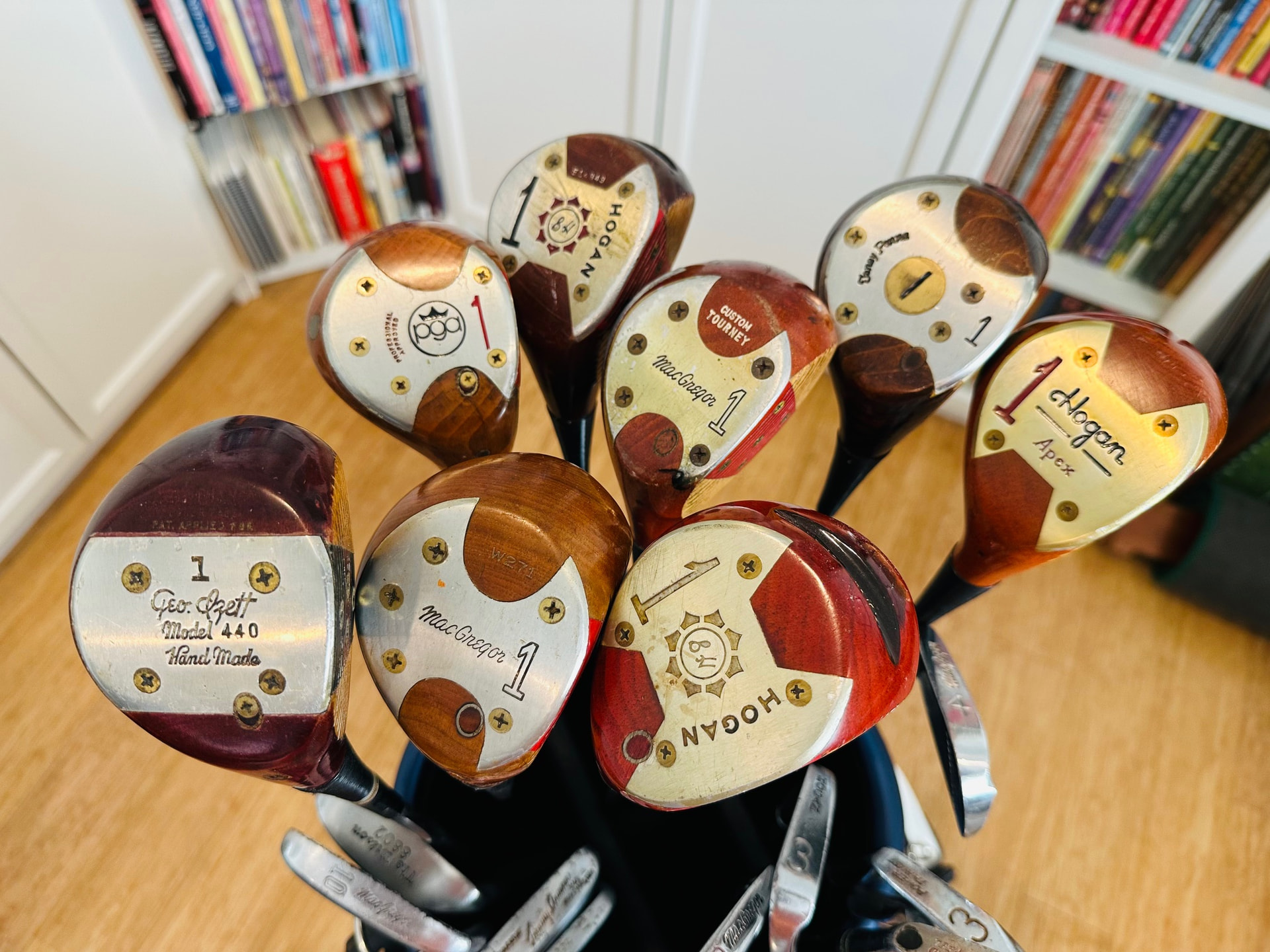
So, thx for listening to my rant. I appreciate any feedback, comments, or advice from you in the ABS community, on how you handled the question “To ABS or not, my collection of vintage iron sets”.

Thx!

John Sing
3 Likes

I have always played heavy clubs S400 shafts at 134 grams or X100 shafts at 133-135 grams and for the last 20+ years I have played -4 flat. When I started ABS I just kept my clubs right where they were and have not missed a beat. I bent a 7 iron to ABS specs and I had to work way too hard to hit my stock draw shot that I have had for decades so I stayed at -4 which gave me the ability to shape shots without working so hard. But I say all of that just to say this. You will find your sweet spot and know when you have. I noticed that Bradley Hughes has his irons set at -4 also, I try to keep in mind that Hogan did at least 6 things to stop the dreaded slinging hook that plagued him and I have to be cognizant that I don’t have the same miss that Hogan had so my equipment should be set up for my strike pattern and my tendencies.

Side note: I don’t say any of this to discourage or dissuade anyone from setting up their clubs however they want or think they should be. I’m simply sharing my experience and how I came to the decision to keep my clubs at the -4 flat. And now my current gamers are -4 flat with Dynamic Gold X7s shafts which are the heaviest and stiffest iron shaft on the planet right now at 135 grams with a tip section that cpms at 978 compared to X100, Apex 5 and ProPel 1 whose tip cpm comes in at 918-928 and the higher the tip section cpm the stiffer that the bottom end of the shaft is. So with the beefed up tip section at -4 degrees flat plays like -6-7 in reality.

My 3 iron comes in at 15.4 ounces & 7 iron comes in at 16.1 ounces and they top out with wedges at 17.2 ounces and that’s with no lead jammed into the shaft or lead tape on the clubs just a bigger hammer using heavy Japanese forged blades and the heaviest steel shaft made available.

Eventually I want to find a nice set of blades from the 80s and bend to ABS specs I’m a huge fan of blades from the 80s because we still had master grinders and master polishers doing the work like Don White and others so there are some gems out here if you can get your hands on them and not break the bank acquiring them.

Side note: You have an amazing collection and I am glad you play them. I have picked up some great clubs from guys that collected and never played them then their health took a hit and they had to let them go. I’m a huge fan of golf clubs should be played not stored in a case to be drooled over.

Cheers

2 Likes

If limited to four choices choice 4 is the way I would go. A person may want to go more upright too as they age and deal with aging conditions. It’s a nice nostalgic array you have, the only thing missing is getting them to and from the course in classic style.

3 Likes

Spot on option 4 is the most realistic choice because as we age we simply will not have the post impact speeds to play the equipment and most likely will be plagued with blocks and thin shots which will make golf miserable.

Cheers

1 Like

If you have any that are particularly valuable, then i would leave alone. Any that dont have stiff shafts or have offset or are way too light, leave alone.

I’d just mess around with good candidates for ABS spec clubs that are in decent shape.

2 Likes

Thx all, really good feedback.

So since I do want to play my vintage clubs, I am thinking about just flatten a set or two at “reasonable amount”, i.e. say 3 degrees flat, and see what happens. See how that feels as an experiement.

I am thinking to try this experiment with my 1989 Hogan Edges as there’s literally thousands of those out there in case I break something.

Then depending on how that goes, I can decide what to do about the other sets.

1 Like

Thank you again, all for your thoughts, each one of you. It really helps to hear your experience and advice on this.

I am thinking now to do a useful experiment to see how “halfway to ABS specs” sets of Hogan Edges compares to true ABS blades. (Yes, I am fully aware the 1989 Edges have offset that can’t really be removed). I fully expect the “halfway set experiment” will almost certainly yield “halfway” results (at best). But it will be useful to have the data points and real-body-experience of that, not just abstract thoughts. I will find out if I can play the “halfway” vintage Hogan Edge set(s) effectively…. and what effect that has on my swing upon returning to the full ABS set. It’ll be interesting to see what can be learned. If nothing else, further prove to myself the validity and value of the full ABS specs.

Tinkering and learning about golf and playing golf, IMHO the joy is as much in the journey and experimentation and learning and practicing. I enjoy practicing and improving golf skills as much as, if not more than, playing golf itself. The destination is not the only goal. Most importantly, I’m safeguarded by knowing what the true goals and principles are, embodied and codified in ABS and the Hogan Modules, and in the full ABS-spec sets.

Thank you again for sharing your thoughts whatever they may be. All of us may learn from this, even if it’s a rabbit hole. Any additional thoughts from anyone, I am happy to hear.

1 Like

Followup post to let everyone know what’s happened.

I decided to go ahead and bend my two sets of 1989 Hogan Edge irons (one set with Apex 4 stiff, the other set with Apex 3 regular shafts) to “near ABS specs”, and see what happens.

The experiment yielded a “not entirely successful outcome” in terms of having these particular irons optimized for ABS or my current swing, but a worthwhile exercise, as I learned things.

I experimented comparing these two bent-to-quasi-ABS 1989 Hogan Edge sets, with a near-ABS-spec set of 2000 Hogan Apex Plus irons (stiff Apex 4 shafts), and a near-ABS-spec 1961 Wilson Dynapower Turfrider set (True Temper Dynamic Gold S300 stiff shafts).

Summary of what I learned:

  1. The sets of 1989 Hogan Edge’s, bent to near-ABS specs (see specs below), are clearly better for my ABS swing than they were with stock lies.
  2. However, it’s clear that the DNA of the various iron heads/shaft/shaft length combo’s, makes a big difference. (Duh!!!) While obvious, I needed to empirically test that for my (stubborn) self.
  3. My side by side comparison testing of these 4 sets, it’s clear they all feel different. Clearly, simply setting a set of irons to ABS or quasi-ABS specs, does not guarantee they are going to be easier or better to hit, or an acceptable optimized set of irons for me to play consistently with.
  4. In comparison testing the four sets, for my current swing, the 2000 Hogan Apex Plus irons (set to ABS specs, Apex 4 shafts and shaft lengths) by far are the best of these. The quasi-ABS 1989 Hogan Edges are not even close. 2000 Hogan Apex Plus for me are better and more consistent strikes across the set, better feel, better turf interaction, better for chipping.
  5. The 1961 Wilson Dynapower Turfriders (Dynamic Gold S300s, ABS shaft lengths and near-ABS lies) are surprisingly good and in 2nd place to the 2000 Hogan Apex Plus, in terms of ability to consistently strike the ball, albeit shorter than the 2000 Hogan Apex Plus and less forgiving than the 1989 Hogan Edges.
  6. The 1989 Hogan Edges set to quasi-ABS specs, whether the stiff Apex 4 set or the Apex 3 regular shaft set, I simply find the 1989 Hogan Edges to be harder to strike well than the full-ABS-spec 2000 Hogan Apex Plus irons. Side note: I tried my Ping Eye2 Orange dot (2 degrees flat) 2-iron compared to the 1989 Hogan Edge 3 iron, and I actually find that Ping 2-iron easier to hit straight .
  7. Clearly, a lot of any comparison outcome is dependent on my particular level of ABS skill (or lack thereof). 2 years ago November 2024 when I acquired the 2000 Hogan Apex Plus irons (already set to ABS specs), I could not hit them anywhere near as well as I can hit them today (June 2026). My original ABS spec 1969 Hogan Bounce Soles, it took me a full 2 years of ABS drilling (started in Jan 2023, it was 2025 before I could strike the Bounce Sole ABS set well).
  8. I will continue to work on my ABS/Hogan drilling. Assuming my ABS skill further improves, I’ll revisit and compare these sets again in the future. The ABS/Hogan drilling methodology is superb in that it’s not dependent on a particular set of irons or specific shot outcomes. Thus, as my body skills in ABS improve over time, I can revisit and see how improved ABS/Hogan body skills can handle these same set of irons.
  9. Given all the above, it’s not yet clear to me for my current (ABS) swing, for vintage irons that I want to play, whether “quasi-ABS” is really worth it or not vs. “full-ABS-spec”. I have a set of full-ABS-spec-including-heavy-lead-tape early 1960’s MacGregor CF4000’s that are really sweet to hit, so that is one data point. I have some other vintage sets that I want to play with, that I need to decide what to do with: 1960 Hogan Power Thrust, 1963 Hogan Improved Power Thrust, mid-1950’s MacGregor P59, mid-1960’s MacGregor Silver Scot Tourney 985.
  10. I also already have a “failure” data point - I already set up a 1971 Hogan Round Sole Apex 3 set to quasi-ABS specs loft and lie (but not with the heavy ABS dead weight), and no matter what I do with that set, they just don’t feel as good or strike as well as the ABS-spec-and-heavy-weight 1969 Bounce Soles or even any of these other four sets of irons.
  11. I also realize that the weighting of these “quasi-ABS” clubs is a further important variable, that I’ve not actively tried to modify.

Summary and Bottom line:

It is clear that for an ABS swing, “quasi-ABS” is clearly better than “stock lies”. But what’s not clear, is whether it’s worth it to only go “quasi-ABS” for irons that I want to actively play, vs. going “full-ABS”. My current leaning is “full-ABS” based on the non-scientific comparison above. I am leaning towards putting the 1960 Hogan Power Thrusts (regular shafts) or one of the MacGregor P59 or 985’s (regular shafts) through the full ABS lie treatment, and see what happens. Thoughts, anyone?

So, the journey continues. Tinkering and learning. You can tell I’m a 12-handicap that is only learning now, what many of you more accomplished/experienced ABS students and golfers already know. But I hope these learning journey rants are helpful to some in the ABS community. I certainly have learned so much from all of you, who have been willing to document your own findings for the rest of us to browse and consider what they may mean to us.

Appendix: specification details for the above sets

Here’s what I had my experienced club fitter, bend the 1989 Hogan Edge’s to these near-ABS spec’s.

The table attempts to show “full ABS specs, followed by my quasi-ABS 1989 Hogan Edge, followed by my ABS spec 2000 Hogan Apex Plus current gamers”.

LIE ANGLE CHART

Club….. ABS lie spec…….. 1989 Hogan Edge quasi-ABS……… 2000 Hogan Apex Plus………

3……….. 53/55 ……………….. 56 ……………………………………………….. 58

4……….. 54/56 ……………….. 57 ……………………………………………….. 57

5……….. 55/57 ………………… 58 ……………………………………………….. 57

6……….. 56/58 ………………… 59 ……………………………………………….. 58

7………… 56/58 ………………….59 ……………………………………………….. 58

8……….. 57/59 ………………… 60 ……………………………………………….. 58

9……….. 57/59 …………………. 60 ………………………………………………. 59

E/PW…. 58/60 …………………. 61 ……………………………………………….. 59

GW…….. 58/50 ………………… 61 ……………………………………………….. 61

Note that the 2000 Hogan Apex Plus irons are following a modified lie treatment where the shorter irons are relatively flatter, and the longer irons are relatively more upright, compared to a true ABS progression. This is to help me keep the long irons straighter, as my current swing still isn’t strong enough to fully bring the long irons straight with a standard ABS lie progression.

Comments and thoughts welcome!

(You can see my recent USGA handicap rounds posted on the USGA GHIN app, under the name “John Sing - Jacaranda West Country Club” (Venice, Florida)).

1 Like

I have always felt that any type of cavity back will not perform well with ABS specs due to the sole design on most cavity backs. Going 6 degrees flat dang near makes them unplayable on a consistent basis I would think. Bending a club 6 degrees flat already has a tendency to move sole/turf interaction out towards the toe then add in the cavity back which already moves weight out to the perimeter of the head and towards the toe you are really creating a club that has excessive heel relief and a toe digger on any missed strikes.

The second issue which in my humble opinion is the bigger issue is you have reduced the bounce of the club dramatically which also pushed it towards the toe making playing any uneven lie haphazardly at best.
Just something to think about when bending clubs it’s not as simple as just going flat. There is always a cause and effect situation even with the best zero offset forged blades. If I was dead set on bending a cavity back I would default to the triple bend method that you rarely see anymore just the older Master fitters still use it and those few who have trained under them.

  1. Add loft to line up hosel/ reduce offset.
  2. Flatten the club to your desired lie angle.
  3. Bend to your desired loft.

Now take note this process can take a few times to get it spot on.
I have also seen a few fitters/ repair shops do it with one bend from an angle. I have tried that method before and it was hit or miss for me. So I defaulted back to the triple bend process which takes longer but it is definitely more precise.
Cheers

1 Like

Thank you, @Blades4life , great thoughts.

From your experience, what might be some reasons that the 1971 Hogan Round Soles experiment putting those at “near-ABS” specs, seems to have been a failure. What should I look into as to why those don’t seem to perform anything like the ABS-spec 1969 Hogan Bounce Sole iron set?

(If it helps, I will later tonight, post the lie settings for those Hogan Round Sole irons).

1 Like

That is a very good question indeed and the only logical response I can give is that the special sole design when put to 6 flat totally compromised the integrity of the design of the club. It’s an interesting thing and I’m going to do some research on this particular club design to try to peel back a few layers.

Thx, @Blades4life, your thoughts and research. For what it’s worth, the Hogan Round Soles have Apex 3 shafts (regular).

I suspect the lie angles may not be spot on - I had the local golf shop do the adjustments and in checking the lies tonight , I think I need to have my reputable experienced club guy (20 minute drive away), re-adjust them.

Another thought - most of my vintage iron sets have regular shafts - for a older slower swing speed senior like myself (I only hit my 7 iron about 125 yards), how does that affect what “ABS-lie-angles” I should put on these regular shaft clubs?

Thx for your thoughts!

More flexible shafts will result in more shaft droop, effectively making the club play flatter than if you were using a stiffer shaft.

For the clubs that didn’t work well, was your tendency to hit more fat shots and miss towards the toe? Or were there other issues?