Check out the magic trick video in module 4. This involves hitting balls from a flat P3 starting position.
Modules 5 and 6 work on transition.
Check out the magic trick video in module 4. This involves hitting balls from a flat P3 starting position.
Modules 5 and 6 work on transition.
Hi Neil, I looked in Mod 4 and could not find anything titled Magic Trick…
It’s amazing how far back post impact intentions have been sources for discussion and practice that some folks, and other forums, unfortunately do not understand. Consider these words.
It should be noted, however, that the object of continuous action of the hands after the ball has been hit is not to secure a balanced finish, but to get the last fraction of speed out of the clubhead; for the player who aims at continuously developing speed in the clubhead after the ball has gone will find it easier to move the clubhead at its maximum speed at the moment of impact than he who has no thought of applying power after the ball has gone. The elements in the question are not only mechanical, but psychological.
Daryn Hammond, 1920.
Many early players sound more and more like founding fathers, but without quill pens. 
Great quote… thanks for posting. I’m not surprised this would be in the mind of a player in the hickory era.. I am surprised it’s not in the minds of most modern players.
Jack Nicklaus in the 1960’s, his post-impact-pivot-thrust is under-recognized by most of golf historians and teachers. Even though Jack is a swinger and not a true ABS hitter… we can see this particular element of Advanced Ball Striking (ABS) clearly in his swing from those years. Jack does a pretty good PV5 (Parallel Vertical position 5).
Here at ABS we recognize the essential need for post impact pivot thrust. While difficult to do well, it’s one of the core ABS fundamentals we work hard on.
What do we accelerate, arms; torso, left shoulder, hips? And what do we not accelerate?
Hi, @Carlmagnus ,
@Blades4life answered to your similar question over on the “Orbit Pull is Non-Negotiable” thread ( Orbit Pull is a non negotiable - #14 by Blades4life ).
I will add my 2 cents here:
I second @Blades4life suggestion in his other post, to practice your post-impact pivot thrust with small “Magic Trick” pitch shots first. Get good at doing “orbit pull” and “post-impact-pivot-thrust” at slow small pitch shot speeds, and as you get better and better with that, then you will slowly be able to start ramping up that capability into longer and longer shots.
The post-impact-pivot-thrust is made up of many interlocked components. Those components are detailed in ABS Modules 3 and 4 and Hogan Module chapter “Explosion to the Finish”, and include the following (not all inclusive list) following:
For right-handed golfer, the left shoulder and left torso pulling away flat and level and hard well-past-impact, at least to P4 and ideally to PV5. In the process of the creating that post-impact-pivot-thrust, one feels the continued pressure of that continued thrust post-impact, in the hands and the fact that it’s the left shoulder and left side executing the orbit pull onto the connecting body tissues between the left side and the hands holding the club
As each of those modules detail, there are a variety of body components and suggested ways to understand our post-impact-pivot-thrust intents of using these body components, how they would feel, and how to drill and interconnect them. If you aren’t already enrolled in those modules, you still have a large number of John Erickson YouTube interviews where he talks about these concepts, that you can view for free (i.e. the Be Better Golf interviews for example)
The body tell-tale points that one sees when viewing a swing with great post-impact pivot thrust include: the hips never stall instead they continue to rotate all thru the strike and well past impact; the hands and the left shoulder continue to lead the club all the way to P4 and ideally up to PV5; the right elbow stays bent well thru the strike and never straightens until very late i.e. PV4 well after the ball is gone; the clubhead continues to be looking at the target a very long time (“angled hinge” if you’re a TGM-knowledgeable person (TGM = The Golfing Machine)).
While most famous PGA Tour players are not doing full ABS (unfortunately for them), but many do have much more noticeable great post-impact-pivot thrust components than their modern contemporaries who are “stalling the hips during the strike”… some examples of great post-impact-pivot-thrust include Scottie Scheffler and Zach Johnson and the above pictures of the young Jack Nicklaus…
The value of learning the concepts of ABS Modules 3 and 4 and Hogan “Explosion To The Finish”, and then drilling A LOT and then learning to apply the concepts in your own personal way first with short “Magic Trick” pitch shots… is that this multi-faceted concept of “what exactly is my post-impact-pivot-thrust supposed to look like/feel like” will slowly start to emerge over time into your own body and feels as you understand, then drill, then apply at slow speeds with pitch shots.
I’m not trying to hide any concepts here, I’m simply pointing out from my own experience, that my understanding of “what is post-impact-pivot-thrust and how is that supposed to feel in my body/golf swing” has been a multi-year journey of drilling and practicing Magic Tricks 100-150x a day… in the process peeling back layers, slowly over time adding and discovering more and more body understanding and feelings of “oh, that is a post-impact-pivot-thrust feeling”… the ball flight and divots from small pitch shots of 20, 30, 40, 50 yards tells us whether we’re on the right track or not … we have to be able to perform post-impact-pivot-thrust reliably at these short distances if we are ever to have any hope of being able to progress to doing it with full short irons, then medium irons, then long irons and woods and eventually driver.
I hope this helps!
@Carlmagnus If in a less than 8’ basement be careful, or at least mindful- if done properly you will quickly find the floor joists and sub floor above you with a crash that can be rather loud. Don’t ask how I know this.
Someone I know very well has hit ceilings with golf clubs as well… Maybe damaged some flooring too. Poor guy.
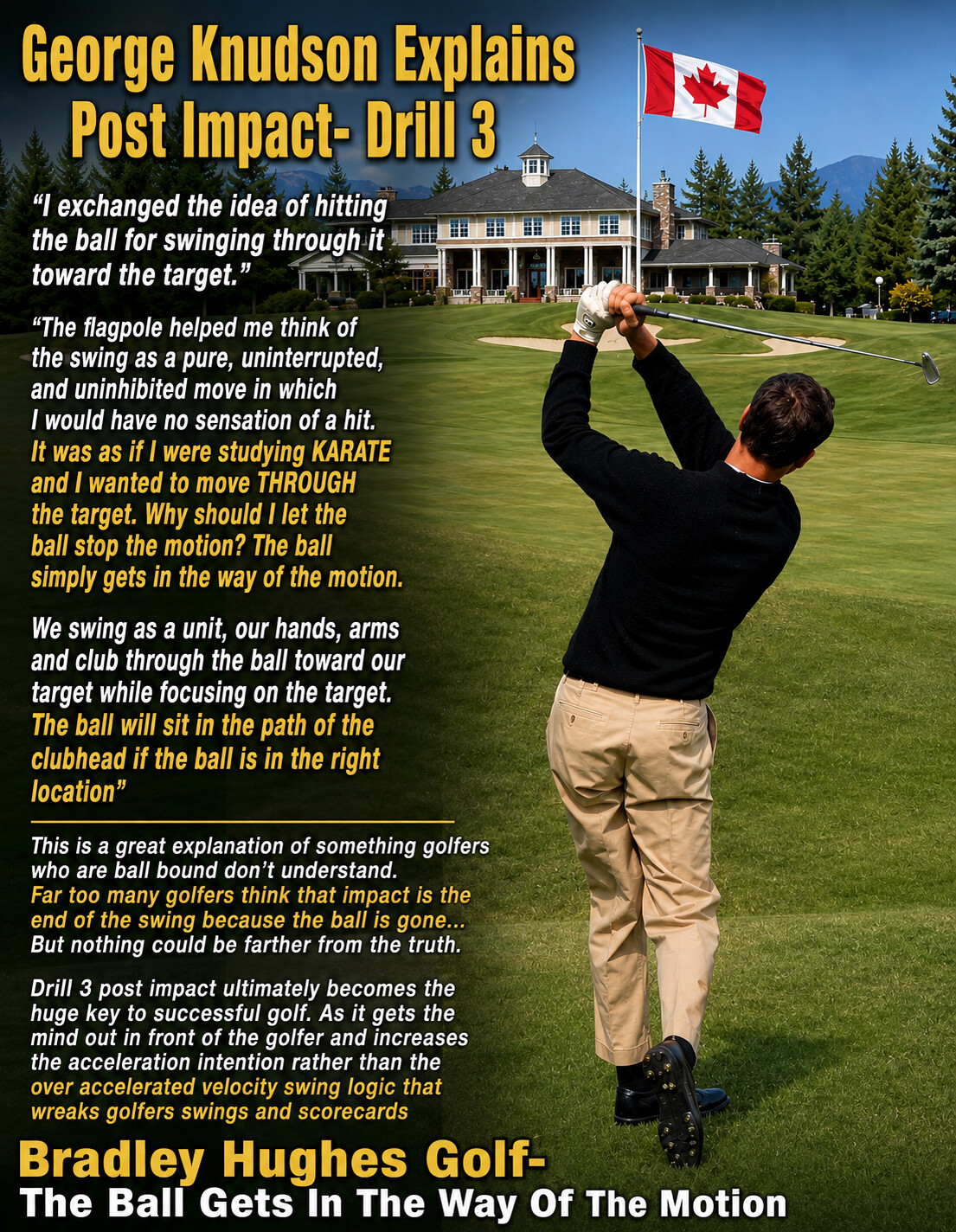
When watching Utopia, I was reminded about Knudson’s important message from his book. And like any diligent Rat, I copied it.
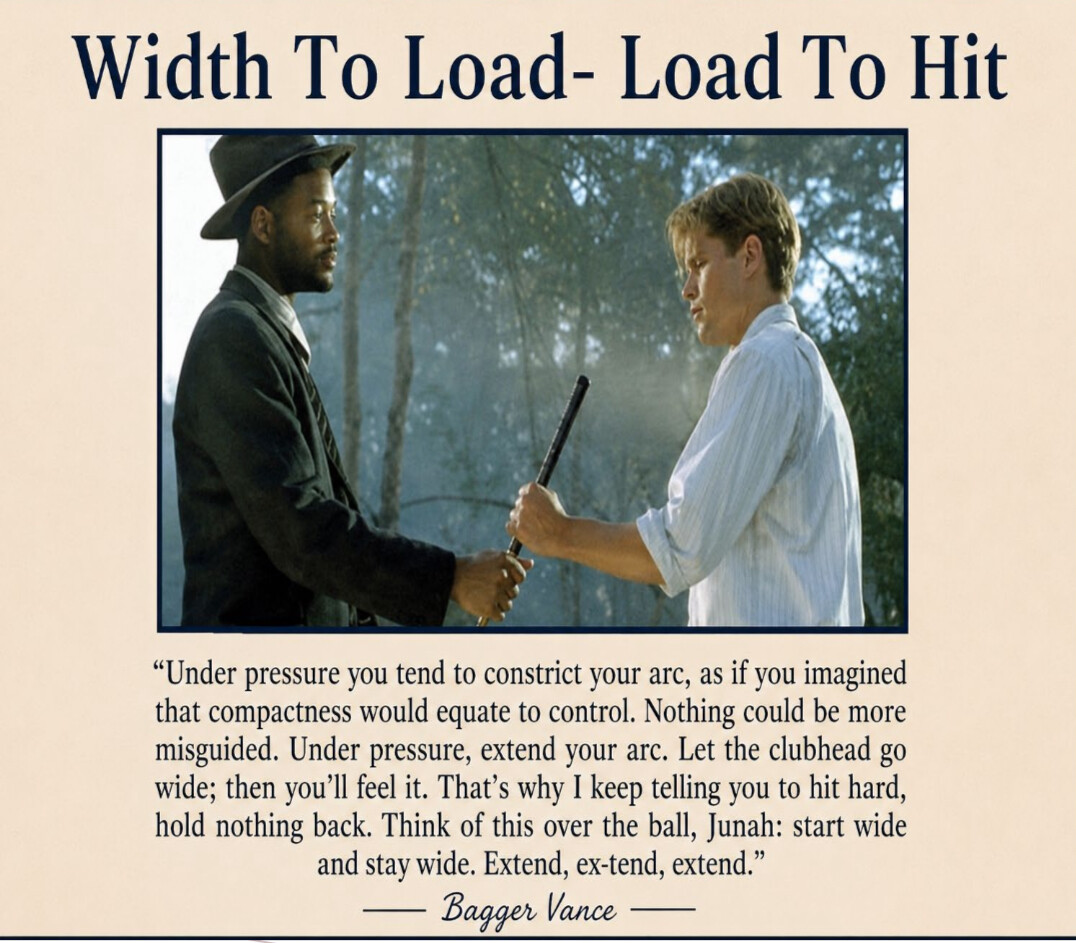
Excellent the true secret- just like Bagger Vance also said to Junah in that movie about extend- extend- extend
Along the same avenue, from Abe Mitchell’s book- The Essentials of Golf, 1927.
In the evolution of a golfer there are two well-marked stages. In the first stage the player is endeavoring to master the mechanical part of the game, that is to say, to make the strokes; in this stage his attention may be said to be directed to the proper poise of the body, the grip, the pivot, the preliminary movement of the clubhead, and so on: in the second stage he is concentrating on making the ball take a certain flight to a definitely desired place. In the former stage he is concerned with what the clubhead does before impact, in the latter with its behavior after impact.
On another very large forum an instructor once asked why anyone would want to listen to “old dead guys” when we have measured data. Your Honor, exhibit 1.
Because the old dead guys would still beat them flat playing with the equipment from that era. A Scottish pro who played in the Open at Carnoustie that Hogan won, said Hogans divots from the second shot on one of the par 5s from all four rounds could have been covered with a towel. Do you think any of the current world’s top 100 players could replicate that under similar conditions. I certainly don’t!