Many small important things are cloaked in bigger movements and get neglected and a good coach takes the time to educate clients on these little things that can make a huge difference in a players golf journey.
Over the years, I’ve had great success working with clients who become consumed by the pivot in the golf swing and the complexities of the takeaway. Many players get stuck trying to manipulate the club with their hands or arms, which often leads to tension, inconsistency, and an abrupt snatch away from the ball. By simplifying their focus and redirecting their attention to how their body moves the club, I’ve seen immediate improvements in both rhythm and ball striking. Helping players understand that a quality pivot can organize the entire backswing has been a powerful breakthrough for many of my clients.
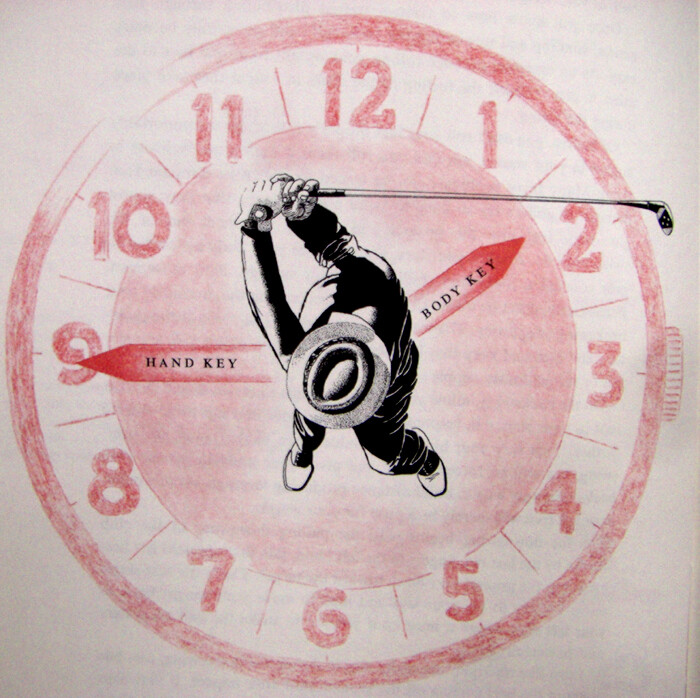
One of the most effective adjustments has been getting clients to focus on the trail shoulder simply turning back. This single cue removes the urge to grab the club away with the hands and eliminates the sudden, jerky takeaway that so many golfers struggle with. When the trail shoulder turns behind you naturally, the club moves away smoothly and stays connected to the body’s rotation. Clients quickly notice better sequencing, improved width in the backswing, and a calmer start that sets them up for a more repeatable swing.
Another key success has come from having clients gently push down on the handle with the target thumb pad as they turn that rear shoulder behind them. This pressure cue works perfectly with the pivot, guiding the club into an ideal position without conscious manipulation. With the added benefit of getting the trail wrist extension without even thinking about. Players feel the club setting itself on the functional plane while their body continues to rotate, creating a powerful yet effortless motion. The combination of these two concepts has helped clients simplify their takeaway, trust their movement, and ultimately produce more consistent, confident golf shots.
What Say You ?
Forensic Golf Academy powered by
Atlanta Golf & Fitness Club
The wrist setting down move mentioned is one of several good pieces within a sequence newcomers can work on, if needed, to help them along what can be a long journey finding sequence repeatability, or responsiveness, when required.
The feel of a massive shoulder turn with minimal arm travel is so helpful. If the hands and arms start running way off the right side of the torso you’re in trouble. Snead knew…
Yes indeed I see so many clients step on my lesson tee and they have arm run over they think lifting the arms is a rotation. When I get them to turn the trail shoulder behind d them with less arm travel they finally underrated how important connection is in the golf swing.
Another idea cloaked by a pivot can be path to plane, or plane to path, either one.
I used to believe otherwise but now firmly stand upon the proposition the only plane of a swing is the plane existing at address, and once in motion all bets are off and any discussion of plane should be in past tense and secondary in nature, not primary.
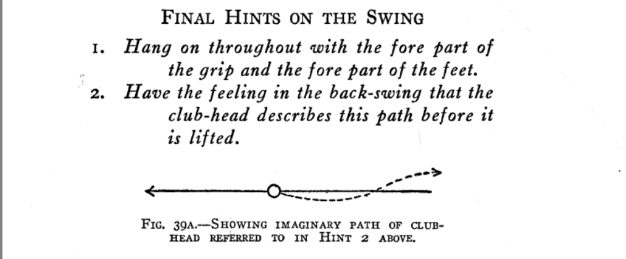
For example. Paying attention only to Hint #2 here’s Abe Mitchell’s diagram about a back move to path, which is the result of the set up and pivot. I think the path visual is quite revealing and a bit different than much of what we see today being taught, trapped, or discussed on a practice tee, and it has nothing to do with hickory.
I agree somewhat with your comment we definitely have a plane at address without a doubt but I also believe that there is a functional swing plane in motion from trail hip to target hip on the downswing and that functional swing plane has a window of success that can be swung into and out of and it will be a little different with each golfer depending on if they slide onto the plane like a Fred Couples or come up to the plane like a Ben Hogan or pretty much stay on the plane like a Tiger Woods.
All three are on the functional swing plane from trail side hip to target side hip but all three get there in their own dynamic way.
Absolutely. Abe’s diagram was weighted toward initial move from the ball as if there’s some magical universal plane to be on- often erroneously linear. Once in motion however, as you suggest above, getting to and passing through the delivery area and how that’s handled is the more important piece. Ground to waist level is the functional ‘plane’.
Coming from TGM, I was falsely led to believe swing plane could simply be manipulated with “educated hands”. The flashlight drills against a floorboard were the gospel. Finally realizing that “plane” needs to be created by opposing forces and pressures …. just like spinning a rock on a string.. the faster the rock spins, the more rigid and structured the plane gets… and the more flat it gets as well.
That being said, the 4:30 line does not feel on plane, and neither does the 7:30 exit post impact… but when combining those opposites, you end up with a net zero or neutral plane through the strike were it matters that is now dynamic and rigid. It’s really shocking that pedestrian golf instruction after all these decades still has zero concept of this.
Spot on I tell clients that the best way to think about it is to know that for every force there is a counter force working against it. And the Orbit Pull is a very good example of the weight of the club along with gravity is working hard to pull away from the player. So what can we do to counter that gravitational pull. And then the light bulb goes off and I simply get out of the way and let the player intuitively figure it out. In the process they also finally tap into spatial awareness.
A toral Win Win situation.
I think simplifying the takeaway is huge, but I’ve also seen players get stuck when they try to ‘build’ pivot too early. For a lot of golfers, the club’s motion and weight are what actually organize the pivot — not the other way around. When the club stays wide and heavy early, the body turns naturally and the downswing becomes easier to sequence. The best cue is always the one that holds up when speed is added.
Very solid points but I have one push back, I have found on my lesson tee that clients that try to get low and wide totally disrupt the natural arc of the golf swing which demands a correction somewhere in the upswing. I like to get clients going into early trail wrist break simultaneously as they make their rotation ie upswing. I want the client thinking up and rotate on the upswing are joined twins they go together.
honestly feel like every time you post, I need to stop whatever I’m doing and read it twice… then a third time just to make sure it actually sank in. I came up through TGM thinking plane was something I could manage with educated hands, and the more I read your work, the more I realize how much of that was me trying to control something that was never meant to be controlled.
That rock-on-a-string analogy is burned into my brain at this point. It completely rewired how I see the swing. Once I started understanding plane as something that emerges from opposing forces and pressures, instead of something I steer or place, the whole motion stopped feeling fragile and started feeling inevitable. I honestly don’t think I’ve ever had another concept hit me that hard.
I still get lost when I isolate individual feels like 4:30 or 7:30, but when I trust the opposites working together, the strike just shows up — and every time it does, I hear your voice in my head explaining why. I’m very much still a student, but your posts are the kind I bookmark, reread, and come back to months later because they keep revealing new layers. I can’t thank you enough for continuing to share this stuff.
This is a great post, and it definitely pokes at one of those things I keep having to relearn the hard way — that plane is a lot easier to talk about after the swing than it is to actually control while it’s happening. Every time I think I’ve “got” plane figured out mid-motion, the swing reminds me who’s really in charge.
The idea that the only true plane exists at address, and that everything after that is just the consequence of setup, pivot, and pressure, makes more sense the longer I’ve been at this. Once things start moving, plane feels less like something you manage and more like something you explain in hindsight.
And that Abe Mitchell diagram is fascinating in that context. I do wonder sometimes how much of that was him working off powerful feels rather than anything we’d call verified data today — but the fact that those feels still line up with what we keep rediscovering says a lot. Path as an outcome instead of a goal is a pretty uncomfortable truth for modern instruction, but it’s hard to unsee once it clicks.
For that one small segment it had to be more than just a feel. Routing movement within both the foveal field and functional plane simultaneously should have been as easily seen during Abe’s day as it remains today- seeing motion and sensing pressures directly in front of us immediately off the ball before the club goes more airborne. I can’t imagine a device not being able to ‘see’ that path, and if it can’t call it scrap metal.
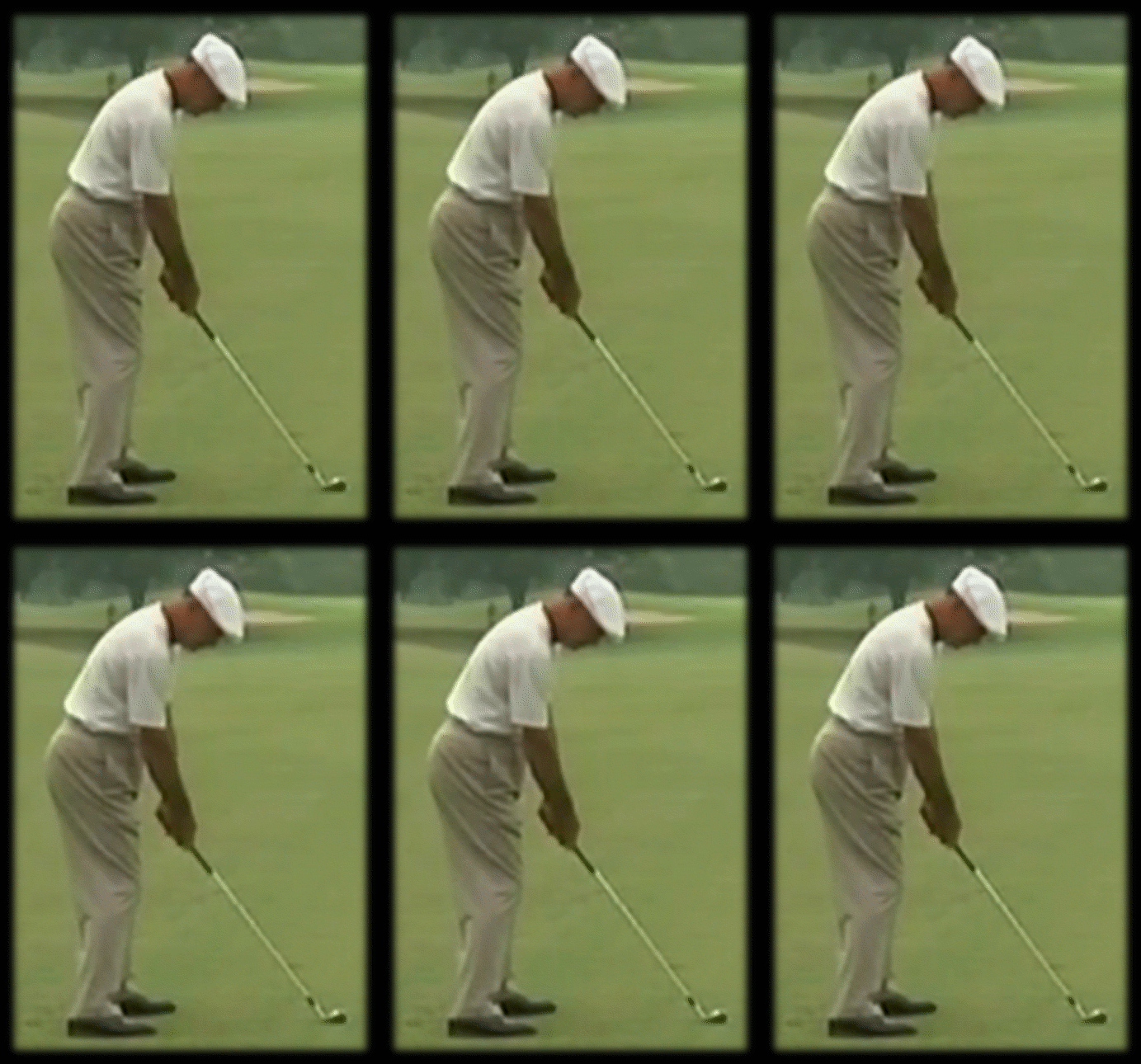
The quick inward with Abe’s path is the centripetal embryo- seen here too in an old grainy GIF when the show about reversing a natural instinct is about to begin.
We don’t accelerate the club, we accelerate ourselves.
Great question — and honestly one of my favorite things about this forum is that we can even have conversations like this.
For me, the TGM years were definitely more of a back-and-forth than a straight line. I absolutely improved in terms of understanding the swing — impact, alignments, pressure points, cause and effect — all of that clicked in a way it never had before. That part stuck forever. But performance-wise? It wasn’t always smooth. There were stretches where I felt like I’d figured it out, followed by stretches where I was thinking too much and the swing got a little mechanical. Then it would come back around again.
Looking back, I don’t see that as a failure at all. It feels more like a necessary phase. TGM gave me a foundation, a language, and a way to see the swing, and over time that understanding just blended into something more athletic and natural. The real gains came when I stopped trying to swing a model and started trusting what I’d learned.
And I’ll say this — the fact that we can talk about this openly, share experiences, and learn from each other is something I genuinely love about this forum. There’s a ton of knowledge here, but there’s also humility, curiosity, and respect for the journey. That’s something I’m proud to be a part of, and honestly, it’s one of the things I appreciate most about the golf community here in our country.
Really enjoying reading everyone’s responses to this — there’s a lot of wisdom in this thread.
really like how you framed that — especially the idea that it couldn’t have been just a feel. Abe was absolutely seeing and sensing something real, not inventing motion out of thin air. The inward move as a centripetal “embryo” is a great way to describe it, because that little re-route is where everything downstream gets organized.
That said, I do think there’s an interesting gap between what was seen and what was measured in Abe’s era. A lot of what he taught may have been anchored in very real geometry and pressure patterns, but communicated as feels because the tools simply didn’t exist yet to verify them in detail. Now we can see the same motions with numbers and 3D data — and sometimes the feels still hold up, sometimes they need a little translation.
I’m totally with you on the last line though: we don’t accelerate the club, we accelerate ourselves. When that happens, the club organizes itself almost automatically. That’s one of those truths that seems to survive every era, tech or no tech.