Paulsy said his irons were 16 ounces. Wonder if his woods were too?
I haven’t tried that. The long iron heads are lighter because the shafts are longer and they add weight. I would think you would need a different step pattern to offset the heavier long iron heads… meaning stiffer shafts in the longer irons. So basically the old step pattern would be tighter than traditional.
I do this naturally to some degree in my sets because I like shafts a bit firmer in my long irons and if anything slightly looser in my short irons so I can move the plastic golf balls around with a bit more ease.
I remember Paul telling me Moe’s driver was 16 ounces. He very well may have got that idea from George. Moe really idolized George.
Getting back on original topic…
With the latest super high speed cameras available now, hasn’t this “holding shaft flex into impact” been debunked as a mere optical illusion? Every shaft, some more than others with stiffness etc, is bowed like this “(” at impact no matter how much you try to make it like “)” because of CF force by then. Thought I read this somewhere. (yep, found the thread at Manzella forum)
The problem with cameras is that some of them show one thing and other cameras show the other. From what I understand it has to do with shutter or iris, and whether or not it moves top to bottom or bottom to top. Maybe a camera expert can enlighten us. My Sony camera showed things correctly. I also had an RCA video camera that would show the opposite. I proved this by using both cameras on the same swing. Played them both back and got different flex directions. So I absolutely know for fact that the camera is not always correct. Obviously the crazy backwards shaft flexing in Hogan’s “Power Golf” is not accurate. Some people still like to argue that… but I will tell you it is not accurate with 100% certainty.

Why would somebody not be able to hold shaft flex into impact? What is stopping us doing that, other than talent? We can do it on the smallest chip to a full shot there’s absolutely no reason why somebody can’t be accelerating into impact.
Manzella also believes that the weight of the club should bring your pivot round post impact, rather than being pivot driven. All his teaching is based on cracking the whip.
I know that there has been a lot of interest from Manzella and his associates and even Jeff Mann in the papers published by Dr Sasho MacKenzie which can be found here:
http://people.stfx.ca/smackenz/publications.html
The following papers sound like they might be worth a look though as always in this debate I suspect that they will always be open to interpretation, claim and counter claim:
[b]Understanding the mechanisms of shaft deflection in the golf swing.
Understanding the role of shaft stiffness in the golf swing.
A three-dimensional forward dynamics model of the golf swing
Examining the Delayed Release in the Golf Swing Using Computer Simulation.[/b]
I scanned them but happily admit that a lot of it was way beyond my understanding so I went back to building a lego dinosaur with my 7 year old 
Cheers, Arnie
Rolling shutter is the problem on video cameras that use a CMOS sensor. Unfortunately most of the consumer grade HD cams these days use a rolling shutter. I used to be pretty active over on the Canon HV20 website, and the rolling shutter is the nemesis of many of the aspiring budget movie/documentary makers. For certain things the rolling shutter just sucks! The average Joe will usually not notice it, but for what we are trying to do with a golf swing, what you really want is a camera that uses CCD sensors, and a global shutter…much better for stop action types stuff.
Here’s a neat video illustrating rolling shutter effects: youtube.com/watch?v=LVwmtwZLG88
You can read the technical explanation here: en.wikipedia.org/wiki/Rolling_shutter
That article has some GREAT examples of distortion and skew caused by rolling shutters…here is one example:
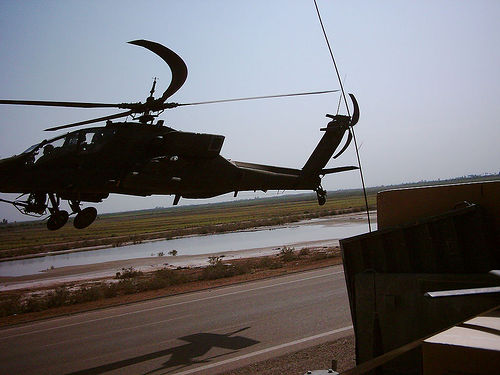
thanks for the explanation. Quite compelling.
Hard to believe people still believe Hogan’s shaft “in reality” was curved so violently the wrong way as depicted in Power Golf. I never heard Hogan discuss those pictures in an article or interview… but I still run into people who think that is what is supposed to happen in a proper golf swing. It can certainly happen in an improper golf swing!
Maybe it’s the Irish cynic in me, which is rather large, but when I look at the photos of Hogan like the one above, I always think it’s funny that we use photos of him doing the right thing to disprove inaccurate photos of him doing the wrong thing. If photos can’t be trusted, then using photos to prove that, always seems funny to me. I’m part of the ‘we’ btw. The eternal search for truth and fact- if you really want them, and honor the search, then you probably already know they don’t exist. Sucks! It’s not going to stop me trying though- I’m clever like that 
Good stuff Paul C.
What would be a typical price range for those type cameras…and is there a manufacturer that has better CCD sensnors and better global shutters than other companies. Thanks…  RR
RR
The only camcorders I am familiar with are the Canon’s, mainly because they have been at the top of the consumer heap for the last several years, and Cano is what I have always owned. Panasonic and Sony both make cams with similar specs, and are great cams as well. In the Canon HiDef lineup, the one you want is the XH-A1. You can also still get standard def models as well…the GL2 would be the ticket and don’t be fooled, the pic quality on the Canon standard def pro models is damn stunning. Both cams are gonna set you back a couple of grand at least…and there will be a it of a learning curve to make it sing as opposed to a consumer cam…basically point and shoot).
The best bet would be to call a local wedding videographer, as they usually have cameras with multiple CCD’s instead of a single CMOS sensor. The reason being that wedding videography demands a camera that can operate in very low lit churches, banquet halls etc… Multiple CCD’s will capture a TON more light at much better quality than a single little CMOS sensor will. Just ask him if he has a camcorder that uses CCD’s and a global shutter. See how much he would charge to to meet you at the driving range for a half hour to shoot some footage. You could probably save about 2 large going this route!
Andy
I was looking over Lag’s original website advancedballstriking.com and forgot about this pic of Trevino
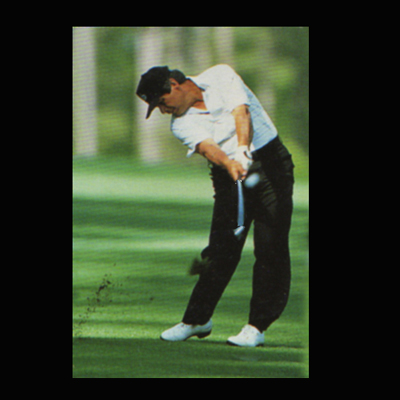
Could we call this a very good illustration of holding flex after impact…I would probably think the club has returned to it’s normal state after the ball collision and then Trevino is again flexing it by increasing it’s velocity on it’s journey to P4
Wondering what people think…I know there have been discussions about it being impossible to hold flex after the impact because people believe the ball collision slows the club down and the shaft will then reflex the other way (what we see in over acceleration too soon pics on the downswing)…this pic just looks like a good example of Trevino doing what Lag and Johnny Miller believes is possible but has not been really documented with proof in real time action golf swings…
Two, I believe it’s true especially when you add mass into the equation, show me a non-believer and I’ll bet you’ll find someone with a set of cavitybacks and a stalled pivot.
You hit the ground and the clubhead slows down, the hands dont, so the club shaft flexs in response to this. One end of the club slows down and the other doesnt, hence the shaft flex.
Thing is without pivot rotation you wont get Lees look. The shaft flexes back then flexes forward. The chain of events at post impact then travel up the shaft through hands, arms etc
I think it can happen. The big difference is whether or not one is seeking in-line relationships at the ball, or actually feeling that in-line is something to actively fight against.
In my own kind of way, I think that the greats figured out that since the ball is in front of us, our inner self knows that somehow, regardless of anything else or the action we use, the club needs to “get out” from a coiled position at the top. In other words, there is going to be some expansion of the club. It’s just a matter if we help it along to get out, or fight like hell to delay that happening. I prefer to fight like hell, as allowing the shaft to go in-line is too easy and subject to timing.
Now, being on plane from P3-P4 only, I have no feeling of inline relationships at all…everything is just motoring…holding the shaft from coming out…but it actually is, only incrementally. If the pivot is strong enough it overtakes the ratio of the shaft seeking to find the ball, or becoming inline, by coming out. That’s why I feel that the automatic release of the hands can be a true feeling if, and only if, the pivot rate of acceleration exceeds the rate of the shaft getting out. 
[size=150]CRAIG STADLER[/size]
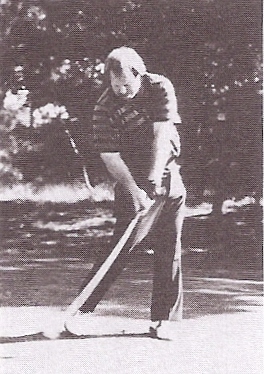
Wanted to bump this up for the newest members of ABS who might not have gotten to this very important thread and why we’re all here. Also check out the thread on Impact Physics, which crr, just bumped up as well…
Actually, buried in the archives of the public forum are a number of extremely useful and philosophically important threads, almost like an ABS manifesto, mostly authored by Lag. Maybe we should move these all to a separate subforum so they are easier to find, yet, on the other hand, maybe those secrets should be left buried and let those interested enough to bother “go dig [them] up” themselves…
Lag,
Acceleration is not necessarily an increase in velocity. Acceleration is a change in velocity. Velocity is a vector quantify. Because the club moves in a circle, it is constantly accelerating whether or not velocity increases. It is possible that efforts to increase velocity can destroy shaft flex. I think a player needs controlled velocity to produce consistent shots. How else can you explain the success of players who swung slowly?