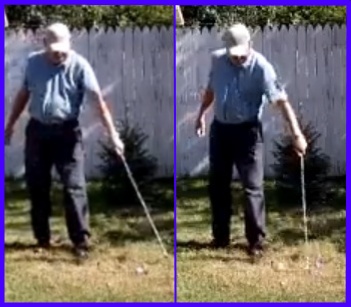
The easiest way to maintain shaft flex is to increase swing radius by using the legs and feet to keep the hands moving past the ball ahead of the club. So long as the hands keep ahead the clubhead is accelerating. Everything comes back to effective use of the earth under the golfer.
Not true Jake. The hands can still be way in front of the clubhead, yet showing the first signs of flipping on one side of the ball, or rolling on the other side, due to non acceleration. 
Jake66,
Push the head of a club into a door jamb and flex the shaft back. Take notice of the pressure in your hands. If you are not feeling this through impact you’re not holding flex. Just moving the hands forward doesn’t necessarily mean you are pressuring the shaft.
Yes. I did not express myself correctly. I meant to say that maintaining the dorsal flex in the right hand and keeping the hands moving in a circular path will maintain the flex even if the hands are not increasing in speed. I am not arguing against trying to increase the speed of the hands or the club either, just suggesting it isn’t necessary. Swingers with good timing can even lose hand speed on the way to impact and hit quality shots. Right now I am watching David Toms winning at Colonial doing just that. It looks to me as if Stricker does it too. I wish I understood that kind of timing, because trying to hit hard at age 68 is very trying.
No, that isn’t right either. But if you release the club right from the top in an arc toward the ball, this arc will sustain the lag (and the flex) without any increase in hand speed. I think this is what Ernest Jones meant by swinging the clubhead. Your explanation of swinging suggests that a player attempting this kind of release should strive for a vertical rather than a forward leaning shaft at impact. Am I right about this?
Sure, but that is not the best way to do it by any means.
If you have a lot of forward shaft lean at impact you are not utilizing the loft of the club properly, and your hands are taking a passive role, so you have to be concerned about timing the straightening of the shaft at impact or consistently from club to club.
Not something I have much interest in.
…just like some things pay big dividends. 

1 Like
[size=150]X marks the spot[/size]
Does it look to anyone that Hogan is “hitting a bunt” but on a different plane? Hitting a bunt…the ultimate paradox?
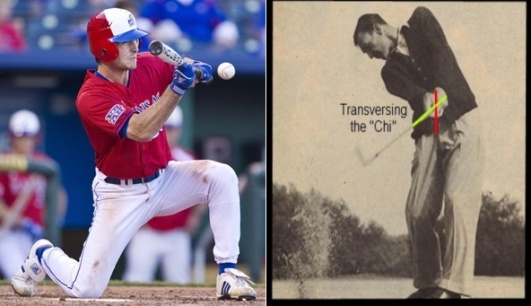
Found a little better view for a batter bunting a low pitch. Pull those hands together, add some dynamic tensions due to strong rotary action, R palm underneath, body mass behind back of the bat/shaft…hit a bunt. 
1 Like
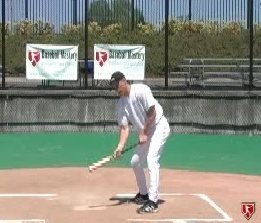
That’s not a bunt, that’s an out. If there’s a game with less proper fundamentals being taught than golf it’s baseball. The top picture is very good, knee on the ground, bat head up, everything dynamic with the eye line on plane or as close as possible. The bottom picture is exactly the position you DON’T want to be in, bat head down, arms extended & disconnected, no crouch to get down to the pitch & absorb the energy. That’s a popup to the catcher waiting to happen if he can even make contact. Yet another game being played improperly and just plain badly by overpaid people who don’t know what they’re doing or what aggressive winning plays are. Don’t even get me started on basketball, I’d never stop.
You can draw similarities between the two but I think they lie more in intentions of controlling direction & force applied by maximizing contact time in opposing fashions rather than looking at static positions.
Didn’t know you wanted to join the discussion Mr. Helper…It’s God again! 
The bunting photos were just an example of holding shaft/bat flex, but obviously no pressures in the bat, and not a primer on proper bunt technique. However, now that we are on that discussion, I can assure you that I know of a small rat who can bunt from any position- because this small rat had speed, but no power for the long ball. Singles and doubles, no problem. Oh…and being left eye dominant and a R handed batter helps…just ask Ted Williams. The key in bunting is to absord the ball, and place it where you want- except for a drag. That lower picture…Ok one squares to bunt on a suspected fastball, only to find out Jack Morris just threw a spit-fingered variety. No time to do a perfect lowering…you’ll have to deal with what the situation is. Not hard to do at all really…it’s how good your hands and eyes are and being ahead of the game. Now to bunt down the 3rd base line from a split finger would be a chore as you would have to deal with a top spin bounce off the bat. Anyway…
…what I was getting at in those examples is the change of direction which you don’t see: going from bunting square away to down the third base line ( low and left ) That would put the pressure squarely in the hands- and at that point there would be bat/shaft pressure.
In bunting we can “present” the bat to the zone as the pitch is on its way, and then change our mind and slam a liner down third.
Play ball
When you see it’s a splitter you pull the bat back, not drop it to to the ground. If it presents in the zone it’s probably gonna bounce & only Vlad swings at that. But no matter what if you drop the head you’re either bunting the wrong pitch or doing it wrong. And even as a golf analogy the 2nd picture doesn’t have any connection or move with the bat in toward the body so I stand by wrong being wrong.
Fyi I was referring to Sam Kinison, I would hope that was obvious but then again this isn’t exactly the Feyerabrand or Prandtl discussion room.
Oh, I can’t resist. ‘Critical rationalism, anyone?’ No thanks, I just ate. LMFAO!
It was…I was just getting back to that Back to School context…which I thought was pretty funny.
I think this speaks loudly to being in position to power mass a club up the plane. The more I think about saving R arm, the more I think that it has to be saved…not only to accelerate mass against gravity through P4, but the saving keeps the torso mass constant through the zone to assist in those efforts.
The picture is quite similar, if I may, to Mod 3…and that was the distinction I was trying to make, and the gravity fight going up.
I do know this…when the flex is held there is a hissing sound from the ball that is music to the ears. 
Well I suppose it’s time to open up another can of worms!
Had a feel today I thought I would share. When the shoulders are rotating level, there is a strong push-pull feel going on in the hands and upper arms with the legs and ground providing some strong resistance and direction. It is the opposing forces in play which everyone knows so well.
As I was stroking it pretty good today, I was finding the more tight and cohesive things were the more pressure was in the hands and those other areas.
I started to experience a relationship to the shoulders rotating level, and the fight between the outward CF and the inward CP that resulted in a hazy image that I just couldn’t put my finger on. Then after a while hitting away it dawned on me what I was feeling, but I couldn’t verify that image until I got home.
Went into Mall Rat’s kitchen and was struck with confirmation of those feelings by one of her utensils. Through the zone when hitting well and holding flex it feels like things are ripping apart at the seams in opposite directions. Like this:
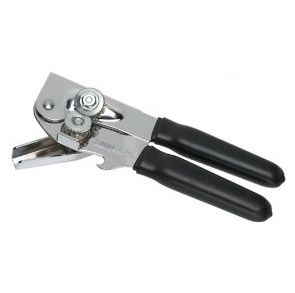
If you hold the opener so that the rotating handle ( representing the shoulders ) is oriented to the floor horizontally and on top of things much like they would be at address, and rotate the handle counter clockwise you will notice the two gears on the underside do some interesting things. The gear nearest your right leg is rotating counter clockwise ( CF ) and the gear nearest your left leg is rotating inward toward the center, or clockwise.
Those same forces rip apart the seam of the can and can rip apart the cover of a ball!
Was actually having some feelings of the circular arc out of P3 as being the rim of the can and how the opposing forces have to be working in harmony.
Fun day
Was doing some thinking about CP the other night at the range just prior to closing and had a pretty cool observation about shafts relative to being in-line, or out-of-line, while moving objects. Went over to YT to find an appropriate video showing this observation and couldn’t really find one- except this guy. I am a little reluctant to post this fearing a perception of raking this guy over the coals, because I’m not attempting to do if seen within the context that one of his other videos was previously posted at ABS by Two and I think there was some discussion about the benefits of Mod 1. It is just that this video captures what my observation was- so here we go with a happy Fourth of July puzzle.
Here we have an individual attempting to show how centripetal forces are beneficial in moving a club…or for the purpose of this forum…to hold shaft flex.
There is some poetic irony in this video that is escaping him…does anyone see it?
Anyone care to take the red, white and blue pill?
[youtube]http://www.youtube.com/watch?v=IKrQcuGqUgw[/youtube]
Ok…here was the observation.
It wasn’t his swing that I was paying attention too. I was looking for something which shows raking a ball, or moving a ball.
Many nights at the range just prior to closing I will take an iron and one hand balls that are too close to the cement foundations that support the mats. We don’t want to bring the ball picker that close to the cement edge where the grass meets the cement. Some nights I will use left hand only, and other nights right hand only…just little raking motions really. It dawned on what I was doing and how it in some ways speaks to CP through the zone and the feel of out-of-line relationships,
With this guy, between swings and how he brings a ball back to him is revealing. Forget the swing, look at that action. His left arm and shaft are in-line and he moves the ball by going out-of-line with the shaft. In this case he used the hand and wrist to accomplish that. The only other way to do that really is to keep the wrist firm and to vary the location of the elbow.
It reminded me of Homer’s view that variations of elbow location can cause impact alignment problems. So what did he do instinctively? He went out of line to move an object. And note how the right shoulder moves behind him. Pretty instinctive stuff if you ask me.
Let’s get that ball…Interesting move to do so