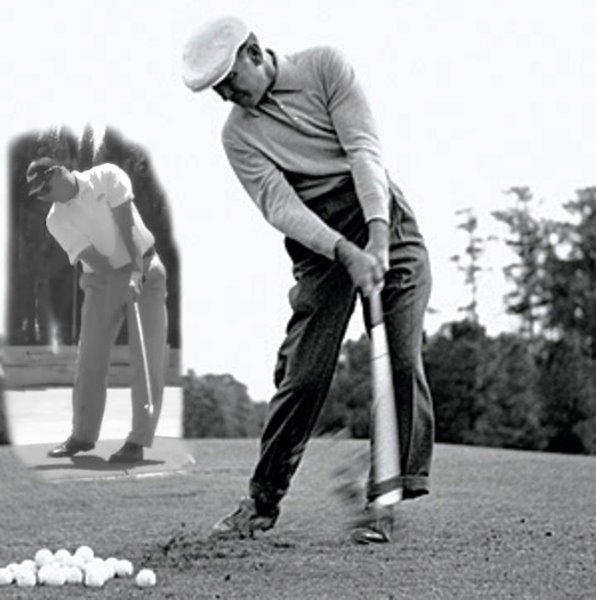
I have always been conflicted with how to get to the hip slot at the ball and arrive at delivery shallow. ABS seeks to initiate delivery with a rotation of the forearms followed by the pivot. My recent explorations have me starting that rotation sooner, and now I am experimenting with how to do that rotation. I am sure that this would be much clearer if I used the proper scientific terms, but I go brain dead doing that. So I will describe the feel. Until recently I wanted to feel the back of the left hand up until right before impact, i.e. having an open clubface. By waiting that late my arms are necessarily away from my body. Lately I am working more on what Hogan is doing here:
The feeling is going from back of left hand up to back of left hand angled slightly down as I get to delivery. Again my fear is that I get steep with my path too soon, but that will be something I have to work out with trial and error.
The interesting thing I notice watching Hogan in that GIF, and it is something that has always confused me, is that his left elbow doesn’t rotate as he closes down the clubface. I know some say he internally rotates his left shoulder at address and “locks” his left arm there to limit CCW rotation on the DS but I don’t know if I buy that theory. All I know is when I start my rotation, both forearm and torso my left elbow rotates as well.
I really like that gif as it shows very clearly the Mod 1 forearm action.
Grady, you were discussing earlier the feeling of turning into the left arm. I think Hogan is setting that up here where he is rotating the forearms but the left elbow is still away from the body. It appears to me that after rotating the forearms and beginning the torso rotation that this would pull the left arm tight into the body.
Possibly, but my focus right now is HOW to rotate the left forearm. I can rotate it without moving at the elbow or with moving the elbow. I think the former is what Hogan did, and what I am experimenting with right now.
I don’t have the best left arm in the world, but that turn into the L arm piece I really feel on the upper left arm. I think I am a touch disconnected at P3, then it almost feels like the upper left arm finds my left breast quickly.
The L arm movement to me feels like that old childhood prank of putting your hand under your armpit and moving your arm to make a fart sound. Like the L arm makes a bellow movement inward and attaches to me.
Now on that gif, that is where I feel the right side, especially the arm and shoulder, begin to pin the club head down, while the shoulders begin to rotate- like the R arm is pinning the club downward heel first.
Getting more comfortable standing close, and experiencing some new sensations. The notion that we get our hands in front of us, which was never a tenet of ABS teaching, now is a death move. There is no room for it. Rather the hands go from the SIDE and BEHIND us to UNDER us. Rotation is more level, and I am very balanced post impact. The challenge now is to get shallow in transition.
RR…yeah the fart sound move was the first thing that came to mind a few years ago when John spoke of it. You can hit it amazingly far if you just take it back 2/3 and exaggerate the distance between your left arm and torso and do nothing more to hit the ball other than close that gap as fast as you can.
nfbandon and RR,
I think that both of you are on the right track. I believe Mr. Hogan closed his clubface prior to impact and opened it through impact. Try hitting or moving a ball with the clubhead right behind it using a Mod 3 action. If the face is open, the ball slides off the face. If the face is closed, the ball can be captured and slung just like a hockey player shoots a puck. This action allows a powerful force to be applied to the ball.
I believe he also kept the boney portion of the left elbow facing down the line at impact. He did not allow the boney portion of the elbow to point toward his left hip. He rotated the forearm only.
Both of these items I addressed in my Christmas Present post in 2012.
The final thing I would like to add is I believe Mr. Hogan flung his left wrist forward post impact to re-cup his left wrist. Mike Austin talks of how the release of the left wrist can knock a man over. If you look as post impact pictures, Mr. Hogan’s left wrist is not flat. This little move added 10 yards to my irons and will develop a little fade.
It probably goes to Lag’s pre-impact hook, post impact slice feel- the closing gets pinned and goes for a 1:1 ride with the turn.
Good thoughts rduhrin on the Mod 3 stuff. I add, from my own perspective doing that before, that getting the full loft to work in that scenario and actually getting the ball airborne requires a ton of weight to remain on the right side, weighted down into the R foot, as you accelerate from right behind the ball- even with an open face it gets airborne cuz the pivot closes the face again. I did not try with a closed face though.
My thoughts now on hands are, and I don’t know if I can explain this properly, but taking a page from old time baseball, and a touch of NASCAR, my hands are seeking “inside the ball” from P3, with the net effect being my inside has an outside ( hands ) that are staying inside the outside- or ahead of the outside. The Outer Limits, but the turn is so tight I can hold nickels in any crevice.
Range Rat,
I do think the weight needs to be on the right side at impact. Look at the post “Leg work of the greats” by nfbandon. The video by zenolink on the bottom (which, by the way is excellent) lead me to this:
Look at Snead on the way down. He is sitting on the RIGHT leg.
I just started reading a new book called “The Hogan Letter Lessons” (very inexpensive through Amazon and good so far) which was written to the pro at Pasatiempo in the late 1940’s. Mr. Hogan talks of loading the muscle “by your right nut” and keeping pressure there throughout the swing.
Intriguing. I have wondered about this, but dismissed it because it does not seem to match what he said he does, nor the drawings in his book. May be didn’t know. However, it would match what he said about " just do the opposite of what you think you should do."
Please expound more if you can. This seems hard to do, but a worthwhile experiment. Are there any imaging/ feel tricks?
IMO it is on the other side of the spectrum from Hogan. Even it looks like Mike Austin didn´t used it.
IMO great for beginners to create clubhead speed - the downfall is zero trajectory control and without
trajectory control - no distance control. But of course it is an option to release like this.
Of course the left wrist cups somewhere around p4 - but this has nothing to do with a slap hinge release.
If you want a higher trajectory, I would understand the cupping…
My feeling is more to go from cupped to bowed and then to flat at impact…
I can agree with the sentiment about allowing the left wrist to cup for higher trajectory. It’s the new game, high through the air. If it’s good enough for Byron it’s good enough for me. But I feel it’s important for people to learn to maintain to the cup in the right wrist first, then take it off if you want higher trajectory. Kind of the opposite of what Jack Nicklaus said he likes to do. As long as you release up the shaft angle. I should note I definitely do not advocate the slap hinge release in the way shown in the picture.
I don’t think it is necessary to slap hinge to play well, even with the modern ball. Of course, it depends on where you play and what your goals are. If you play older, traditional tracks that allow an entry to the green along the ground it isn’t a problem. And frankly it isn’t a problem on modern tracks if you have sufficient clubhead speed. It is certainly not what we seek here where we work on maintaining shaft flex for as long as we can. Byron wasn’t slap hinge anyway. His left wrist was flat or bowed well past impact. His intent was to keep the clubface on the target line as long as he could, and he did this by maintaing lots of knee flex. So he maintained shaft flex for as long as he could extend down that line, and then he broke everything off.
Thanks for the discussion Grady. It seems like we’re taking different stances but I believe we have the same one. The point I am trying to make is that maintaining shaft flex and releasing down that line is the idea, but there are many different looks that get it done. You don’t have to look like Hogan. Hogan didn’t even think he had the best swing at the time. I think it’s funny how we focus on Hogan so much but I’m reading the American Triumvirate book and Nelson always took Hogan’s lunch money.
I don’t feel like we talk about Byron as much as Hogan.
These videos of Nelson demonstrate Nelson’s intention of forcing the path dlt post impact, and show how he just buckled when he couldn’t stay low anymore. The film quality is poor so it is hard to see his hands, but there is enough there for me to conclude that he didn’t hinge slap at all. Indeed he keep the hands up with the shaft well past impact.
Can we get some discussion or a consensus here on the legwork’s affect on handpath?
If we conclude that both Nelson and Hogan (and other great ballstrikers) were good because they were able to pressure the club up the angle set at address/impact as long as possible, what is the connection between legwork and handpath?
It seems like if you straighten out your left leg through impact because you’re using it as resistance (the squeeze part), in order to maintain this shaft pressure you must cut more left around the body. But if you maintain your knee bend as long as possible (more of a knee buckle) does that keep you lower so you can maintain pressure without having to cut left? And is this why Nelson must release more with his hands than Hogan?
Is this why Knudson is more “handsy” through impact than Hogan as well? I’ve always noticed Knudson releases more up the shaft line with his hands through impact than Hogan, he is more similar to Nelson, in this respect, and both Knudson and Nelson maintained much more bend in their left knees through impact.
It could be that having more knee bend forces you to release more with your hands otherwise your trajectory will be too low to be useful. That’s my experience with experimenting with more of a Nelson knee buckle. It gets the hands sooo much lower to the ball, which shallows out the angle of attack big time.
How come we know so much about the specs of Hogan’s clubs but I can’t find anything on the specs on Byron’s? They could be useful.