Wow NRG, that is enviable from my view.
Just grinding the modules?? Are you feeling anything different, any different intentions? Does this nice look just happen now or do you have to try?
Wow NRG, that is enviable from my view.
Just grinding the modules?? Are you feeling anything different, any different intentions? Does this nice look just happen now or do you have to try?
Well, to be honest, it wasn’t till I started working on the rotated plane stuff that I got that flat, OTT for 30 years is not easy to get rid of. My new feelings are trying to go from really steep to really flat which loads massive pressure onto my PP3 on the way down. I am trying to feel as off plane as possible. Everything is the opposite, I get flat by first getting steep, I rotate my forearms by first un-rotating them. (drag across the bag feeling) Am sure that won’t make much sense to most. Its a weird feeling for sure, but I really was hitting the shit out of them when I took that video, I just hope it translates onto the golf course.
 nicely done
Ben Hogan: “Reverse every natural instinct you have and you will probably come close to having a decent swing”
Makes sense to me NRG. I call that lag loading, or drag loading, or reverse loading. I generally role it open, but I’m going to give lagging it more a try next time and see what difference, if any, it makes in the relative elbow location at P3.
Good stuff. 
Two, getting off plane has been a real lightbulb for me.
Rat, I’ve heard it called reverse roll or something like that. I like it cause it seems to make the club to come up more steep over plane, whereas if I fan the club open, that tends to take it back under plane then I come OTT. But I think that what happens is when you enter the CP phase of transition, the clubhead flips open and it rotates your forearms, there is nowhere else for the clubhead to go really, you can’t keep rotating it the wrong way. Not sure I will stick with it.
I like it either way NRG as the open forearm is key IMO. I’ll check it out for my own curiousity.
I think rolling is natural to me because my L elbow is weird maybe. Now it’s not Calvin Peete weird, but when I place both palms flat down on a table top and press down as hard as I can from above them…the L elbow, and those two bones that are there…I think they are bones… rolls clockwise about 90 degrees, whereas my R elbow essentially stays put. Pretty weird. Anyone else’s L elbow move like that?
I also think that rolling helps me get a flatter shoulder turn going back. But I am going to see if the reverse roll will shorten the hand travel even more.
Glad you posted that NRG…real good stuff  RR
RR
This is excellent, and nice to see such an improvement and some real lightbulbs turning on here.
You would be OTT from that first photo. Goodbye left side of the golf course if you hold off release with some pressure into the hands.
NRG: Last night while watching my grandson during his swimming lessons some thoughts on the forearm rotation we were discussing were demonstated by his instructor. It caught my attention and I thought I would put it up here.
The instructor was showing the arm movement while treading water.
He started with extended arms with them being in front, and palms facing. As the arms were moving backward they were actually reverse rolling inward and pushing the water backward, and after reaching the furthest point back the forearms would “rotate open” going back the other way…much like we were discussing.
It was interesting to watch as one would have a hard time treading water in reversing the process. And even though the arms in hitting a golf ball is a lot different than treading water, I thought it was interesting to see how the arms in treading water really act as a propulsion vehicle in an attempt to move the body mass upward out of the water.
Good stuff MM( Mighty Mouse).
I think Bom told of practicing golf swings under water. Wonder if he noticed a similar thing?
I agree completely with the idea of going flat, and more along with Lag’s specifications, heavy. When Two and I first set up my clubs we went vintage(His idea). I saw a set of Two’s Macgregor VIPs and thought the were beautiful. We looked online for a month and found a set of 1986 macgreogor jack nicklaus murifield 20th anniversary blades(1-PW). Two put a set of x-300 shafts in the heads with a bend of 6 degrees flat. At the time I did not understand the reasons for having flat lies, but I assure you that after 18 months with Two it makes perfect sense. I am hitting the ball more solid now than ever before.
The guy below is a junior and seems to hit lots of fairways&greens - thus the title by his coach Ted Long “The next Ben Hogan” - who works for St. Leon Rot here in Germany and works alot with junior golfers.
This guy seems to hit it very very straight. So i was curious how he enters into impact - to me - that looks extremly flat, doesnt it? What do you guys think?
So another argument for flat = straight?
[youtube]http://www.youtube.com/watch?v=tPROpQcKUQE[/youtube]
[youtube]http://www.youtube.com/watch?v=cesqJtR-5KQ[/youtube]
A lot of good stuff going on.
A bit weak post impact, but that could worked on over time.
I hope he gets to the right instructor or finds the correct path on his own.
Don’t know how you got those separate pictures of a fluid motion…pretty cool though. Do you freeze the motion where you want and then do a screen grab, or print screen? When I freeze the motion the shaft gets real fuzzy at times, whereas your stops and grabs are clear, or I can’t get it to stop precisely where I want.
But frame #7 and #9 are telling for me: he’s lost the opposing force past P4 and lost the opportunity for PV5 
I’ve looked at this kid’s swing a few times, and his instructor also seems to be fairly strong- good post, thanks. He’s definitely a modern day Hogan interpretation in that he’s defined by the ‘top transition’, and also the drop. He’s no doubt a top notch golfer and capable of being a Hogan type player in modern times, but beyond that, in terms of his swing, I don’t see a huge comparison.
It’s a very good swing, and I am sure he hits the ball very well at times. Where Hogan separated himself from everyone else, even to this day is what he did post impact. Hitting positions on the backswing and downswing is one thing… but doing it also post impact is just as critical.
I just can’t see a Hogan type striker evolving from modern gear. I really don’t even see that as a possibility.
Flat vs Flat or Upright vs. Flat? Took it from a match of Shells wonderful world of golf:
[youtube]http://www.youtube.com/watch?v=ntxm7ceeVJI[/youtube]
I think Geiberger has a very shallow, flat downswing. When the video is stopped at impact you can clearly see the shaft is pointing well under his beltline.
Geiberger did it very well…Mr 59
Right arm bent - Hands in tight and packed - Shoulders opening thru impact - Club staying on plane thru the strike
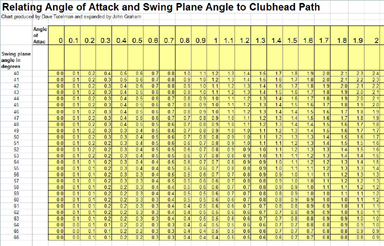
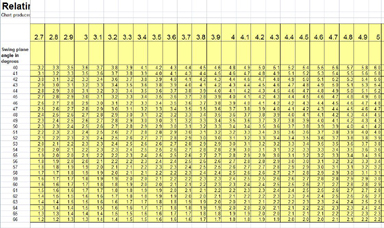
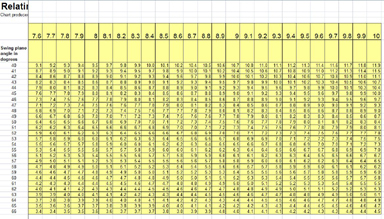
I came across this chart by John Graham and find it interesting…I did some ABS searches and didn’t come up with anything…Forgive me if this has been already discussed before but if not it might be worthwhile…
It’s a spreadsheet of angle of attack vs. plane of the swing…As one can read, the flatter the swing the more out to the right one swings through impact on a descending blow. What I find interesting is the calculation that is used to determine where to aim in yards if you know how much you are hitting up or down on the ball…And that’s a big if in my mind assuming you don’t have a Trackman at your disposal. Let’s take an extreme case of the driver @ 45 degrees with an Angle of Attack of 10 degrees…If you plan to rock it 300 yards then you need to aim 51 yards to the right…(300*.017*10 degrees) = 51…Plus I’m guessing that you probably need 10 degrees of shaft lean so you are not adding loft at impact…
Also what jumps out at me as well are the numbers below 1 degree of angle of attack…If you can do this shallow attack you can pretty much aim right at the target with all clubs in your bag…(200 yards*.017*.5)=1.7 yards
To me this info begs a couple of questions, can one use steep clubs/plane and swing on a shallow A of A? or is the only way to swing a shallow A of A is from a very flat entry?