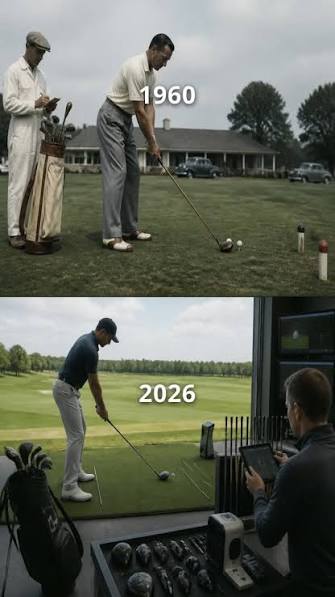
Equipment 1950s- 2026 with Elite Players


I have been doing a lot of research on the equipment that the best players have played from multiple eras and two things that have stood out to me were that today’s top players are playing iron sets that are much heavier than players in the 1950s-1960s.

The culprit was right in front of me, take the popular Propel 1 shaft in a standard length 7 iron came in at 118-121 grams and let’s take an Apex 5 seven iron standard lentgh shaft and they came in at 117-121 grams.

7 iron head weight from the 1950s was 267-268 grams and today’s 7 iron head weight comes in at 268-270 grams. So head weights have stayed pretty consistent with irons over the last 50+ years.

Now take today’s elite player who plays the Dynamic Gold X100 comes in at a standard 132 grams the other popular shafts on tour are KBS tour X at 134 grams and Project X 6.5-7.0 coming in at 132 grams.
Head weights for irons have stayed extremely consistent so lets stay with the base 7 iron we are talking about and they come in between 268-270 grams so today’s players irons are definitely heavier than the players in the 1950 - 1960s. They caught up in the 1980s with more players using Dynamic Gold which came in at a stout 130-135 grams across the board depending on flex. So the math tips the scale to the modern elite player on irons.

Now lets look at woods which is easy to break down. 1950-1980s players played Persimmon and they came in at 13& 3/4 ounces up to 14 & 3/4 ounces for the tour player pretty much across the board save a few players that tipped the scale between 15-16 ounces.

Now todays tour player is coming in at 11.5 - 13 ounces with Bryson Dechambeau coming in at the heaviest at 14 ounces. But I had to even think about breaking that down one notch after saying the heavy scale with woods definitely tipped the scale to the players from 1950-1980s easily.

Then I broke down a round of golf for the elite tour player who scoring average is 68-71 and asked a real important question :thinking: How many times will today elite tour player use his driver in a round of shooting 68 and the best I could estimate from records was 10 times on average. Add in the tour average for putts and that meant todays player was swinging a heavy club the majority of his/her round.

Another question came up in my early research. Do I think the 10-11 times a round a player is swinging a light driver is causative to injury or correlational ? It may be correlational but it is definitely not causative I would say when the majority of their round is spent swinging heavy irons. I of the belief that bad movement patterns are the result of injury moreso than swinging a driver 10-11 times a round.

Im going to put all this together in a spread sheet and go a lot deeper into it his fall.

2 Likes

I suspect a lot of the weight issue is with the woods because of graphite shafts. I weighed a GBB Epic with just the head and it was close to where metal drivers of the past were. So if one were to install a steel shaft to the same head AND be able to get it to an appropriate swing weight the club would probably come in to the 13-14 ounce range. As for the injury issue I know of a torn tricep muscle in the trail arm. In the past we only saw rotator cuff trouble in the lead shoulder. Purely physics related I think a MLB pitcher would be more likely to through out a shoulder with a wiggle ball than with a regular baseball. All it takes is one swing also. Just my .02.

1 Like

Yes indeed with the irons it’s not even close today’s elite players irons are heavier due to the shaft coming in at 10-15 grams heavier across the board with the same head weights that have pretty much stayed consistent the last 50+ years. But with woods the classic golfer wins the heavy case easily due to having a steel shaft versus a graphite shaft. While doing my research I did see that Bryson Dechambeau and Gary Woodland and a few others have their modern drivers right at 14 ounces and they are considered some of the longest on tour with driver distance. I remember years ago I installed a steel shaft into a Titleist 975D driver at 44 inches playing length. It came in right at 14 ounces and a swing weight of D4. I still play it 10-20 rounds a year.

I’ll offer my honest feedback on this. Firstly, I don’t think some of the facts you have stated are accurate. Including the following:

  1. “best players have played from multiple eras and two things that have stood out to me were that today’s top players are playing iron sets that are much heavier than players in the 1950s-1960s.”
    1. What is your data source? Which 1950s clubs did you weigh and which modern ones?
    2. You should also be very specific on whether you are comparing these based on club number, club length, loft, of some combination. Club numbers now vs 1950 are completely different in length, loft, and weight.
  2. Bryson’s driver is 14 oz… He used to use an extremely heavy grip but I think uses JumboMaxx’s lighter version now, so it would be very unlikely to hit 14 oz with a graphite shaft and a 45 in club. You would end up with an insanely high swing weight unless he backweights the club significantly. What is a reliable source claiming 14 oz?

Secondly, consider using something like Moment of Inertia (MOI) of the whole club instead of dead weight. Adding 20 grams to the grip or to the clubhead are dramatically different things. MOI considers the distribution of the weight and not just the total weight. For example, your post is comparing persimmon drivers which are heavier than modern drivers, but they were also about 2" shorter on average, so the comparison doesn’t actually make sense until you account for length. And most of the weight difference is in the shaft which has a much smaller impact on MOI (or SW) than it does deadweight.

Lastly, if we want to make any inference on the impact of club specifications on injury risk, you would need reliable injury data. This does not exist, certainly not for players from 70 years ago. And even if it did, the medical terminology and diagnosis criteria and procedures would all be so different to make it very difficult anyway.

My opinion summarized: I have not seen any good data source demonstrating modern players are injured more often than previous generations. I have only seen speculation/anecdotes to support this argument which means close to nothing if you want to do a real investigation into the matter. Additionally, any retrospective analysis of this matter using only existing data on the web will yield nothing conclusive or convincing. There is simply not enough reliable injury data nor is there an easy way to avoid missing other confounding or omitted variables.

1 Like

That all being said, learning about old vs new equipment is fascinating and I think about it often. I prefer old, heavy clubs and find they are easier to hit. I personally have not been injured golfing but I also do not play or practice much.

2 Likes

Good points but math matters iron heads total weight have been consistent the last 50+ years. Todays elite players iron shafts simply weigh more than the shafts of the 1950s-1970s. So todays elite player irons are simply heavier.

Now take woods and players from the 1950s-1980s woods weighed more due to a steel shaft and a wood head that weighed more. So that era the scale definitely tipped towards classic golf for heavier woods.

Now add in the statistical data that elite players only use their driver 10-11 times a round which means 80-90% of the round they are using other clubs. Add in the tour average of 27-28 putts a round and overwhelmingly the elite player is swinging their irons more than any other club. And today’s player overall static weight for irons are simply heavier than in the 1950s-1970s.

Dynamic Gold was created for one purpose. Tour pros wanted a shaft that was more stout and heavier from wedge to long iron. Dynamic Gold is still the number 1 golf shaft on tour coming in at 130-135 grams heavier than any shaft from the 1950s by 12-15 grams.

An uncut Propel 1 shaft is 130 grams. Once it is butt trimmed to a standard 7 iron lentgh it comes in at 117-118 grams while a Dynamic Gold X100 7 iron is 132 grams.

I definitely agree with you when you speak of injuries today versus classic golf. Injuries are part of the sport of golf on the elite level and there is no emperical evidence that shows that today’s golfer is injured more than yesteryears golfer. What we do know is that rotational forces apllied to the spine, hips and knees will eventually cause pain and injury and we can look at the older golfers like Jack and Trevino that show it in real time. Just like we can look at today’s golfer and see it also.

But many might be shocked to find out the highest injury point on the body has not changed in over 75 years which is lower back followed by elbow, wrist and shoulders. Those are the same injuries that were happening in the 1950s. So my stance is we can’t simply say that todays equipment is causing injuries when the same injuries have been consistent for the last 75 years.

I think if we peel back a few layers we can get closer to the cause
Rotational Stress: The golf swing forces the lumbar spine to undergo extreme twisting, side-bending, and compression all at once. The spine simply was not created for this stress.

Anatomically I point to players get injured on all levels when the joints have not segmented properly allowing for a more efficient stretch - shortening cycle of the muscles but that’s another passion of mine for another topic one day hopefully.

Poor Swing Mechanics:

Misalignments during the swing place intense, unnatural stress on the body. For example, a “reverse spine angle” forces the lower back to hyperextend, while hitting the ground too hard (“chunking”) sends severe vibrations up the shaft into the wrists and elbows.

Prove it (that iron head weights have not changed). And are you comparing by club #, length, loft, etc…? Comparing by club number likely doesn’t make sense, neither does comparing weights of drivers with different length shafts. It’s the same reason longer irons weigh less than shorter irons.

My degree is in applied math and my day job is in data, systems, and evaluation. That doesn’t mean I’ll pretend to be an expert an everything, but it does provide me insight on how rigorous analysis actually works. My feedback was only to explain why I found your comments less than convincing. Unless you explicitly show data sources and the methodology accounts for the distribution of the mass, it is not of much value.

If this is back-of-napkin kind of speculation, then have at it and I should apologize for ruining a light conversation.

Okay, so what is the x100 after you butt trim it? 130 grams is the X100 before it’s trimmed the same as the propel shaft (supposedly, I haven’t seen a proper spec sheet for a propel shaft).

1 Like

I see what you are trying to equate but it’s incorrect because you are not butt trimming 3-5 inches off of today’s taper tip iron shafts. We use to purchase a blank shaft and match it by tip trimming and butt trimming. In irons that is rarely if ever being done today.

You are trying to compare fitting from the 1950s era to modern technology and it’s night and day. Equipment is better today due to tighter tolerances etc Hogan use to go through 100 shafts just to find 9 similar shafts. You simply do not have to do that now.

You don’t have to butt trim modern golf shafts nearly as much as builders did in the 1940s - 1950s because of a fundamental shift in how golf shaft manufacturing and R&D have evovled

The main reasons for this evolution include:

  1. The huge shift to Taper-Tip Shafts

In the 1950s, it was common for steel shaft manufacturers to ship long, identical “blank” shafts to clubmakers. To build a full set of irons, a clubmaker had to perform extensive “combination trimming”—cutting significant amounts off both the tip end (to adjust the stiffness for each specific iron head) and the butt end (to achieve the proper playing length thus today 130 gram 7 iron shaft is 130 grams not 118 like a Propel 1 or Apex 5 after being tip and butt trimmed for flex and lentgh.

Today, major manufacturers produce (constant weight) taper-tip shafts.
This means if you buy a shaft for a 5-iron, it is specifically engineered and pre-cut at the factory to the precise length and flex needed for a 5-iron. When assembling the club, the builder often only needs to trim a tiny fraction of an inch (or sometimes nothing at all) from the butt end to match the golfer’s exact specification.

It’s a very rare occasion for a modern fitter to have to butt trim and tip trim an iron shaft. We will opt out to soft stepping or hard stepping instead maintaining the dynamics of the constant weight shaft.

As far as iron head weights that’s really simple, just pull apart a 1950s-1960s iron head and weigh it. Then pull apart a modetn iron head and weigh it. You will see the heads are within 1-2 grams unless they were special edition like Edel and a few other companies make where they offer 3-4 head weights.

My Avian Redbird 335s head weigh 2 grams heavier than my Macgregor Muirfields & VIPs and my Miura Limited Edition weigh 1 gram heavier than my 335s but they are all within 1-3 grams of each other. So again iron head weights have stayed extremely consistent the last 50+ years that’s why I submit that the scale tips towards modern golf when it comes to irons.

But for many of the same reasons the scale tips towards classic golf when it comes to wood a heavier shaft a typical tour Persimmon Head comes in 190-200 grams @ 150-190 CC head and a modern 460 CC driver comes in at 195-205 grams. So the heads weigh pretty much the same but here is the difference.

Classic persimmon wood driver shaft steel 120-130 grams wheras a modern graphite driver shaft 50-75 grams so classic has 55-60 more grams in the shaft alone which is almost a full 2 ounces so that’s how the scale tips towards classic golf the same as in modern golf it’s in the shaft because head weights have remained extremely consistent regardless of the material being utilized.

And finally I’m not trying to diminish what a person chooses to play I’m just stating some very obvious things when you remove emotions and simply do the math.
I personally love my classic gear I have some iconic woods and irons and play them weekly but I also know that my modern blade sets with Dynamic Gold X7s shafts in them are more stout than any classic iron set that I have.

Todays Dynamic Gold Mid 115-120 are simply remakes of the famous propel 1 and Apex 5 when you put them side by side on a shaft flex oscillation machine.

Blades I agree with you about a lot of this in theory but as for the shafts I think you’re have it backwards when it comes to tip diameters. Pre 1980(I apprenticed starting in 1988) virtually all shaft were tapered shafts. Wood shafts especially had various diameters. The lower coast unitized .335 and .370 parallel tip diameters came about in the 1980s. Tapered shafts never required much butt trimming to length as the were always stepped to the proper club. Uncut shaft for a 7 iron was usually 37-38 inches so that there was a little room for over length fittings and slight variation in hosel depth.
That said I did just a small bit of data collection myself. I own a set of eye2 from late 1980s and a set of i210s. 180 eye2 has stock zz lite tapered shaft that weighed about 115 grams uncut and tho i210s have DG120 so the shaft weights even cut should be pretty farn close. Since playing length loft and head weight all point to mdern7 iron equivalent to older 6 iron that’s where I began. Ping i210 7 iron 417g total weight eye2 6 iron 428g total weight. Eye2 7iron still topped the i210 coming in at 422 grams. That is actually pretty darn good for being primitive study because a 1/2 portion of the butt end would usually be in the 5-8g range in my experience.

1 Like

You make a good point but I think you are bypassing how in the 1940-1950s most elite players were getting sets of blank 1 irons and tipping for frequency and butt trimming for length. I still remember sitting on a bench and having to widdle down a tip like a pencil sharpener after tip trimming so that it could fit into a head deeply. Soneone can just test it themselves by pulling out a Propel 1 7 iron shaft or an Apex 5 7 iron shaft and putting it on the scale. Then put an Dynamic Gold X100 7 iron on the same scale and write down the results.

I guarantee in order to get a Propel 1 or Apex 5 build up to suggested weights the builder will have to add lead tape, lead powder or Tungsten powder.

Let’s just take my last build
Avian Redbird 335s
7 iron 270 gram head
Dynamic Gold X7s 134 grams
Golf Pride MCC Plus four 55 grams
No tip weights, no Tungsten or lead powder at all
Static weight 460 grams
Swingweight D 6.5
16.23 ounces

Hogan Redline 7 iron 271 grams
Apex 5 shaft 1/2 inch over standard 118-121 grams
Static weight 444 grams
Swingweight D5
15.66 ounces

Very similar builds but the constant weight shaft pushed the Avian over 1 pound while maintaining my actual playing lentgh wheras with the Hogan Redline which had a heavier head I had to go 1/2 inch longer than my playing lentgh in order to get it to a static and swingweight that fits into my window.

The constant weight shaft is the difference a heavier shaft is going to be more mass not only in woods but in irons also is all I am sharing.

I’m also in agreement with you about taper tip era especially up into the early 1970s. What I’m trying to share is a Dynamic Gold X100, S400, S300 simply weighed more than a propel 1 or Apex 5 or many of the other shafts of that era. If a Propel 1 one iron shaft weighed 130 grams then a 7 iron could never weigh the same 130 grams after being butt trimmed compared with todays constant weight shafts where a builder barely has to butt trim if at all the shaft still maintains its 130+ weight. I suppose that’s a more precise way to share the information

I believe most on this forum are familiar with taper tip and parallel tip shafts… :laughing:

In any case, as you were and good luck with your investigation.

Heavy is cool.

I have a new double-edge safety razor which is so much heavier than my previous blade handles that sumbitch does the work by itself. Letting the dead weight of the razor work on those frisky whiskers presents no challenge.

I kid around with my friends that use alignment sticks. I’ll say…‘hey, why do you have those sticks on the ground’… and when they say…‘so I know I’m lined up good’…I say…‘why, don’t you know where you are’… And I get that well deserved look in return.

1 Like

I just wonder where the green is on the hole the guy is playing in 1960 :joy:

Ha, love it. I’ve used an old school single blade style razor for a long time, probably a decade now. The disposable ones with many blades and highly engineered moisturizing pads and whatnot always feel like they’re ripping the hairs out of my face. Probably user error, lol. And replacement blades are dirt cheap this way. Love a simple blade with a heavy handle.

1 Like

Missed this somehow. I use the same one my grandad used. Super heavy and paired with a sharp blade(I use western razor made in USA) handles the messiest of stubble.

1 Like

It’s been really fun chatting with you my investigation proves without a shadow of a doubt that todays elite tour players are playing irons that come in at a heavier static weight than the 1940s-1960s
And that the elite tour player from the 1940s-1960s woods were a heavier static weight

And both are for the same exact reason, the heft of the shaft in the head.
Cheers

That’s a weird definition of a shadow of a doubt… When you actually measure a single club from modern or 1940’s elite tour players, let us know. Not to mention, your entire argument assumes all modern your players use heavy shafts. Many don’t.

You haven’t even proven that trimmed propel shafts are lighter than trimmed modern dynamic gold. I’m not even saying they aren’t, but where did you prove it?? You compared alleged specs of trimmed propel shafts to raw specs of a modern dynamic gold.