What Dave said is very important. It’s important to get the motion of the module down correctly. I go back and review Lag’s module videos and supplementary vids often to make sure I’m still doing them correctly. Thousands of reps the wrong way is creating a big hole to climb out of. Like Tim, I work from home and can spread my work out over a day.
thanks for the advice guys
i’ve had a few positives from Lag…
‘‘Big improvements… I don’t see any big issues now at all… much more aggressive and looks much stronger…So keep banging out reps… let’s just look for more fluidity over time as your strength increases…I am very happy about what I am seeing there…’’
so hopefully it is becoming broadly correct, though no doubt it can still improve untold amounts & no question i did wander off track last week for sure
Paul, if you think you can get me to let up on the reps with that line ??? Pulling Dave in on it was a nice move though 
only kidding - seriously i do appreciate you taking the time to advise that the quality is as important as quality - thanks
This is great stuff, here. Even the idea of probability going into a round can be very beneficial to your mindset for the day, it makes brushing off bad shots so much easier, because they’re not really seen as ‘bad’ shots, as such. Golf really is a game of odds over time, and knowing that, and operating with that understanding, is the best way to approach a round, a tournament, a career, even(and, maybe especially) a single shot.
When we are out on the golf course, with all the crazy things that happen, someone that beats you on average by one shot a round out of 72 shots … it can be hard to pin point exactly what it is. It could appear to just be luck. You get one more bad break than they do… or they seemed to just get lucky a lot, even when in trouble.
When I was on tour, Kirk Triplet and I came up at the same time, both playing in Canada and Australia. It seemed to me he would always somehow get away with wild tee shots. Somehow he would find his ball, somehow he would have some kind of a swing at it, somehow he would wedge something back into play, then somehow he would wedge a shot onto the green 10 feet from the hole, and somehow he walked off with a par. Logic would tell me this could not be the case. He must have just been lucky, and it would all average out over time. But every time we would play together, he would do the same thing at least twice a round. Looking back, it really was his fine wedge play and good solid putting from inside 10 feet. Had he hit poor wedge shots or missed those par saving putts, I probably would never have taken notice. But because he did, you couldn’t help but notice. I would hit fairway - green and have a 20 foot birdie putt and we would both walk off with par.
It seemed he was in nothing but trouble the entire hole, while I was just plodding along hitting fairways and greens.
His stroke average was about 1 shot a round better than mine. Hard to pin point it. Didn’t seem he was better to a casual observer, but he was. Somehow he was… just a little better, even though I would never hit the ball in the places he would.
4 shots a week on average… but over the course of 20 cuts made, that’s 80 shots. And it’s a huge difference on the money list. So at the end of the season, you are just getting killed by this guy. But when you play with him… it’s hard to see what it is… because in any one round of golf, with all the luck elements, it’s sometimes just not visible.
On the other side of the coin… you have the guy who plays great 2 or 3 times a year, picks up a win and a 2nd or 3rd, and you don’t hear from him again for 6 months. Stroke average is poor, misses lots of cuts… and just doesn’t seem to be that good a player. You beat him every year on the stroke average, cuts made, and even all kinds of key stats… but his career is blossoming with special exceptions from wins, getting into key tournaments and so forth, even though he doesn’t seem to play well often. So it can be quite confusing for a younger touring pro to figure it all out, and what is actually going on.
I would suggest the key is to know or define what kind of player you are, then learn to excel at that kind of play. On the two extremes of success, you have the iron man… cut maker types, who don’t win, but they are like the “penny a day” in the jar types. Then you have the hot - cold streaky players who can really shoot low and get hot… and they are more the lottery winner types. It takes a different mentality to be each type of player. If you are streaky, you need to learn to deal with down time. You can’t be living and dying over every week. You need a lot of patience, and inner confidence… but you also need to know how to reap the harvest when it’s time.
The iron man type needs to keep in that grinding mode, and almost has to be more concerned with each week. Since they can’t always rel upon the big check, they need to be solid each week, and grind out each check the best they can. Hard work on the range, lots of practice, good course management and smarts. It’s a different mind set. Different personality type… and often very successful over time financially… but often not memorable. You don’t often notice that guy who finishes top 25 every week.
I think it’s similar to playing Roulette. You have the red and black bettors and then you have the gamblers who play their lucky number. The red and black players get lots of little wins… but it’s never as exciting as hitting your favorite number.
Very different personalities.
i spent a bit of time trying to work out what skills got the big bucks on the PGA Tour & where ball striking fitted in, it won’t surprise to see that it suggests that those with an edge in ball striking no longer feature as they used to - the recent (08-10) top 20 ball strikers who also made the top 20 money that year were Mahan (twice) Woods Perry Toms Van Pelt & Allenby
top 20 ball strikers in the top 20 money list for the 3 years combined
80-82 = 29
90-92 = 23
08-10 = 7
top 20 scramblers in the top 20 money list for the 3 years combined
80-82 = n/a
90-92 = 10
08-10 = 12
…ball striking was more than twice as likely to win you the money in the early 90’s (& probably more than that in the early 80’s when there was a very strong correlation between ball striking & money but no scrambling stats to compare with) now the situation is completely reversed with scrambling nearly twice as likely to get you the dollars
Agreed, great stuff. Plus the mind has a great ability to notice the ugly side of probability and not notice the good side, making one look like they’re plagued by bad luck. The last round I played with my father, 8-10 times he pulled up within a few yards of getting wet, never going in but awkward lies nonetheless–I couldn’t believe how lucky he was, yet he was continually screaming his head off how his ball just gets attracted to water.
The next time I played with him, he started off again as his first approach just caught a bunker. So I counted his good breaks and bad breaks, out aloud to him. He soon shut up as he saw how many good breaks he actually got. It’s something I start doing to my own game when it seems like the gods against.
Two,
I thought this would be a good photo pairing to hear your thoughts about what’s going on, both in relation to Greg, but also(more importantly) how it relates to your own feelings through impact…
Cheers…
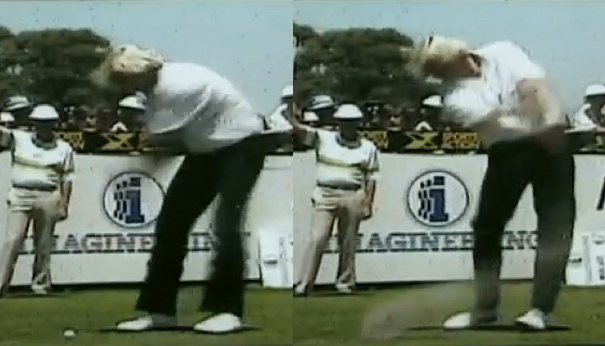
Bom----The big thing I really notice and more importantly felt myself when looking at those 2 pics of The Shark is
Left photo… Who said you had to have your weight on the balls of your feet??..Greg is powering down with the heels supporting his stability- keeping his hips square- NO spin out whatsoever–this all helps or allows the club to stay approaching from the correct inside track to impact
and
Right photo…In fast motion that swing (it is from my youtube video posted a few pages back of Norman)…it really looks like his weight is driving left…BUT…there when viewed in a still shot it looks like there is still a lot of weight (the majority) still pressuring down into the right foot and leg for his torso and shoulders to rotate off
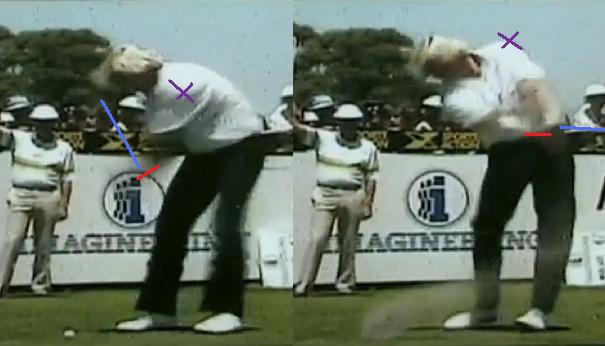
This is not a real good effort by myself using paint to draw lines/dots on those pics …but hopefully you can see what I am getting at…
Red Line- Is the hands…They have travelled maybe 18 inches from left pic to right pic
Blue Line- Is the club…It has travelled a good 5 feet or more from left pic to right pic
Purple Cross- Is the rotation…closed low shoulders to opened shoulders from extraordinary chest rotation
That is tremendous clubhead distance travel…done by hand speed at impact and carried on by phenomenal body speed post impact- excellent stuff
And with all the strong pressuring against the lower body I don’t recall (I may be wrong) any injuries on Greg’s part related to the lower body (back, knees, hips)? Seems almost incredible… or perhaps biomechanically it’s really the way to do it!
Bradley - I’m curious as to yourself? With action similar to GN’s, have you ever dealt with any lower body or back issues?
robbo
I think he had his hip fixed up or scraped a few years ago but that may have been from carrying his wallet full of $$$$ around- non golf related issue!!!
Zero issues…
I will tell you something funny however… in about 2006 as I was starting to get disinterested and winding down a little, I started to get very stiff hamstrings and sore legs towards the end of each round and at night…I didn’t know what it was. I would ache and ache and could hardly sit down for a meal for long and was restless in bed. I had MRI’s and all sorts of stuff done…I finally went and saw a sports therapist in my area about it also who works with golfers and olympic athletes…guess what he told me…
( My module 2 disappearance!!!)
That my legs weren’t strong enough…I totally agreed…I had forgotten to use them in my swing and my muscle tone had deteriorated…another pitfall of the worrying about the big upper muscles to swing with and forgetting the rest of the body and the very important legs for ground pressure and stability
So I did have one issue but it was from getting away from that ferocious Norman action- not from actually doing it 
Bradley You mentioned in the post that he (GN) looks to be still pressuring down on his right foot and leg to rotate off… question did you mean his left foot and leg or did you mean like you said the right foot and leg…please explain ie clarify if possible I am interested in reading your explanation especially if it is the right foor and leg what are the dynanmics and feeling involved. I say that only because many these days want you squash the bug/step on the coke can, as you transition from back leg to front leg—thank you
“it really looks like his weight is driving left…BUT…there when viewed in a still shot it looks like there is still a lot of weight (the majority) still pressuring down into the right foot and leg for his torso and shoulders to rotate off”
Jaym…nope I said it correctly-- the right leg and foot
Most people try say they drive left and squish coke cans and all that stuff…but if you look where his head is, his right shoulder is and his right knee and right hip is and his spine tilt back…they are all situated behind the club’s impact position with the turf… that 100% shows his weight majority is over the right side still…feel isn’t real much of the time…the feel is a drive left… the reality is something entirely different.
This is from the article posted a few pages back about where the weight really is throughout the swing
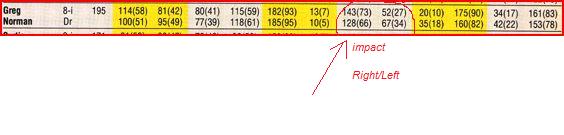
The proof is in the pudding here also…almost 75% of weight on the right with an 8 iron at impact and 66% on the right with a driver
I would say that right around this point in the swing a huge transference from right to left occurs and the left side would heavily outweigh the right from here on in majority weight
Interesting data, I just reviewed it and noticed that more than a handful of guys actually had more weight on their right at the top of the BS with the 8 iron than the driver…clearly counter intuitive since you would think irons to reach a lowpoint in front of the ball you would want less weight not more on the right—go figure
Now I can visualize what you were saying here… I see it interesting dynamics.
Also, fortunate to have met and played with a number of those fellows in the study ie junior golf , college and amateur golf
Module 2 and 3, Baby! Beautiful stuff, beautiful freaking stuff.
Captain Chaos
Thanks for those posts, Two, good stuff. I liked your point about hand speed. In a weird way, fast hands kind of feel slow, in that they’re driving hard through space powered by everything else. Slow hands can actually feel fast because they move a lot in a flippy way, but basically stay put in space. It’s one of the big downfalls of the focus on raw clubhead speed in the modern game.
Another interesting thing from that swing, and I put it into a sequence but it doesn’t really show up, is that left heel shift I reckon a big part of loading square with the hips is that he pressures into the front of the left foot during transition. Watch the clip in frames to see it- it may just be the type of shot he was hitting, but I still think it’s relevant. I know you said it was into the heels, but I think if you get into that left heel too soon, it’s a sort of spin out move. Does that sound like something you would’ve felt at any point. It does get into the heel, but I think that coincides with maximum acceleration, as he he reaches down into the strongest point to leverage out of. So if you get into that left heel too soon, you’re spent because you’ve lost the left hip as a leveraging point. I feel like getting into the left heel too soon, is actually getting to the left side too soon.
Bom,
Here’s a great up close video I made of Norman’s footwork…(courtesy of The ABS Vault)…gives an awesome view…tell me what you think…looks like the weight on the way down on the left foot goes to the outside and toward the heel… as evidenced by the spikes showing on the front part of his under shoe.
It’s a massive footwork action…great stuff. I guarantee he was never the ball striker he once was after they eliminated this foot action from his swing. It gave him so much basis to work the rest of his swing from
I think he does something a little different with his woods, he’s more rotational and less linear- he tends not to shift that left heel forward with his woods, which makes sense. Though at the same time, he does go deeper into his heel during his active rotational acceleration, as can be seen by how more of the inside front of his left shoe is exposed the faster he’s going- so he’s not going straight to his heel from the top, though it’s not as apparent as it is with his irons(perhaps). You can see the overall rotation of the body in the feet, and in this case, the left foot. It’s a predominantly circular journey that starts from the top where the pressure is on the inside front of the left foot. As the club comes down and around the corner, the pressure travels around and through the foot and into the heel, with the inside front of the foot fully unloaded at peak speed(the opposite of the top of the backswing). The heel is the strongest leverage point because it utilizes the leg bones and muscles when properly aligned- this is why it’s so important to still have the left hip in place, and not spin out- it links the left shoulder/arm to the left foot, and if it’s gone there’s no leverage. If you’re doing a big dead lift you’ll use the heels and not the front of the foot- that’s basic leverage. So when he’s going hardest, he’s pushing into and out of the heel. If you get into the heel too early, it’s not as alive. The pressure increases from pulling out of that leverage point in the ground, or accelerating- I was talking about my thoughts on this a bit ago in relation to knee flex and ground pressure. I think the overall point I’m making, and what I see in Norman, and yourself and Hogan etc, is that there’s no rush into the heel, because going there and getting there, is part of acceleration. Do you have any thoughts on that? I really think this is a fascinating area because it speaks to the different roles or each side of the body.
Btw, if anyone needs any help with grammar or sentence structuring, I’m available for tutoring sessions 