Right on, lads. Yeah they aren’t puzzles so much as images that may create pictures which would create actions. It’s a good thing that they’re obvious since that’s the goal. I would say that my jury is still out on the idea of a force centre or that the energy comes from the centre. I’m inclined to think that the middle of something is powerful for what it doesn’t do, as opposed to what it does do. An axle or a foundation work best when they don’t budge, a loose axle produces a wobbly wheel. The whole ‘eye of the storm’ concept. A question that sheds some light, or at least doubt  would be, where does the centre end? Or where does it start, for that matter? Is the real force coming inward or going outward? I’m almost sure that the outward force is a byproduct of the inward force, or a symptom of it, and this fits with the ABS model as far as I can see. So the real force is coming in and not going out, if you know what I mean. I yabbered on about this in a thread one time, I think it was a question about rotation, or something like that. In terms of the wheel, the speed exists because of the chain, and the chain is not at the centre, it relies on the centre. This feels like a groundhog day post, but it’s interesting to me.
 Feels like a groundhog day to me too seeing you hammering away at the keyboard. Which by the way…why is a keyboard set up like it is: all offset and randomized scattering of letters. There must be something to that, but would take too much of my stash to figure that one out.
I think the outward force is really the by-product of the inward as you state applicable to the site. Good question about where a center starts and ends. I suppose it ends only if there is an outside. I think you were on to something like this before when you mentioned whether or not the sides create the middle, or does the middle create the sides. Probably both real important concepts to mess with the mind. Typically, we might think of a middle, or center, as something between 2, or more sides. But a circle has no sides…maybe it’s realted to the big bang theory: one middle only and the rest is expansion. Kind of like a period on a page- it we blow it up through magnification to infinity all we might see are untold number of pixels. But then what makes the pixels. Maybe pixels and God particles are the same. Whoh…way too much for my fragile noggin.
Nice to see you keep your fingers in good shape by typing here. Nice to hear from ya’
Cheers Bom,
Have you read “On Learning Golf” by Percy Boomer? It’s a great book.
Here are a few extracts from the book, where Percy discusses the phrase he coined, “the force centre”:
RR - I’m pretty sure the modern Qwerty keyboard design was invented (back in the days of manual typewriters) as a way to slow down the fastest touch typists, who with the older keyboard layouts were typing so fast that the arms of the keys were clashing against each other in the body of the typewriter. The Qwerty layout was meant to keep the most commonly used keys away from each other to avoid these clashes.
Bom,
You really do bring up a good point about the center, and what is it really, how do we know it is there, and how do we apply it to the golf swing.
In my brief exposure to Martial Arts, the center or chi was discussed right off the bat. To them it is a given, a proven concept of rock solid timeless principal and credibility.
Having given it a bit of thought, my first impression is that it is the center of opposing forces. If we wring a towel in opposite directions, at some point in the middle there is going to be that place that is neither being stressed one way or the other. The point where clockwise meets counter clockwise.
How that point was originally located within the human body thousands of years ago I don’t know. It might have been through a combination of human movement and meditation.
I started becoming extremely aware of this on my own when I switched from being a swinger to a hitter. With two polarized thoughts on how the body should feel in the conventional teaching community, it was clear that as a hitter, I needed a firm structure within the body from head to toe, rather than the relaxed body approach I had been taught up to that point.
I don’t see any reason you should not pre set all these tensions right from address. I call it creating a cohesive body tension.
Greg Norman must be the best example of this. That picture you posted is wonderful. To see Greg strike the ball (particularly back in his prime) is so vivid because you can actually see this stuff with the naked eye. The shoulders rotating counter clockwise and the feet moving clockwise. So this opposing force towel twisting action is creating this connective center right into his chi area in the lower abdominal cavity below the navel and somewhere inside the body as the Martial Arts has described for ages.
To me, these tensions are the tangible lifeblood of the golf swing. Tangible because you can really feel them… identify them and ultimately use them to repeatedly shape a golf ball. This is why I am so adamant about teaching ground pressures early in the ABS instruction to get everyone working toward this kind of awareness.
Most golfers, especially higher handicappers have never felt these things. The sooner the better.
So to really answer the original question, I would say the center is the meeting point of opposing forces that are being applied out at the ends. At transition in the golf swing, the change in direction of the club is started with the lower body, knee flex and so on… creating a downward pressure into the feet. There is then another force being applied into the hands which are feeling the resisting of the weight of the golf club. To tighten the time interval of this entire action, the firmer and more connected the body conduit is, the more efficient and effective this is going to be.
The complications only come from the fact that we shift the plane of the club upward to varying degrees to increase the range of motion to gain power… but this is often done at the expense of connection and ultimately accuracy.
And to me, this is what Hogan figured out that set him apart from the others.
Whoa!..do I like that. 
i remember watching a secret in the dirt video awhile back and the guy (sevam1) was talking about turning the right foot clockwise on the downswing.
I am assuming this is the same principle? if i recall correctly he said that is why hogan liked the extra spike.
it makes all sense just hard for me to execute, i’ve been swinging everything back together, forward together for a long time.
Lots of great thoughts there, Lads, lots to ponder.
I just wanted to post this clip of Langer in 85. Check out the almost perfect clockwise quarter circle he makes with the tip of his right shoe, it’s magic!
You also have to love how he’s hitting his second shot out of the boondocks right of the fairway, yet the commentator still persists with the thinking about ‘Langer’s trademark precision brand of golf’. It’s pretty funny, I reckon. Langer played ‘balls of steel golf’ in my opinion, he is/was awesome.
[youtube]http://www.youtube.com/watch?v=sxLaeIJXeQs[/youtube]
Cheers for that info, St Hubbins, I read that book a good few years ago and really liked it at the time, though I can’t really recall it. I remember I rented it from a library in Tampa, Fla where I was living at the time. It seemed like an odd book to find there so I had to give it a read. The description of the force centre is cool, and different to what I’d originally thought it to be from you first post. By the description you quoted, it sounds more like a centre that’s created by what’s around it, rather than an actual epicenter, so to speak. There was a phrase in that book that I remember liking and playing around with for a while, but I can’t remember what it is. It was to do with free natural motion, or something like that. You probably can’t remember it based on that limited description. How’s that for in informative post 
Cheers…
I think this is a sort of misconception, it has no straight sides, but I think it effectively does have sides- maybe an infinite number of sides? Or at least 360 of them? Or maybe one big round side? It’s telling that the circle goes all ways at the same time while it’s rotating; there’s no one way that it goes, even if the force or intention that you apply to it is in one specific direction. I have an image of one of those halloween spinning sparklers, it’s technically going one way, yet it’s giving off sparks in every direction. Again, the question is, is it going outward or inward? I think if it’s accelerating, it’s going inward. The sparks that are coming off it are in the process of decelerating, this would be the visual CF of the sparkler, if you believe in CF, that is. There may only be CP in reality, which would add to the idea that the real force is inward, while the out force is a result. And if the real force is inward, then it’s technically not coming from the centre, but going towards it. And this would, in a way, imply that the sides create the force, and anchor around the centre? Maybe? Put it this way, if we’re all made of DNA, and DNA is structured with it’s sides, why should we, the manifestation of that DNA, be any different? I’m certain this stuff is pertinent to the actual point of the discussion, ie. playing top class golf.
Good stuff as always Bom…and I think that it is real important to get a full grasp on things like this.
Funny you should write about it today as I was on a Philosophy Forum reading about square circles. It was a good read, but I will have to go over it again to get a better feel for it. One of the major arguments was that there are square circles all around us, but we cannot perceive them. They also got into talking about Escher, which if I remember correctly, you like some of the stuff he does. They also talked about coordinate points of a square about a sphere (earth).
Interesting stuff. If you have insomnia, or need a need to drink  …here’s a link
http://forums.philosophyforums.com/threads/square-circles-10510.html
This circle talk, and the image of Norman, CF/CF, and the spirals always brings this to my mind: That as the skater pulls in her arms, she automatically spins faster.
So for the golfer, not only does that initial vertical move down with the hands and butt of the club prevent OTT, but also as the golfer can get his hands close to his body by straightening his right elbow, he can turn his pivot faster with the same effort…because he has moved more mass near the center of rotation. So he can get a double bonus with this move(no OTT, and faster rotation) The better he can make the move, the more the benefit. Hogan got plenty.
And for the question as to which direction the force is going…I’d say both…CP and CF mostly balance, except for the golfer may precisely regulate the strength of his inward pull(resisting CP), so the sweet spot can hit the ball…and also whether he uses the hit(more inward) or swing(less inward) technique.
That my guess. My be totally off base.
Great description, I wish I’d seen it. Based on the sound he produces in that Dunhill clip on Two’s YT channel, I can only imagine what it was like. I remember you saying you could actually feel the ground move- I don’t doubt it one bit.
Here’s a Trevino photo I did that speaks a bit to this sort of circle/sides question during drop/fall/downward time. Obviously there’s no depth to the image, but you know…
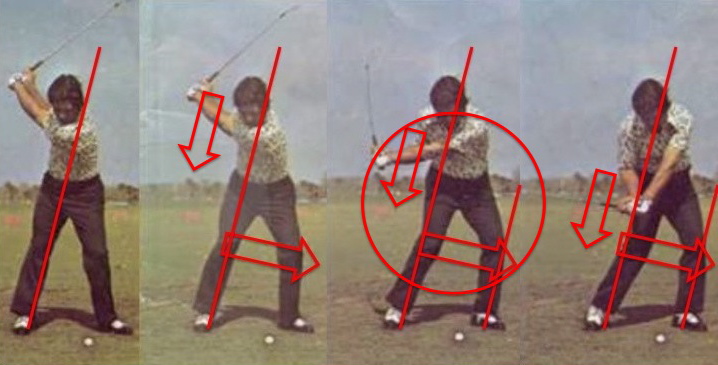
Thanks Bom.
The nearest phrase in the book that I can think of right away is this one:
Ring any bells?
That’s not the one, St. Hubbins, but I like it a lot. I have a similar thought about a ‘loaded imbalance’ in the swing, which is a feel I like. The one I was thinking about was something to do with the clubhead I think- we could be here all day and not get it, so no worries if nothing comes to mind…
Cheers for that…
BOM
There’s a decent chance I’ve posted this before, but I can’t remember. It’s still great though…
[youtube]http://www.youtube.com/watch?v=oX7CcDIkMhE[/youtube]
I made one for fun. Messing around with opposing forces.
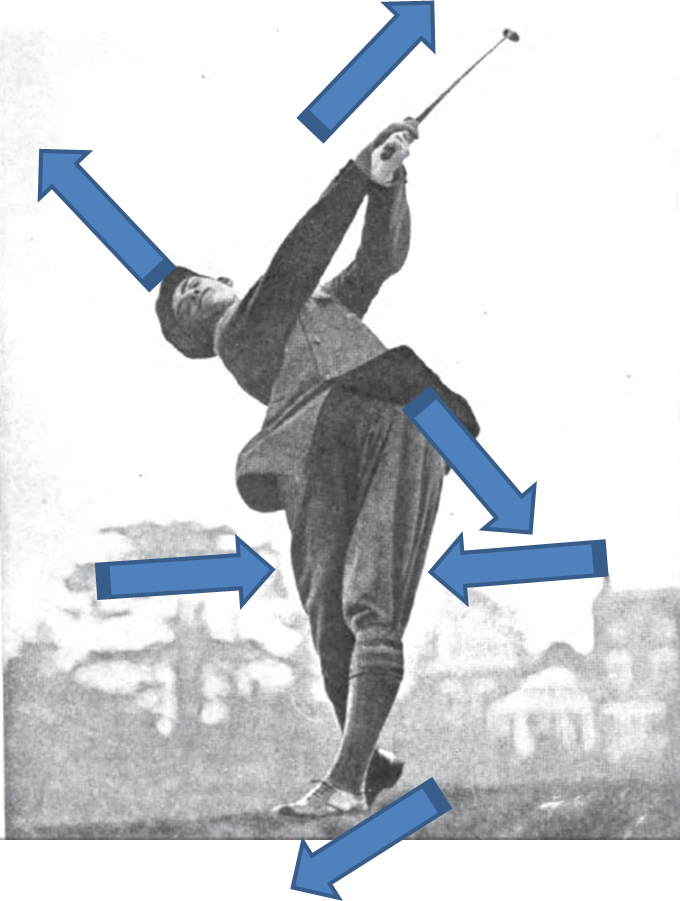
Nice one Lipout. You’re starting to resemble Bom a little with those blue arrows- which is a good thing. Who’s the golfer, do you know?
I think, if I remember correctly, it was common in those days to wear heavy tweed jackets and small arms holes prevented the arms from going all over the place and connected them to the turn better.
Encountered a small world item this morning that is a bit unusal, and never quite noticed it before even though I use the damn thing every day. Will put it up when I can find a good example of it on Youtubeville. 
The golfer is George Duncan. http://en.wikipedia.org/wiki/George_Duncan_%28golfer%29