Hi,
Tend (to often) to have a light push slice with the driver when try coming down on 4:30 with open face. Any ideas what to work on. It might be that I rotate torso a bit early.
Hi,
Tend (to often) to have a light push slice with the driver when try coming down on 4:30 with open face. Any ideas what to work on. It might be that I rotate torso a bit early.
Make sure weight is fully loaded to right side (heel) ala curtis strange.
Possibly lacking some forearm rotation through impact due to the ball being on a tee.
Post impact pivot probably a little late as well, again due to the tee and also a longer club.
I’d focus on forearm rotation mostly.
Where are you in your ABS module training? I only ask because depending on where you are future work is likely to deal with your issues. The push(to me) is a good sign as it shows an inside path to impact. The curve simply means you’re not squaring the clubface. The face issue is as @Sawfeat mentioned likely a forearm rotation issue.
All great suggestions. Push is good sign of 430 line but I can’t see how you can slice from there other than weight not being loaded. Wouldn’t the curve mean path issue??? Forearm rotation will for sure close the club and post impact is never a bad thing…
I only say this because I was at range last night (rare) trying the Hogan around the waist swing. I was hitting exactly what he was describing a bit. I was thinking so much about opening the face and swinging around my waist and tripping that I never got my weight to right side. Once I did that it was a smoke show. It is funny though how when you find something you tend to just suggest that as fix for everything :).
I am at 4 years into this. As Nuke Lalooosh used to say, “Don’t think just pitch”. Drill are great for that. “You’re playing this game with fear and arrogance… You’re having fun, you’re looking like a jerk, but you don’t know what you’re doing. Now, don’t think. Thinking can only hurt the ballclub.”
I am 4 years into this crazy journey. Time flies!
2-3 years in; but a bit back and forward. Now I go all in.
The concept of the ball flight laws were drilled into me very early on. In the order of importance as they were presented to me clubface angle, swing path direction, centeredness of impact, angle of approach and speed/force. I. Relations to swing path direction we always ciphering initial direction to be indicative of swing path direct at impact. Clubface angle in relation to the direction gave us the curvature of the shot. Speaking simply in these terms @Carlmagnus could have his ball position a bit too far back which would mean impact is occurring on the inside to our portion of the motion and his clubface is a tiny bit open to the path. If the ball were too forward and he was orbit pulling out to 730 the resulting shot might be a pull fade. It’s late for me so I hope I got this right. I will progress tomorrow after some sleep.
You’re referencing the old ball flight laws which have been proven to be wrong. It has led to many players making their push slice/pull hook misses worse. The OP could have a leftward path with a clubface both open to the path and target, which would cause the push slice.
Under the old ball flight laws, they would think their path is right of target line which is supposedly causing the push (it’s not) and then make their path actually more left. Which then leads to the face angle being even more open to the path, and now they got the same push but a worse slice.
I assume that means that everything has defaulted to track man and launch monitor data. I only question this because I corrected many golfer using the old ball flight laws when it came to using vintage equipment. Not criticizing just saying.
Please describe in more in detail what you try to explain. I think my ball is quite forward and my OP is strong or a bit early.
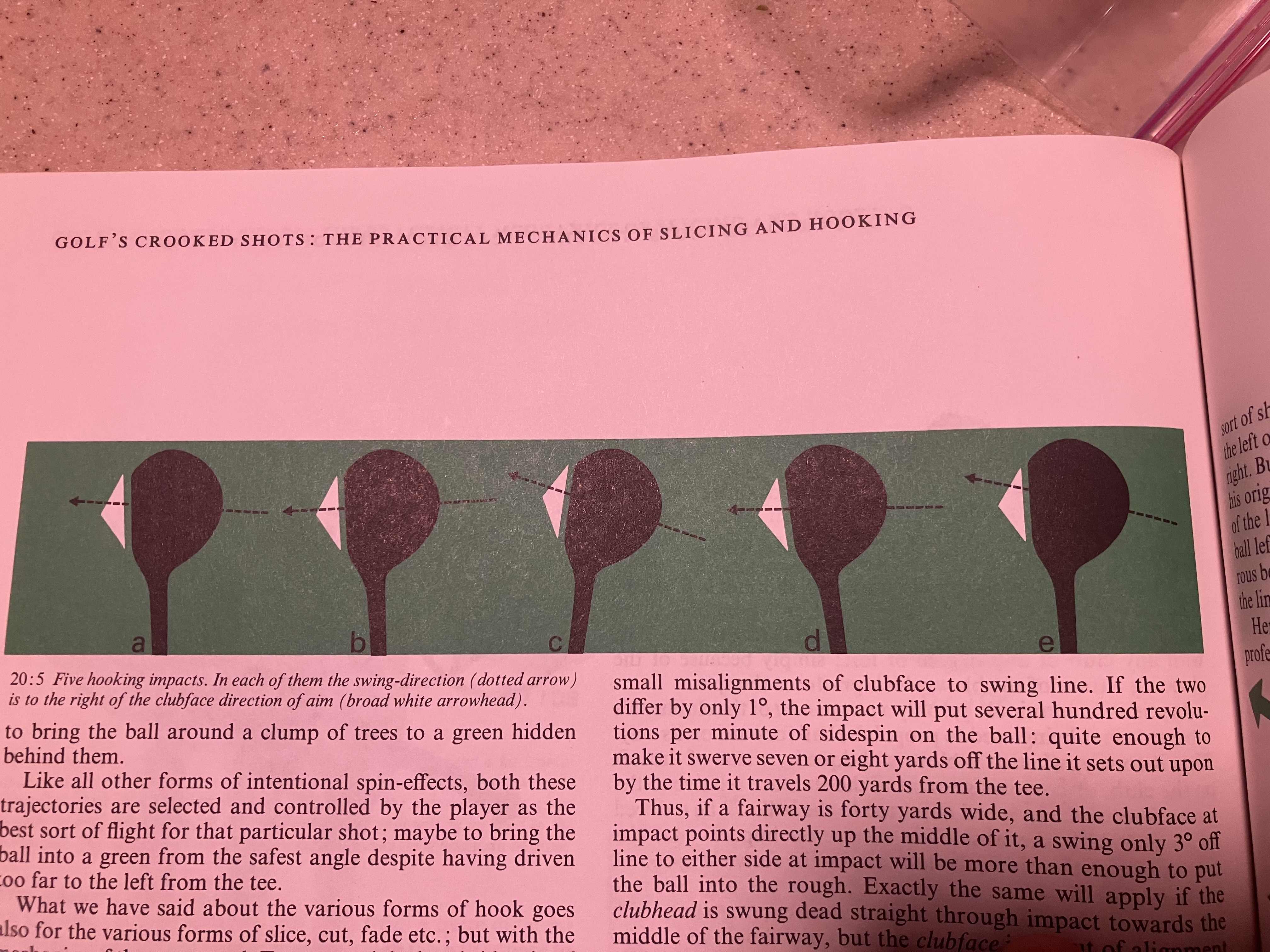
I know your reply was to @Flushballstriker but I’d like to explain what I was talking about. Without actually seeing your swing and using the ball flight laws as I know them a push fade is always a result of some combination of open clubface or in to out swing path. I often refer back to a book calle “The Search for the Perfect Swing” and in it is a diagram that shows 5 hooking impact positions. The same can be held true in reverse.