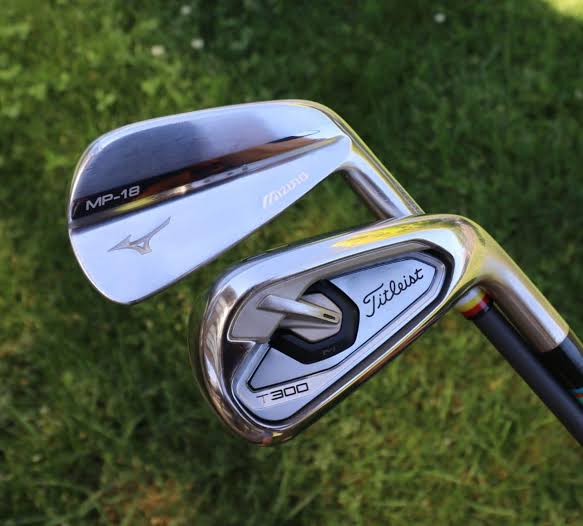
Muscle Backs vs. Cavity Backs: What the Maltby Playability Factor Actually Reveals
I wanted to share something with the ABS community that challenges a long-standing assumption in golf equipment: that cavity-back irons are automatically easier to hit than traditional muscle-back blades.
Most of us have heard it for decades. Blades are supposedly difficult to hit, while cavity backs offer greater forgiveness. But when you examine Ralph Maltby’s Playability Factor (MPF), the engineering tells a more interesting story.
MPF evaluates measurable clubhead properties, including vertical and horizontal center of gravity, moment of inertia, and center-of-gravity location relative to the clubface.
Now consider these published MPF ratings:
Iron
Design
MPF
Mizuno MP-33
Muscle Back
419
Titleist 716 AP2
Cavity Back
417
Mizuno MP-20
Muscle Back
359
Callaway Apex TCB
Cavity Back
355
Wilson C300 Forged
Cavity Back
269
Look closely at those numbers.
The Mizuno MP-33, a traditional muscle-back blade, actually rates slightly higher than the Titleist 716 AP2 cavity back.
The Mizuno MP-20 blade rates higher than the Callaway Apex TCB cavity back and considerably higher than the Wilson C300 Forged.
So much for the idea that a cavity automatically makes an iron more playable.
But here’s where I think this discussion becomes particularly relevant to John’s Advanced Ball Striking philosophy.
In ABS, we’re concerned with developing a functional golf swing that delivers the club with proper geometry, leverage, shaft loading, face control, and a repeatable strike through impact.
We also recognize that the relationship between the golfer’s delivery and the clubhead’s physical characteristics matters.
A cavity-back design doesn’t automatically place the center of gravity in a more favorable location. Nor does it guarantee a higher moment of inertia or a more playable head according to Maltby’s measurements.
And a traditional muscle back doesn’t automatically mean poor playability.
There’s another distinction worth discussing.
MPF is a measurement-based classification of clubhead design. It isn’t a direct measurement of how well a particular golfer will strike an iron, nor does it tell us everything about turf interaction, sole geometry, impact feedback, or how a club responds to a particular delivery pattern.
Those are important considerations, especially for golfers working through the ABS protocols.
From my perspective, after more than 30 years on the lesson tee, I’ve become increasingly convinced that we need to separate three things:
- The engineering of the clubhead. Where is the mass located, and what are the actual design characteristics?
- The golfer’s impact dynamics. How is the player delivering the club, controlling the face, managing shaft lean, and interacting with the ground?
- The player’s actual performance. What happens to strike quality, dispersion, trajectory, distance control, and consistency when we put the club in their hands?
A higher MPF rating doesn’t automatically make one iron the better choice for every golfer. But the numbers certainly challenge the assumption that a cavity-back construction guarantees greater playability.
I think this also raises an interesting question about how much modern equipment marketing has shaped golfers’ perceptions of blades.
Perhaps we’ve spent too much time telling golfers what they should be able to hit based on the appearance of the clubhead, rather than examining the engineering and the quality of their impact.
I’d be interested in hearing from John and the other ABS members on this.
Have you found that certain traditional muscle-back designs actually perform better for golfers who have developed stronger impact alignments and more consistent ball-striking mechanics?
And how much importance do you place on center-of-gravity location versus the overall mass distribution and feel of the clubhead?
I think there’s a worthwhile technical discussion here.
Michael Cunningham
Advanced Ball Striking Coach
Atlanta Golf & Fitness Club
Reference: Ralph Maltby Playability Factor — The GolfWorks