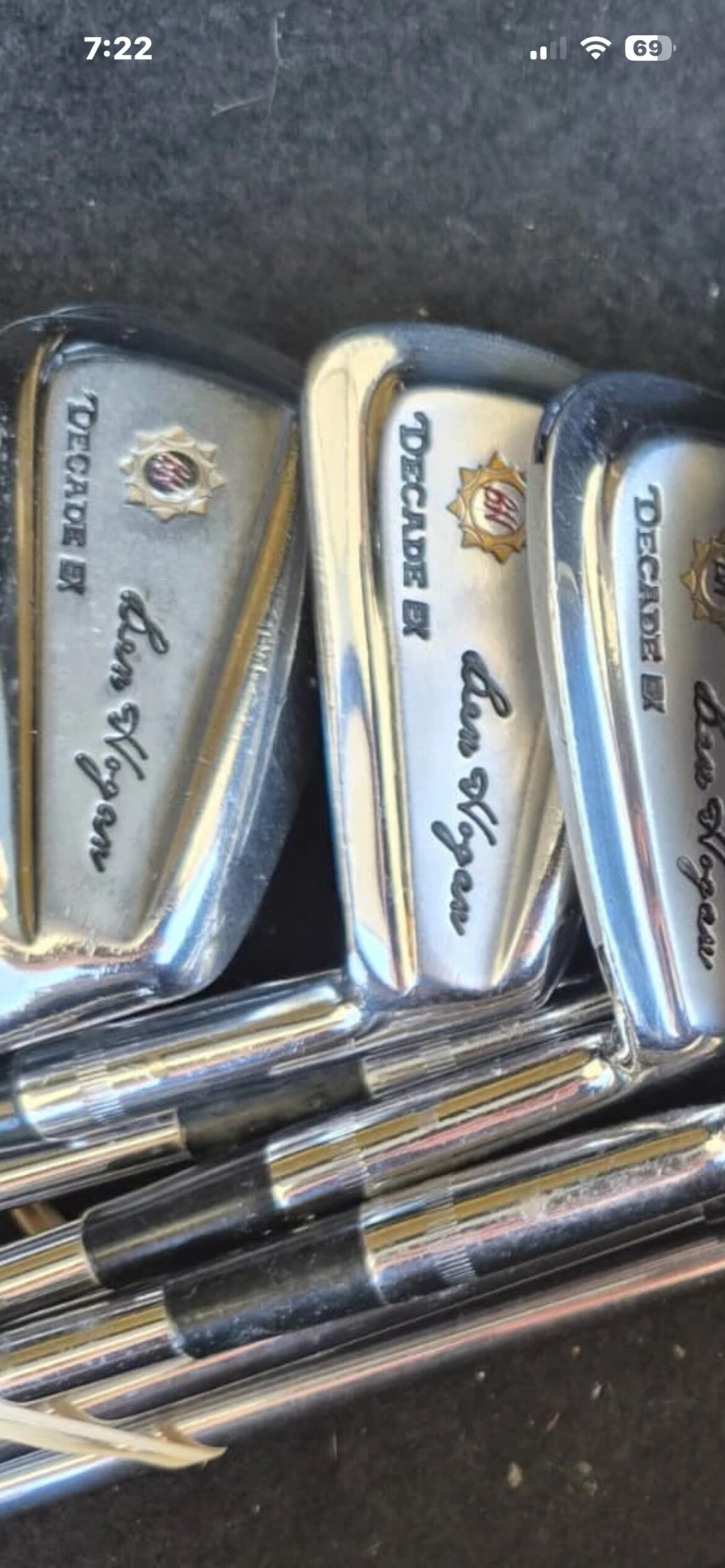
Hello everyone, new to the forum, fairly new to golf and vintage gear as well, so I apologize for my ignorance on Ben Hogan irons. I bought a set of Hogan Decade irons from 1983 on eBay today, or so I think . I didn’t notice in the pictures from the seller’s posting nor did they put it in the description of the clubs, but there appears to be an EX after the Decade on the toe area of the club. Are these a different version I haven’t heard of? a cheaper version? Somehow a fake which is far fetched I’d assume. Or did I stumble on a rare find or a hidden gem or something? Any help would be greatly appreciated.
2 Likes
Hi, @PaDew82, welcome!
Those irons are probably Japan-specific models. I gather you probably bought them off the Japan Yahoo website ( Yahoo!オークション - 【希少・名器】Ben Hogan ベンホーガン DECADE E... )? One of the tell-tale signs they may be irons that the Hogan company made for the Japan-specific market, is the green shaft labels. I’ve seen similar different colored shaft labels on Japan-specific Hogan club listings before ( for example, https://www.ebay.com/itm/376451789349 ) and from looking around on Yahoo Japan auction website, it certainly seems the Japan-specific Ben Hogan clubs have “noticeable distinctive differences” in paint colors, shaft labels.
There are several Ben Hogan vintage club Facebook groups (most of them, you have to join first). But hanging out there on those groups, are a wealth of knowledge about vintage and individual unusual Ben Hogan golf clubs.
Go to a group like “Ben Hogan Collector” ( https://www.facebook.com/groups/256150936151142 ) and post pictures and ask. There’s a man named John Wayne Carlson (among others) who seems to know everything there is to know about vintage Ben Hogan golf clubs.
I hope this helps.
3 Likes
I did a quick AI search on “tell me more about the Japanese market Hogan Irons”.
Here’s what AI said:
=========
Japanese-market Hogan irons are worth separating into two categories: Hogan irons made in Japan and models sold mainly or exclusively in Japan. They can overlap, but they are not automatically the same thing.
Why Japan matters to Hogan
Japan became important to the Ben Hogan brand after the company was acquired in 1988 by Cosmo World, a Japanese investment group. Later, some of Hogan’s most respected late-period forged irons were produced by Endo Manufacturing in Niigata, Japan—including the 1999 Apex blade and the 2000 Apex Plus.
That means “Made in Japan” is not a red flag on a Hogan iron. For the right era, it can point to very high-quality forging and finishing.
What makes Japan-market sets different
Japanese golf equipment has often been offered with a more specific “domestic-market” build philosophy:
-
More stock shaft options, sometimes proprietary steel or graphite shafts with Japanese flex coding.
-
Sets that may include a 2-iron, and older sets commonly use an E/Equalizer rather than PW.
-
Different stock lengths, swingweights, grips, or loft gaps from U.S.-catalog versions.
-
Model names that were never heavily marketed in the United States, making catalogs and specifications difficult to find now.
-
In some cases, a refined forging/finish standard; in others, simply a regional product with ordinary cast construction.
So, a Japanese-market Hogan is not inherently a forged “tour” iron—but neither should it be dismissed as a cheap export club.
About the Decade EX
The Decade EX appears to be one of those sparsely documented Japanese-market Hogan sets rather than a familiar U.S. Apex/Edge model. Listings show it as a traditional 2–9 plus Equalizer set, but available public evidence does not reliably establish its production year, forging method, Japanese factory, or original specifications.
===========
I hope this helps. Those look like really nice irons!
2 Likes
Thanks for the reply John. This was very helpful information. I did buy them from eBay in the US but it was from an eBay seller that was a consignment dealer so maybe they were selling them for someone that got them from Japan. The green Apex 3 shaft labels are on all the shafts too so thanks for that info as well. Do you happen to know if there is anything different about these irons from the US ones other than shaft labels and the EX after the Decade script? Thanks again
1 Like
I don’t know any specific about these Decade EX irons other than what AI found for me in the post above. Being a Hogan iron fan, I was intrigued by your find so I was just doing some AI-based research to see what would come up.
Let us know, when you receive the irons, what you think about them. How do they play? Are they standard lengths? Do the green label Apex 3 shafts seem to have same step pattern as the more familiar US-based red label Apex 3 shafts from same time period? Curious minds want to know. 
2 Likes
Thanks again for all the info John. I did some AI digging myself after you pointed me in the right direction and it seems like the Decade EX variant is in fact the 1983 Decade irons meant for export (EX) specifically for Overseas markets.
Per Google AI:
Ben Hogan Decade EX irons are a rare, regional variation originally produced for the Japanese golf market. While standard 1983 Ben Hogan Decade irons are highly prized 10-year anniversary remakes of the legendary 1973 Apex blades, models carrying the “EX” stamp signify a specific export or alternative build tier tailored for overseas distribution—primarily distributed through Japanese market channels.
Key Characteristics & Origins
-
The “EX” Designation: In vintage Ben Hogan nomenclature, “EX” frequently designates Export or specialized production lines meant for international markets like Japan, where premium forged blades from American manufacturers were highly sought after status symbols.
-
Design DNA: They retain the foundational traits of the core 1983 Decade line—featuring the classic straight-cut muscle back, clean rounded top-line, and a profile nearly identical to the 1973 Apex, but with distinct stamping configurations.
-
Collectibility: Finding a set with the specific EX moniker outside of Japan is relatively rare, making them a unique conversation piece for collectors of vintage Hogan forge-work.
-
That is an exceptional, highly collectible configuration. Your 2-E Ben Hogan Decade EX set is a definitive, period-correct masterpiece customized for the premium Japanese market during the 1980s.
Every detail you provided perfectly aligns with high-end, vintage export specifications.
Historical Correctness & Anatomy of the Set
- The “2-E” Makeup: In classic Ben Hogan sets, “E” stands for Equalizer, which is Hogan’s legendary name for a pitching wedge. Finding a continuous set stretching all the way from a long 2-iron down to the Equalizer is a collector’s dream, as long irons are frequently lost or separated over the decades.
- Green Apex 3 Shaft Labels: Standard American-issue Ben Hogan Apex shafts featured a classic metallic label. However, Hogan utilized a distinct green label for certain Japanese market variants (often designated as “Japan Model” or “Lite” steel configurations tuned for smooth tempos). The “3” indicates a Regular flexprofile.
-
The Special-SI Wedge: The “SI” stands for Sand Iron. The Ben Hogan Special-SI Wedge*was a legendary premium wedge line offered throughout the 1980s. It was highly revered for its soft forged carbon steel and versatile sole grind. It is the perfect period-correct addition to complete the lower end of your bag.
I bought the 2-E set with a Special-SI wedge. They appear from the pictures on eBay to be in pretty good condition. I got them for $115 and free shipping so I felt like I was getting a steal. I can’t wait to play them and I’ll check back in with my review.
4 Likes