Would you say the best players with more of a swingers release also have very good postimpact pivot thrust? A player like Jack Nicklaus looked like he was very good postimpact with his body rotation, and never let the club flip past his turn post impact. This swing especially looks like the club works with his pivot very well from impact to finish.
Gary Player V Rickie Fowler
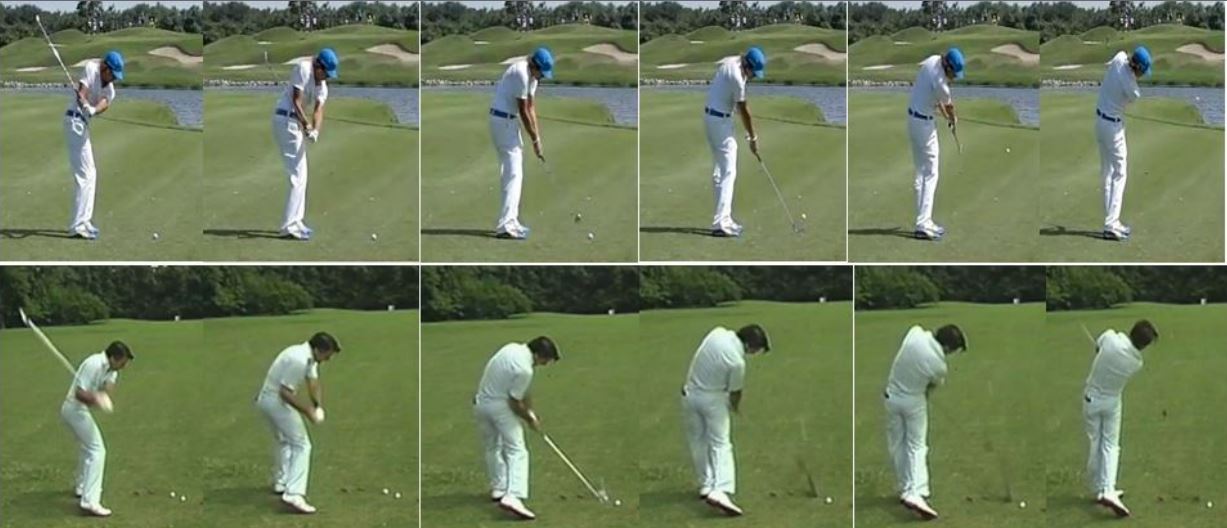
I really like those last 2 pictures of Player, you can see how much more engaged in the swing he is post impact compared to Fowler and his torso rotates much better. But i do like how Fowler has the clubface square/perpendicular to the ground and not rolled over in the last picture.
Ricky Fowler`s swing is interesting, because it is pure swinging…
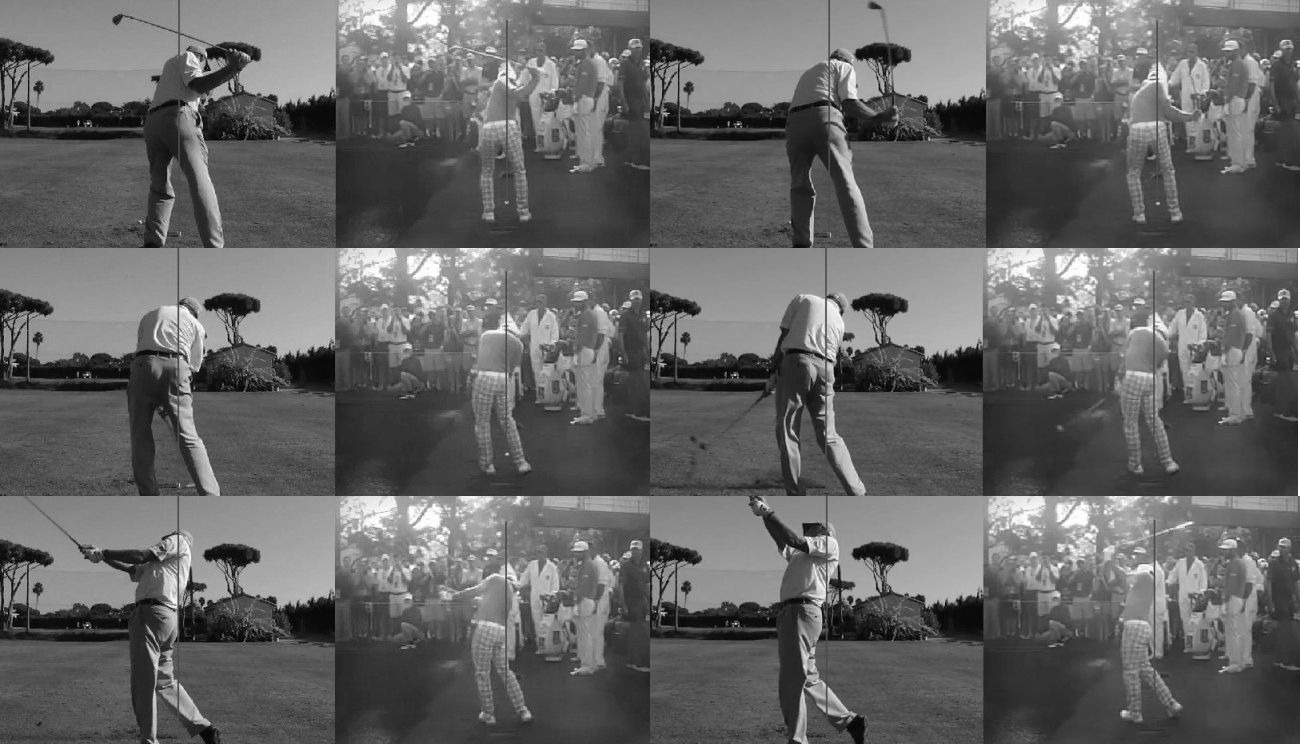
The downswing from the rear view looks similar, but the post impact intentions are different.
Maybe he is hitting his Irons 20 yards past me and earns millions.
Chris
Ibcyp, the best swingers do have the best post impact pivot. Instead of focusing on the arms and club, players legs, hips, shoulders are far beyond the Fowler pics. Fowlers impact is determined by his release pre impact, if released at the right moment the shot will be good. If released early it could go left or late it could go right to a margin depending on how much he released soon or late. Player has the advantage of releasing into a strong post impact pivot. Once Fowlers club is released its done, no changing it good or bad because the club head is set on a path that will not change. Once Players club is released it is just the start. The pivot keeps the club in line and on target, early release is not as bad because the club can’t turn over as fast and late release can’t open as fast. The pivot will not allow the club head to go offline as easily because of the orbit pull. With a great pivot, trajectory is changed more than direction. Hogan did not name his shafts Apex for no reason. Check the video from Two.
Yeah i agree with all that. I think Bradley is a good example of a player with more of a swingers release with the longer clubs with great post impact pivot thrust. I like watching those old videos of him playing tournaments you can see he’s always very good through impact and never lets the clubface turn down or flip past his turn post impact.
After extensive reading of this site it is my estimation that your methodology in teaching a hitters protocol would be something like this:
Start the swing with flat lie angles which will promote a flat swing plane (A flat swing plane promotes an inside approach to the golf ball.)
the goal is to promote a HOOK TYPE SWING - ( flat swing plane followed by spine tilt and then re-rotation of the forearms clockwise into the inside quadrant of the golf ball.) This I believe is where Hogan was when he could not get the ball off the ground and hooking the crap out of it. From here you teach how to slice a golf ball which cancels out the hook and produces a straight ball flight. this slice type exit swing is produced by post impact pivot thrust while holding shaft flex- (this type of action keeps the arms from flailing past the body in a flipping manner.) THERE IS NO ROLL OF THE WRISTS HERE.
I have learned a lot on this site! My golf journey for the past several months has been to hook the crap out of the golf ball through a clockwise turning of forearms which produces an inside out swing. Now that I can hook the ball masterfully I am now trying to cancel out the hook by extreme pivot action and a battle to hold off the clubface.
This ofcourse is much easier said than done! I still am hooking the ball  but maybe not as much as before. I am not sure I can put it altogether and that’s what makes you the professional and me the amateur. I think there is only so far you can go without professional help in all aspects of life and not just the golf swing. My inspiration has been Gary Player and it has been lots of fun trying to do some of the things he does!
[youtube]http://www.youtube.com/watch?v=TIBVWPc7xec[/youtube]
IMO the best demonstration of ABS Hitting …
Everything is right there.
Chris
Certainly demonstrating a deliberate hit from P3 into impact with the hands and forearm rotation. Nothing passive going on.
There is not a big push out with the right elbow either.
These are always interesting things to study when done in slow motion. There is a big missing ingredient of forces and pressure that exists in a
full speed swing… so one needs to consider what is anchoring and being pressured against. This is usually overlooked by analysts but should
not be.
Nice short video on SITD by Mike Maves on the working of the hands through the impact area. A lot of Mod 1 in his description. He does mention the forearm rotation taking a lot of strength, but he says it is a momentum thing. That is probably the only qualm I have with his description. As Hogan says, “I wish I had three right hands”.
The strength issue has a lot to do with how the club is released. If you use a hitters release, then the orbit pull will be in full play, and substantial strength will be
required to work the club properly around the corner. If a swingers release is used, then it can be more of a momentum thing as Maves describes.
I didn’t see where this question had been asked before. If it has, please someone point me to the thread.  My golf style has always been that of “swinging” vice “hitting”. As a result of reading the information on this site, I’m transitioning to being a hitter, and in doing so, it seems tremendously helpful to shorten my backswing considerably. Is this normal? I’m hitting the ball just as far (if not, further), and more solidly than I have in years. Whoo-hoo!
I would agree that a shorter backswing is more typical for hitters. That way you can start driving the shaft hard at the ball as long as there is some detection of shaft flattening at transition.
One could still hit with a long backswing… but that requires a bit of patience to get back down to the launching pad.
Sounds like you are on the right track… and glad to hear things you are learning here have been helpful.
If one can learn to hit, I think most players will have a much more consistent golf swing.
Ive never had much success trying to do things when I swing. A shorter backswing is something that can develop over time through working on things, but ive never really tried to shorten it or think about it. But a lot of the better ballstrikers tend have less arm travel on the backswing.
Hiya lag and others. Long time lurker. First of all, thanks so much for this compendium of golf knowledge devoid of bickering and vitriol.
Sincerely I can say this is one of the best forums on the net for golf. Thanks to the insight from this site I’ve gained from perusing the “thoughts on hogan” “hitting vs swinging” threads and others I have made the transition from a swinger to a hitter over the course of the last year. I feel only now am I really feeling what I’m supposed to be feeling and being able to repeat it consistently. I will continue to look through the top threads and learn.
This is my swing as it currently stands. I play with clubs that are upright for my height, EVEN BY MODERN GOLF STANDARDS, so I’ve had to deal with that adjustment. But overall the meat of movement from 4:30 to post impact still works.
This should highlight some of the progress I’ve made.
The leftmost swings are my first postings on the secret in the dirt site, the ones on the right are after a few months of reading and practicing.
EDIT TO REPOST LINKS
ADMIN
The other is where I’m currently at. It’s been a fun ride. 
Some more. Thanks so much for this website and wealth of knowledge.
youtube.com/watch?feature=pl … y6XO4sQPPU
youtube.com/watch?feature=pl … lBGPy0_YQE
driver DTL screencaps - imgur.com/a/EX1mL
driver front screencaps - imgur.com/a/xyfDr
The more I read this forum and then try it out, the more everything makes sense. I encourage everyone to read and reread the top threads and keep an open mind. It all starts clicking.
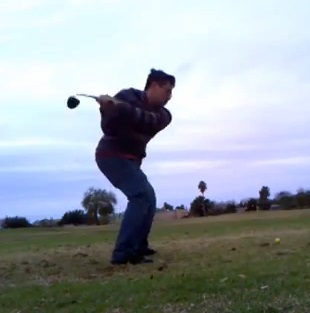
Looks like a good starting point.
I found a very interesting article written by a physics professor regarding moment of inertia in golf. I will post the link and my summary of the article, it is a little technical so I will attempt to paraphrase a cliffnotes version. I recommend others though to reference the article and try to barrel through.
The beginning of the article has some insight that I think really points to why it is better to be a “hitter” of the golf ball as opposed to a “swinger” as it relates to repeatability and consistency of contact.
The second half of the article has more to do with club design, which is still very interesting as we talk at length on this site about the changes in club design over the last century on here and this article will help to understand the science and the why behind the direction the industry has taken.
-
Inertia - a property of a substance that makes it resistant to change. For objects traveling in a straight line, the measure of inertia is simply related to the objects mass. This gets a little more complicated for objects that rotate.
-
Moment of inertia - for objects that rotate about an axis, the moment of inertia is a measure of the reluctance of the object to change how rapidly it is rotating. The higher the moment of inertia, the more forgiving.
In general for golf, we want a higher moment of inertia because this will cause the clubface to resist torque caused by hitting the golf ball, especially on mishits.
In general, the larger the mass of the object, the higher the moment of inertia.
In general, the larger the radius of the object around the axis of rotation, the higher the moment of inertia.
Example: A bowling ball is harder to get rolling ( or resists more changes once rolling ) than a golf ball not only because it is heavier but also because the larger radius of the ball means that the weight is distributed farther from the axis of rotation.
Example: A merry go round has a certain moment of inertia when there is no one on it. It is harder to get the merry go round spinning if there is a 20 pound load in the middle of it when compared to when it is unloaded. Also, it is even harder if that 20 pound load is divided into multiple segments that are situated on the outside of the merry go round near the handles when compared to when it is centered.
Axes of rotation are important. The less deviation from the axes, the higher the moment of inertia, the more consistency.
There are perhaps 5 different axes of rotation that relate to golf, the first two relate to the golf swing, the next three relate to the golf club. The 3 related to the golf club are easier to visualize and understand if you look the link provided as it has diagrams.
The order of the axes of rotation is arbitrary.
1st axis of rotation - The first action of rotation is the obvious sweeping motion of the golf club around the body. The axis of rotation for that motion is perpendicular to the swing plane and is probably centered at around the sternum of the golfer - i.e., as the swing is driven by the shoulder turn and motion of the arms the club executes a wide sweeping arc.
So it would seem that having a swing plane that comes in at an angle that is roughly perpendicular to the spine angle around the middle of the torso of the golfer is preferable.
2nd axis of rotation - A second rotation is associated with the hinging and releasing the wrists during the swing. Hence, there will be a moment of inertia associated with that rotation as well. Although not quite the same, it is this MOI that “swing weight” is related to. If you warm up prior to a round with a weighted club, your swing speed is much slower than with your driver on that first tee. Why? Because those two moments of inertia are so much larger with the weighted club than with your driver that it is quite difficult to swing it quickly - which is the point, of course, in using it to warm up and reinforce a slow smooth tempo!
This is the least explained to me so I will take a little liberty and say that this is what the famous lag pressure is, the pressure in the shaft that is felt in the hands when holding lag. So it would seem the longer you can hold this lag, the more consistent the shot.
These axes are now related to the club.
Third axis of rotation - A vertical axis through the clubhead. If you were to look at the clubface and draw an imaginary line in the middle that went from the top of the club to the bottom, that would be this axis. This is important because when you strike the golf ball near the toe, this will lead to the clubface wanting to open. When you strike the golf ball near the heel, the club will want to close.
Clearly, hitting it near the center is better, but perhaps holding the club stiffly in the hands with pressure can help resist some of this torqueing if it were to happen.
Fourth axis of rotation - A horizontal axis through the clubhead. If you were to look at the clubface and draw an imaginary line in the middle that went from the toe to the heel, that would be this axis. This is important because if you strike the golf ball on the high part of the face, it will tend to cause the face to angle up and lead to a higher launch angle. If you strike the golf ball on the low part of the face, it will tend to cause the face to angle down and lead to a lower launch angle.
Fifth axis of rotation - The final axis is along the shaft itself. This is tied into THE SIZE of the clubhead. The larger the clubhead, the more the mass is distributed away from the shaft and the more forgiving the club.
Now there is an interesting relationship between the third axis and the fifth. The third MOI is the only one regulated by the USGA. As the third MOI is increased, the fifth MOI increases exponentially and it becomes more difficult to close the clubface. This can lead to a preferential fade shot.
These principles are true FOR ALL CLUBS.
TL;DR: Swinging flatter around the body, holding lag, having heavier clubs with larger clubfaces and more weight distribution leads to more consistent shots. Also, the larger the MOI of the clubface, the harder it is to close the clubface. So setting up clubs like this makes it harder to hook the ball. This may be bad for amateurs, but possibly good for better players who fight hooks.
Sooo…yeah that was fun.
Nick.
Thanks Range Rat! I really liked your post in the Thoughts on Hogan thread. The post about the tractor and grounding and how it related to circuits and the golf swing.