BOMbastic? I like it, man… nice to be doing a little posting again.
Cheers…
1T, here’s another one of those circular images. I’ve tried to depict some depth or perspective to the motion but I’m not sure if it gets across in 2D…
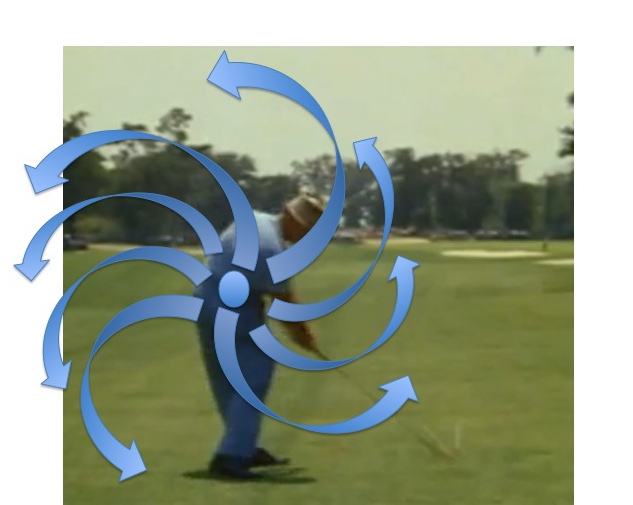
I am trying to interpret it with respect to my current conception of the overall flow of feel of the downswing, impact, and post impact including the finish. I am not an excellent golfer by any measure, merely an awkward student. So my perception and conception is a dodgy “work in progress”. I would like to read more about your ideas giving rise to your image.
loving your ‘fall&fire’ series of images Bom (on my desktop now) & Lag’s endorsement of it.
I wonder is anyone using audio keys to go with the images ?
i remember a British boxer (probably back in the 70’s) who used to box to an audible rhythmn (i think they stopped him doing it eventually).
Is it likely that there may be a place for (silent) audio keys in the golf swing even though the brain deals in pictures ? Are there are instances of top players talking about audio cues that anyone knows of ?
Sam Snead said he used “The Blue Danube” waltz for his rhythm cue.
Maybe I was 20 years ahead of my time, but I had a “mentalist” I worked with who would give me audio tapes (yes magnetic cassettes put into a walkman in the days before ipods) and it was filled with breathing exercises to use on the golf course while playing. Mostly breathing in through the nose and out through the mouth at varying tempos while pacing steps. For example, inhale for 5 steps and exhale for 5 steps. Then it would change to 5 and 6, then 6 and 6 then 6 and 3, 6 and 4 and so on. It would actually change both my heart rate and blood pressure. Then it became integrated with mental imagery. It was somewhat complex, but it worked. Certainly good for swingers who need to control their internals due to the difficulty of heavily timed releases.  However, once you master hitting… the mental side of things gets a lot easier because the golf swing is so much simpler. From tee to green, I think you can win on just technique. Of course you always have to make putts, and regardless of technique, putting will always be a bit more esoteric by it’s nature.
interesting 1tee thanks
i have the beat
1 2 3 4 5
67
89
1 2 3 4 5
67
89
i wonder where he was for each number
Tim,
I am fairly sure I know what measure or measures your numbers refer to but I have no way of communicating it to confirm without having video of Sam’s demonstration. I have looked to see if I could find, with no success so far, video of the interview of Sam where he demonstrated the part of the Blue Danube he meant. I think it was a CBS interview during the Masters some years ago. If anybody has a link to it, don’t hesitate to chime in with a link to it.
OK, Tim,
Beginning on the 11th or 12th second in the following YouTube clip is the Blue Danube rhythm in a TV ad many of us remember before ABS was born.
http://www.youtube.com/watch?v=OnDiy8I_rPo&feature=player_embedded
Here’s a link to a study published in the “Journal of Sports Science” that may address some of your thoughts Tim:
“Improved Motor-Timing: Effects of Synchronized Metronome Training on Golf Shot Accuracy,” by Marius Sommer and Louise Rönnqvist,
Department of Psychology, Umeå University, Umeå, Sweden
Regarding the previous post about “Improved Motor-Timing: Effects of Synchronized Metronome Training on Golf Shot Accuracy,” at http://www.jssm.org/vol8/n4/22/v8n4-22pdf.pdf…
Here are Key Points about the Study and Info about the Researchers: Marius SOMMER and Louise RÖNNQVIST
Key points
• This study investigates the effect of synchronized
metronome training (SMT) on motor timing and
how this training might affect golf shot accuracy.
• A randomized control group design was used.
• The 4 week SMT intervention showed significant
improvements in motor timing, golf shot accuracy,
and lead to less variability.
• We conclude that this study’s results provide further
evidence that motor timing can be improved by
SMT training and that such timing improvement
also improves golf accuracy.
The authors’ research areas of interest:
Marius SOMMER
Employment
PhD student, Department of Psychology,
Umeå University, Sweden
Degree
Bachelor Sc.
Research interests
Effects of task specific vs. non-task
specific training methods in sports.
Laterality, timing and co-ordination,
training and transfer, kinematics.
Louise RÖNNQVIST
Employment
Professor, Department of Psychology,
Umeå University, Sweden
Degrees
PhD Psychology
Research interests
Sensory-motor development and deviation,
laterality, brain plasticity, training
and transfer, kinematics.
I think that’s something that would be more relevant to a CF swinger, but relevant to hitters as well to a certain extent. As a very musically inclined person, I seemingly always have music “playing in my head” during a round of golf, and when I can lock into that tempo it seems to help. I think for me it is more a way to keep my mind occupied in between shots.
The tempo of my swing changes from shot to shot… not because I change speeds but because I change the length of the backswing. Short means more aggressive… not easier. I actually feel more intensity through a chip shot than a full swing.
Metronome training might be useful to work on a particular shot… but not so sure it would be beneficial working throughout the entire bag and the array of shots one would be required to strike properly on a golf course.
The finding of the SMT study is another step on the long path gathering objective evidence about ways to assist our minds to grow into enhanced physical and mental performance, perhaps beyond golf. The study seems to underscore the significance of Tim’s interesting questions and feels like it is in a similar line to Sam Snead’s advice. I look forward to future controlled studies that explore the impact of synchronized metronome training on accuracy in the other types of golf shots and on swinging and hitting styles of both expert and handicap players. That should take nothing away from the pure and simple fun of grabbing a club and banging a ball around the course or pounding out ABS drills on the impact bag to build skill toward potential mastery. If anything, there seems to be potential in SMT for possibly augmenting playing and drilling and perhaps without deal breaking drawbacks.
I certainly do my bag work very rhythmically.
I remember talking to multiple PGA Tour winner Bill Glasson and he said he would listen to heavy metal music  on the way to the golf course which seemed a bit odd if you knew him at all… having gone to Oral Roberts University.
Snead liked a waltz to swing to.
Thanks Lag for addressing the metronome question. I was curious as to what you would think about it but I didn’t expect you to reveal another piece of the puzzle in your response… This said more (2me) than any metronome could have.
In case I haven’t mentioned it lately. Thanks for hosting this great site and for being the absolute best guide anyone could have on this journey.
All true imho.
Have to avoid early morning posts in which lack of caffeine will make one see Trevino and think and speak about O’Meara. Oh well, that’s what happens when still in ones pajamas and not enough coffee in the system.
Didn’t read the entire article Teebox but I have a fairly good understanding of metromones, so I thought I would chime in too. I think what is more important than adhering to a set of clicks is to recognize that travel is equal on both sides of the top for a metromone and equal on both sides of the bottom for a pendulum ( both which measure time ) regardless of tempo or speed. I think the equal travel dimension would be more important to a swinger than it would be for making sure the backswing ends on one of the clicks and the finish ending on another click- if that sort of thing was mentioned somewhere in the article.
I used to arbitrarily assign a number to my process of swinging on a scale of 1 to 10. When swinging well, it always felt to me like it was a “6” on both sides ( 6-6 ). Don’t know why it felt like a 6, but I could ratchet it up and go to a 7-7, or 8-8, but I would be on the border of sacrificing control for accuracy. I used to tell swingers…“whatever it feels like to you, whether it be a 5, 6, 7, or even 8, make sure the back and down and through feel the same. They won’t actually be the same due to the mechanical advantages taking place, but it better feel like they are equally matched”. This usually helped with not rushing things from the top- much like a pendulum is not rushed on either side of the travel…nor is a metromone.
I like Lag’s comments about the variety of shots and the differences…I can sense the drummer in him that’s aware of the different timing and tempos that can overlay each other within a grander stage set upon entirely different timing.
As a swinger, the process reminds me of Foucault’s Pendulum- with an inside path connected with a pendulum motion. I like that image a lot. 
Accuracy improved significantly for the SMT trainees in 4 weeks with a system that excluded hitting balls. The SMT program used a computer that generated rhythmic beats through headphones, and the trainees’ hands and feet tapped on sensors in time with the beat. (It seems to me, the prescribed movement patterns in tapping the sensors did not imitate golf movements and did not need to.) More important than the established improvement in accuracy was the researchers’ intent to accumulate objective data needed to work toward gaining deeper understanding of why the improvement in accuracy occurs without doing golf specific activity.
The great difference between the SMT and ABS protocols is apparent yet both SMT and ABS assert we may gain accuracy without pounding buckets of balls at the practice range. Though these two approaches are different, they are not necessarily in competition for superiority with me. As for priority in practice time and attention, ABS already has that. But what if an athlete could not do the ABS drills due to injury for example? Does SMT suggest there may be, against conventional wisdom, alternative training methods, such as learning to tap out patterns to music or flashing light, to offset some decline or possibly exploit some previously untapped area of capability?
Interesting stuff Teebox. I’ll read the study more thoroughly this time and report back as your commentary triggered some interesting thoughts about it such as:
On top of, or in between the beats?
Now this one is pretty cool. Allow me to explain. For instance, in Zepplin's song The Ocean, the timing goes from 4/4 to 7/8 and back to 4/4 in consecutive measures. When transitioning from 7/8 back to 4/4 it takes some initial work to avoid dropping an extra 1/8th note at the end of the middle bar. It seems natural to want to play an additional eighth note but you have to hold it back and start with the first beat of the next bar. So that transition from one bar to the very next is key, and I wonder if the SMT training could in some way be designed to change timing patterns within the overall flow to address golf's actual transition piece. :question:
By the way. Vintage Oldsmobiles used to have the greatest metromones…a pure click track with a great “ink-a, ink-a” beat with enough spacing to do some foot and hand work while driving. Could never figure out why the salesman would look at me funny while sitting in a car on the showroom floor being overly interested in how the turn signal sounded. 