Musket we need ur scientific data asap. Please help. Thx

Musket we need ur scientific data asap. Please help. Thx
I have no idea what this photo you keep posting… it makes no sense, so to clear things up, I shot this video. Still photos can’t replace moving video footage at high resolution.
Claiming something was doctored up here is absurd. People send me stuff all the time, photos of others, of me etc… and as far as I know, you or Jeff Mann doctored the photo, if it was… I don’t see the point of it or what it is showing or not… it certainly has no place on this forum.
So back to the video I posted.

Clearly this is holding shaft flex through the strike. So clearly this isn’t to your liking because it conflicts with your understanding of the golf swing and you have gone on to say it is not possible even though I am clearly holding the flex of the shaft through and beyond lowpoint.
So, please tell us how this is happening, because it is clearly not handle dragging the grip through …what would be… the impact area.
Maybe handicaps aren’t improving because of swing techniques being marketed using phony science saying things like ‘the physics proves this or that’. Gullible golfers (me included) trusted the opinions of many elite golfers/teachers over the years wasting money on their opinionated ideas. Now we have biomechanical research that provide us with a better perception of what is actually happening (and not from just a ‘feel’ side). The full story will take years and a lot of expense to measure the actual forces and torques applied by/via each hand on the grip.
You said the following:
“The fact that you need machines to do that for you tells me how far gone you are…or stupid, but I honestly don’t want to disrespect you. I was once a number chaser/figure it out guy. I figured it out BY DOING THE WORK AND OBSERVING/CORRECTING. I came back to thank our teachers and help those attempting to take on this program.”
So you call me stupid but don’t want to disrepect me ! Lol! I don’t use any machines to try and dictate what I must do in the golf swing to affect shaft flex, only ABS seems to use that idea (which is proven to be an inaccurate claim).
Personally, I use external focus cues in my golf swing and that seems to work well with a general perception of ‘what not do’ from the biomechanics I’ve learned. The latter ‘external focus cue’ technique is also science driven to improve/retain your ‘Motor Learning Skills’. My long game is generally good and I don’t need to practice. But my short game is terrible, mainly because of distance control and that can only get better with many hours of practice (where I do not have the time).
I’ve no doubt JE is a great player but his claims about shaft flex retention and improved dispersion for off-centre strikes is flawed.
I have no objections to your opinions on what the greats used to do or your distrust in modern equipment (each to their own). So do you think old school techniques were superior because they used something similar to ABS or could they also be categorised as swingers too? JE posted an image of Greg Norman implying he was creating shaft flex at/through impact, but I showed you graphs that says his shaft was in lead/forward flex at impact for both Driver/5-Iron. How about Arnold Palmer, did he use a superior old school technique? Was he a superior swinger or hitter retaining shaft flex through impact?
JE posted his swing in slow motion using an abbreviated backswing - like a punch shot . If he performed a swing at his normal speed from a full backswing position it would show lead/forward flex by impact. He’s not inviting people into his house for free lessons , isn’t it $500 for a 3 hour session?
“he’s not hiding anything”
Then why does he continue to delete my posts showing the ‘edited’ images to prove his shaft flex through impact claim?
I don’t care about him being anti post-modern equipment , etc - that’s his own personal opinion and doesn’t interest me in the slightest.
“It’s funny, I originally wanted to get on GEARS for a totally different reason…now I see it’s the typical witch hunt. I wanted to help you guys understand, get the word out”
That’s your decision and I’m sure there are other ABS students who might wish to test JE’s claims on GEARS if they want to discover the reality of what is happening to the shaft flex at/through impact.
So why are you deleting my posts? I’ve got the screen prints showing they were there before you deleted them. Shall I post them again?
Say what? 
 The real golfing world would probably disagree, sorry. Scientifically its not on a score card tho right?
I have showed video at high speed of holding shaft flex through the hitting area without a ball. It’s a false claim of yours to say this isn’t happening, which makes you suspect of having ill intention.
Discussion here are fine, but to refute obvious evidence that is posted, clearly the point is to show that is is not impossible to hold shaft flex through the strike. I have done this repeatably.
Same for off centered strikes. The clubface does not torque nearly as much with a hitting protocol. My cameras are high speed and show this clearly. Just as valid as someone else’s high speed camera.
Dubious, I’m not an ABS student, just a long time poster on here and decent player.
Does ‘clubhead lead’ mean that the shaft has kicked forward at the bottom? And when it says ‘at impact’, what specifically does that mean?
I’m trying to follow this discussion, but even though there’s a lot of data flying around, it all seems quite unspecific to me. Is this clubhead lead just prior to impact, like the head has already kicked before it hits the ball? Granted, we’re talking milliseconds, but I’m trying to be specific.
Here is what is happening (far right image) in virtually all full swings with a driver and down to 5-irons. The shaft is rotating so fast that the hands/wrists cannot physically keep up (ie. mainly lead wrist joint friction inability to uncock quickly). So the club ends up dragging on the hands so that they end up applying a passive torque in the clockwise direction. This all happens just before impact of the clubface with the ball.
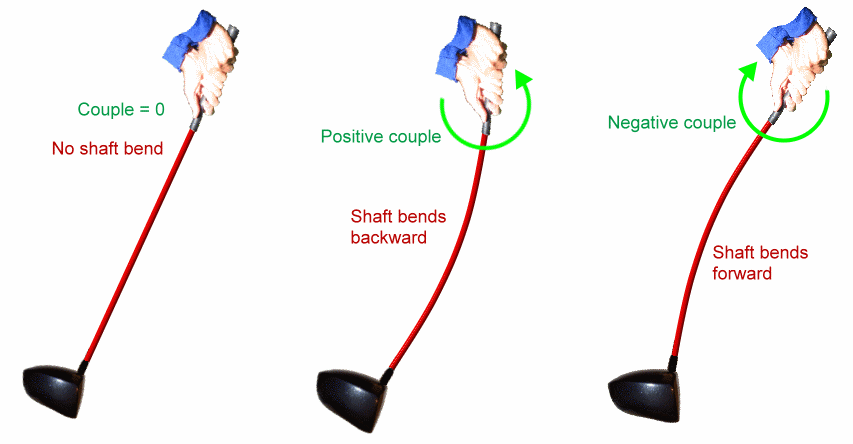
Even without that negative torque, the shaft will still forward flex because the COM of the club will want to align with any net force applied at the grip end . Some biomechanics people call that ‘Centrifugal Loading’ (not a phrase I would personally use) but in reality, there is more forward shaft bend than is expected which is accounted for by that extra passive negative torque applied via the hands.
If you don’t understand the above , here is a slow motion image of what is happening to the shaft just before impact.

You can clearly see the shaft is in forward bend before impact, then its shape changes to an S shape at impact before moving into complete lagging flex after the ball has flown.
JE claims that his technique causes shaft lagging flex before/at/post impact but his evidence is very weak using flawed videos with an abbreviated backswing.
Flawed videos?
There is nothing flawed about the videos I am posting…
I understand you don’t like seeing this because it is counter to your belief system about the golf swing… but to say they are “flawed” is unacceptable here.
Dubious, would you agree that you cannot hold shaft flex through impact, and logically, nor apply more force to the ball in that manner, if the attitude of the clubshaft is like a wave form or an S bend or any other attitude other than appearing to be in backwards deflection?
I am demonstrating something different here… on the BBG Youtube. I am hitting all kinds of shots and swings etc…
There is also the rolling shutter issue on cameras… and this was not my camera… so there could be issues there.
We will discuss the acceleration video here…
Thanks for that, it’s what I was thinking alright - you can see why ‘at impact’ was misleading. That’s not on you btw, more that it’s just not specifically accurate.
I’m not disputing the Norman data, or any of the clarification you posted, more trying to see why someone with Lag’s opinion might be correct, like Johnny Miller, Hogan, etc., that they accelerated through the strike.
My initial reaction/question would be, does the clubhead know when impact will be? I ask that because there must be a reason it kicks forward prior to impact in the swings your data cites.
It’s slightly tongue in cheek to ask that, because I know it can’t ‘know’, but what knows if it doesn’t?
Alpha, beta, and gamma are simply just the 3 dimensions/axes of the golf club. Force is linear and torque causes rotation. You force the club in the alpha, beta, and gamma planes and you torque the club around the alpha, beta, and gamma planes. The planes are fixed on the club, but that means they rotate in space as the club rotates throughout the swing.
Gamma force, for example is longitudinal along the shaft. Gamma torque is around the shaft, like a piece of meat spinning on a spit. At the top of a backswing that goes to parallel gamma force is along the shaft rearward. At left arm parallel in the downswing gamma force is still along the club, but it’s orientation is downward toward the ground. At impact it is along the club, but back in toward the golfer. And the golfer is simultaneously torquing the club around that axis like turning a screwdriver.
But that’s just one. You have alpha and beta forces and torques all also simultaneously occurring. They all blend to make up the swing.
All of the individual force and torque components combine to give you a sum of the forces which is an overall picture of everything working together. But to make a change to the sum you have to change a component.
All of the forces and torques are applied to the club at the grip. That is the force couple and that is where the hand path curvature is measured from. And that spot on the grip is a good distance away from the center of mass of the club. This is why linear force causes angular response. For example, beta force into the club near impact causes a rotational response of the club in the alpha plane. This in turn requires an alpha torque to counteract it.
This is a good as I can do in the written word without images or video to demonstrate the axes.
It’s in forward bend just before impact and then the clubhead decelerates on impact with the ball. Therefore an impact wave moves from the clubhead up the shaft which causes that S shape. That wave reaches the grip end and some of it deflects back down the shaft and results in a lagging flex. By the time lagging flex is reached the ball has flown.
There is nothing you can do during that impact period (ie. 0.5 msec -clubface touching ball) at the grip end that will have enough time enough to influence the clubhead/clubface. The clubhead can be regarded as being a free moving body colliding with the ball, while the shaft may as well be viewed as a piece of string (for that 0.5 msec impact period).
Explain what is flawed here…
We’ve also got a bit of kick velocity in the shaft that further complicates things but that doesn’t account for all the forward shaft bend.
What does account for the forward shaft bend, in your opinion?
I don’t have to as it was covered in depth by Erik Barzeski on ‘The Sandtrap’ forum.
John Erickson (Advanced Ball Striking) in 2022 - Instruction and Playing Tips - The Sand Trap .com
Look for post number #13
@dubious you cannot show a video of a modern graphite shaft, and modern driver. It does not have the mass to support the load. When you turn the jets on with ABS techniques, the shaft buckles.
@BomGolf222 is right anyway…its the swingers anticipation that causes the stall in your references above, dubious.
Modern shafts are designed for an early release and high hands. Low hands with orbit pull literally collapses the shaft onto itself. Ive posted slow motion vids showing the deflection post imact. Grab a persimmon, shoot the vid again. This is why we are trying steel shafts in modern drivers.
If you’re going to discuss an old school technique. Stop presenting modern data with modern golf clubs. We dont do that here…or, in my case, if we do…we merge techniques. Swinging and hitting together.

