John,
If you are really capable of “sustaining lag” between P6 => P7 using your “holding shaft flex” technique in your driver swing, it would have huge repercussions because it would call into question the legitimacy of Kwon and Sasho MacKenzie’s explanation of the forces/torques causing the club release phenomenon (= release of PA#2) in a skilled pro golfer’s driver golf swing action.
Let’s look at some of the “evidence”.
I will start off with Ben Hogan’s driver swing action by using the slowest motion film (converted to video) that is apparently available.
https://www.youtube.com/watch?v=x8Wi6TNuuN4
Here are capture images of his late downswing.
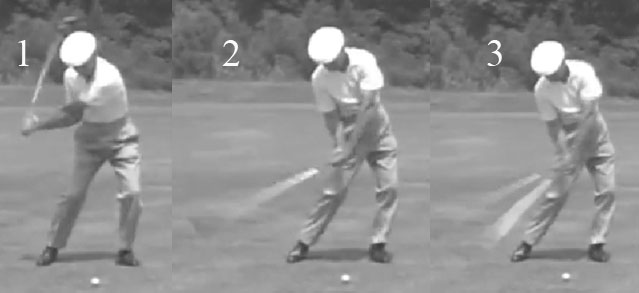
Image 1 is at P5.2 and the peripheral clubshaft is bent backwards, which indicates that he is “sustaining lag”.
Images 2 and 3 are at P6.3 - P6.5 and it looks like the peripheral clubshaft is bent forward, which according to Kwon/Sasho MacKenzie (SMK)/David Tutelman indicates a negative hand couple torque scenario and the absence of a “sustaining lag” phenomenon.
Unfortunately, we do not have slow motion videos (at frame rates >1,000 frames/second) to be certain of what is really happening in Ben Hogan’s late downswing.
So, let’s look at your golf swing action.
Here is one of your videos on “holding shaft flex”.
https://www.youtube.com/watch?v=bjvJPeBWJGk
Here is a capture image from that video.
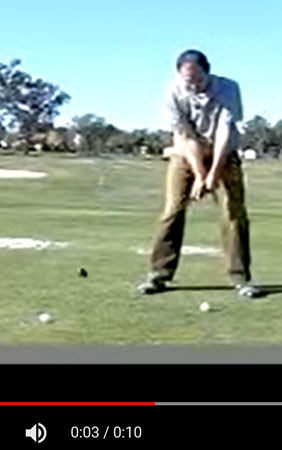
My visual impression is that the peripheral clubshaft is bent slightly forward, which indicates that you may not be “sustaining lag” at the P6.5 position.
Here is another one of your “holding shaft flex” videos captured at 1,000 frames/second.
https://www.youtube.com/watch?v=qJ_wqBdGCms
Here is a capture image from that video.
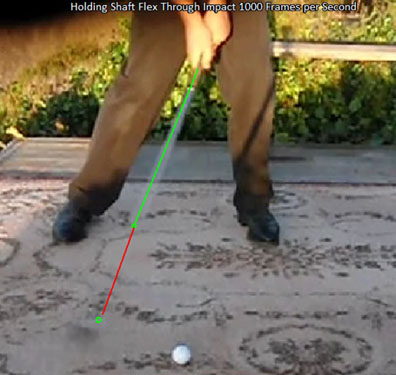
I have drawn a green line down the proximal clubshaft. I then drew a small green circular marker at the peripheral end of the green line and another one at the hosel of the clubshaft. I joined the two green circular markers with a red line. The red line looks to be tilted forwards to a very small degree suggesting that the peripheral clubshaft may be bent forward and that indicates a small degree of loss of the “sustaining lag” phenomenon.
Now, here is a capture image from your instagram video where you are swinging a 16 oz persimmon driver.
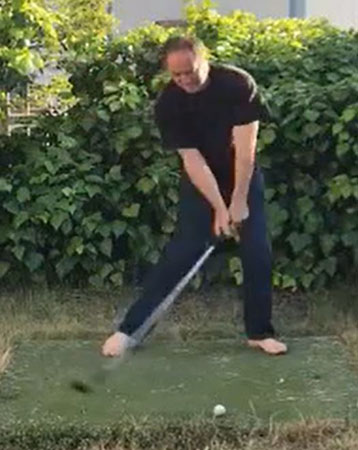
This capture image suggests that your perpiheral clubshaft is bent back slightly, which suggests that you are successfully “sustaining lag”. That’s amazing! I have never seen a pro golfer get to that ~P6.7 position with a driver swing and have the peripheral clubshaft bent backwards.
It really suggests that you may be capable of “sustaining lag” with your driver swing.
I suggest that you produce a high quality swing video of this same driver swing action (at a frame rate of 1,000 - 4,000 frames/second) and post in on you-tube. That would allow me to download the video in order to use my swing analyser program to view the video one frame-at-a-time so that I can determine whether you can successfully “sustain lag” throughout the entire P6 => P7 time period.
If you can successfully “sustain lag” between P6 => P7, then Brendon should introduce you to Dr. Kwon so that can he perform “inverse dynamics” modelling of your driver swing action to determine whether you are capable of sustaining a positive trail hand couple torque to well beyond P5.5.
Here is Kwon’s image of the torques been exerted by pro golfers and skilled collegiate golfers when swinging a driver.
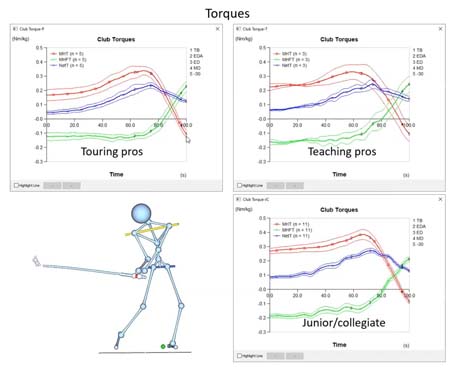
The red graph (showing one standard deviation) is the hand couple torque graph, which is positive in the early downswing but it becomes negative after P5.5 in all those skilled amateur and pro golfers. Your “holding shaft flex” technique may be enabling you to have a positive trail hand couple torque to well beyond P5.5 and well into your late downswing, and it could be very informative to see what your trail hand couple torque graph looks like.
I also would like to see Kwon (or SMK) perform an instrumented grip study on your driver golf swing action. Although David Tutelman questions the legitimacy of instrumented grip studies ( see https://www.tutelman.com/golf/swing/openloop.php ), an instrumented grip study could be very informative in your specific case. I would particularly like to know how much push-pressure is being exerted by your trail hand at PP#1 (which is above the coupling point) and on the aft side of the club handle at PP#3 (which is below the coupling point) during the P6 => P7 time period.
Your video showing how light/firm grip pressures can affect the ball flight pattern of a toe hit is also very interesting. I would like to see you repeat that performance at different clubhead speeds using an instrumented grip, which could actually measure your grip forces being exerted in different planes (relative to the clubshaft).
I find your “holding shaft flex” technique intellectually fascinating and I would like to see golf researchers study your driver golf swing action in great depth, so that we can better understand what is actually happening at the level of your hands where it interacts with the club handle.
Jeff.