More information from the manufacturer.
More information from the manufacturer.
Honest Qs – how are modern-day manufacturing techniques in actuality better? What about general claims that I know I’ve read various places that old-school forgings were unmatched by today’s manufacturers (at least all but a select few)? Are forged “players” blades made differently in a material way today? Or is it more a design argument – in that having the ability to create a 3-d rotating rendering of a clubhead on a graphed computer screen somehow must make the finished product better? Why is longer on the whole better?
Why do my dynas and Hogans feel more solid, more substantial than my mp-33s? Subjective of course…and this subject ain’t exactly a machine…could be shaft choice of course. Still, makes me wonder.
I’ve been told that it is mostly dependent on the steel being used. I’ve hit the MacGregor 985’s and some Colokrom’s and some Haig Ultra’s and none of them feel as good when hit flush as the modern Mizuno’s. Mizuno uses grain flow forging which is supposed to remove air bubbles from the forging process and produce a better feel. Whether that is true or not, I have no idea, but Mizuno makes a better feeling, softer club than any of the other major OEM’s if you ask me.
Scratch Golf is supposed to have the softest steel available and everybody I’ve talked to raves about their blades (SB-1) and their feel. I have yet to hit them, but plan on doing something this year with making a trip to Chattanooga where their clubs are made which is only 2 hours away from me. Scratch has a patent on the steel they use, so nobody else can use it right now.
Now as far as what steel the vintage Hogan’s and Wilson’s I’m not sure what was used. I know the Hogan’s I have feel fantastic. I would say right in line, if not better than the Mizuno’s…but if I did a ‘taste test’ I’m not sure I would be able to tell the difference. At a recent TGM summit physicist Dr. Aaron Zick explained why blades are a superior design of irons than the CB’s and Game Improvement irons. Never really got the answer on that because I didn’t attend the summit, but that was one of the talking points he went over.
3JACK
Here is Olazabal’s set back in the day… lots of lead tape and personal tinkering…
I think what has been lost is the education of the player themselves to really understand their gear, and what is going to be best for them… The idea of buying a set off the shelf that is going to be a perfect set from any era is not likely. All the greats tinkered constantly with their gear, and having to rely upon a custom clubfitter to do it for you is very very limiting.
What kind of swing do you have? Are you a hitter, swinger? Steep, flat? Do you have a definitive shot shape you are working with or against? Too much pride to put lead tape on the back of your club? Too scared to bend your irons flat?
It’s a constant search for what will work best for you… I swing flat so I like a lower profile club, with a lower sweetspot, but don’t mind a club with different specs. My golf swing feels different everyday, so I don’t mind my gear being different to a certain degree. With a good golf swing, you can hit any kind of gear… but personally, I require that I really can feel the sweetspot of the club, otherwise I am to some degree, damaging my golf swing. Nothing could be worse for me than cavity backs or a hollow giant head void of feel.
Irons are for accuracy, not distance…
I had a long discussion about this with a great player named John Morse, who right around that time had won the Australian Open.
Morse played the heaviest set I had ever seen. All his irons were like E5 or something and really heavy deadweights. He said he did this for distance control mainly, and that he also felt being able to feel more head weight helped him hit it straighter. He was just a really steady ball striker, who rarely made a mistake. He would just wear you down with fairways and greens… a really solid player.
I think light irons are very difficult to control distances with.
I’ve never hit a modern day blade but to me, a sweet spot is a sweet spot regardless of what club you hit. As long as you can feel when you have hit it off the sweet spot (something that you can’t easily do with a cavity back) then you will do good.
Personally speaking and given my above sentiments, I wouldn’t pay $1200 for a set of modern blades when $200 or less will get me a set of vintage ones.
I added a boatload of lead tape to a set of my Hogan’s. When I got them measured they were at C9 swingweight. Now with the lead tape they are probably D5-D6. First day I hit them out on the course with the lead tape and I think it was pretty obvious I hit them longer with the lead tape on them. My guess is that the acceleration stayed the same, but the mass increased greatly. Thus more force was applied.
3JACK
The other big difference that I don’t think has really been mentioned is bounce. I reckon the added bounce on modern clubs was intended to help the steep swingers but has ultimately encouraged and promoted it. The thin soles and no bounce on the older clubs meant that you had to be shallow or you were just going to dig holes…
YAHTZEE!! The only way you can set it up with the leading edge on the ground is to move it back and/or shove the hands way in front of the ball Willie Wood style. Impossible to approach from an open position, it’ll either bounce or dig before it gets to the ball.
Oh wait a minute I forgot I don’t know anything about golf, my bad.
… and these days if you’re not steep you’re just gonna skull the crap out of it… what a mess…
The 73 Apex I picked up have minus bounce on the 7, 8, and 9 irons… which is just genius because it encourages you to be shallower with the clubs that you would tend to be steeper with, ie. the shorter shafts… and the bounce increases ever so slightly through the set to encourage a downward strike on the clubs you’d be inclined to try to lift? Was he really that clever?!
I tell you what,I reckon Ben Hogan was a genius beyond anything any of us can comprehend… he’s like the Mayan’s or the ancient Egyptians of golf- how the hell did they figure out a way to build those things…
The leading edges on my Hogan '63 IPT’s and '67 Percussions are razor sharp by golf club standards. While I like Tom Wishon a lot, his agenda as a clubfitter is different from my agenda as a golfer. So I trust him in regards to actual facts about equipment, but as far as his opinion on fitting a golfer for equipment, I tend to disagree.
Awhile back, Tom was nice enough to tell a member here (IIRC, Addington Arnie) about what he noticed about Hogan’s personal set of irons. He noticed that the leading edge was razor sharp as well and said ‘any other golfer would hit it fat 80% of the time.’
That’s really the mentality of OEM’s and clubfitters. They are trying to appeal to the ‘quick fix’ golfer and I’m not sure I really blame them. But I think the more refined golfers tend to suffer, especially when their swing starts to go a little south on them and the cavity backs or the GI’s are not helping them any.
3JACK
I agree, you don’t want to fit clubs to a bad swing…
You need to fit clubs to where the player should be for their size and impact potential…
Not doing that is really dropping the ball on club fitting.
Hey Bom
If you have them handy, I would love to see the bounce numbers for the Apexes…
I had my percussions measured and they were all over the map; I believe they were bent and re-bent a few times
and just wasnt worth it to dial them in (the beauty of buying clubs for 45 dollars is the ability to sell them for 45 dollars!) LOL
Anyway, I just wanted to compare the #s if you have them
thanks
bent
bob
B, I don’t know the numbers for the bounce. I just did some ‘eye-dometer’ work with them on a flat surface…
It really is interesting how much his older clubs were built to challenge you and help you by not helping you- some good old school teaching!
Sorry about that…
BOM
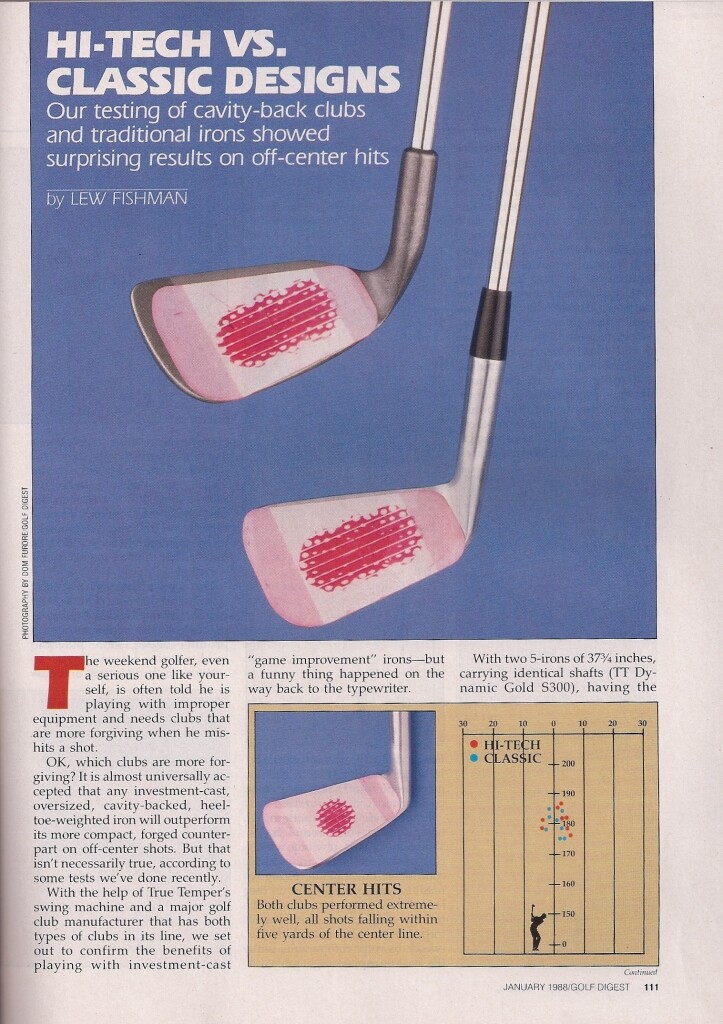
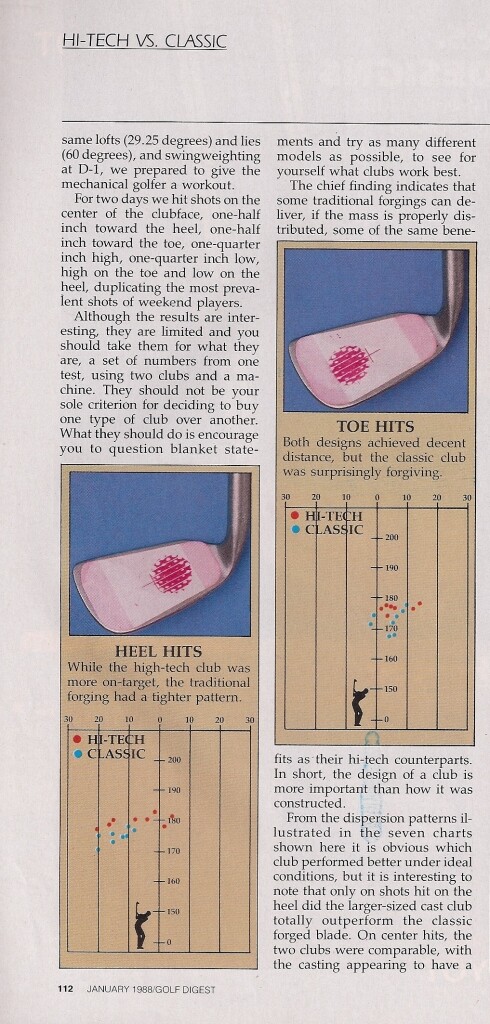
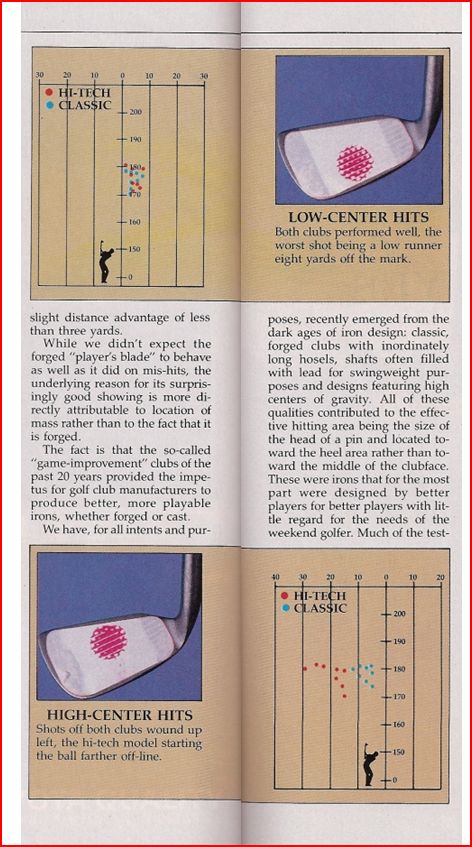
Here’s a mighty fine article about the ‘hi tech’ clubs versus the blade
I know we are talking vintage blade V new blade in this thread but this article is from 1988 so holds bearing in some regards
I know todays equipment is even more ‘advanced’ since 1988 and balls are different also but I really thought this article was interesting.
It really shows how marketing has duped many into believing they are better off with these game improvement irons when in reality in this test the traditional blade was a hands down winner
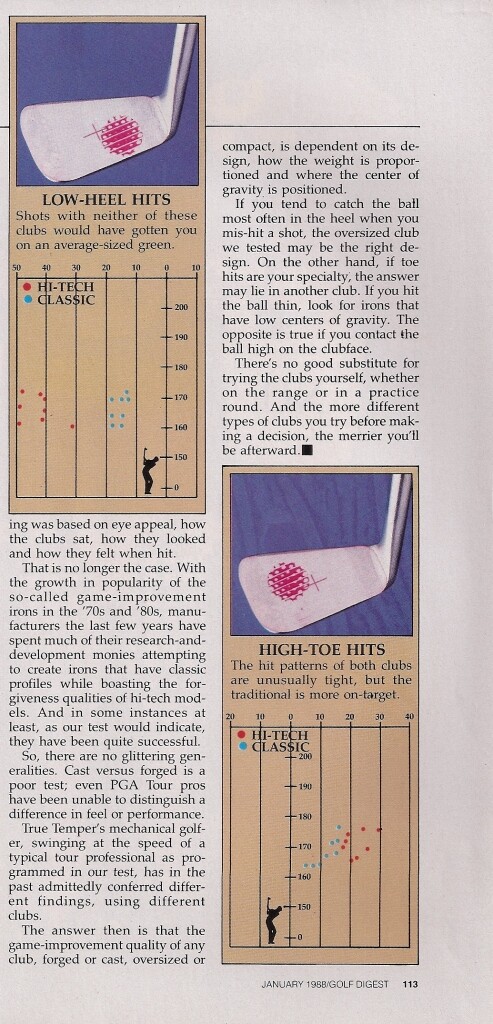
That’s a very interesting article. Thanks!
Fantastic article.
The only thing I don’t agree with is the theory that it’s invalid to test forged vs. cast.
I think the line of thought was years ago there was a blind test done to see if golfers could tell the difference between a forged and a cast club depending upon the feel of impact with two clubs that looked identical. The results were that golfers could not tell the difference.
Having hit forged clubs for quite some time and some cast clubs, I never bought into that. And I knew I wasn’t alone from talking to other golfer over the years about the great feel of a forged irons.
Scratch Golf CEO, Ari Techner, pointed out the flaws in this study. Mainly that the study had golfers using clubs from the same type of steel, just forging one and casting the other. As Techner pointed out, most companies use a different steel with forged clubs than are what’s used with cast irons. And it’s the steel and its softness that matters. Techner also pointed out that Scratch Golf has the patent on the softest steel available for use only on their clubs. The problems with a lot of these studies is that they are often hardly scientific or done properly to draw an accurate conclusion. This study acknowledges the lack of a sample size and some of the other flaws, but I think makes a largely a good point. But they really need to stop referencing an old and flawed study on forged vs. cast.
3JACK
I’m going to print that article, laminate it, and hang it off my bag.
The next time someone tells me: “Only Pro’s should play blades,” or “When you miss hit blades they must go nowhere,” or “The technology is so much better today,” or any variation thereof I’m just gonna’ let them flip the pages…
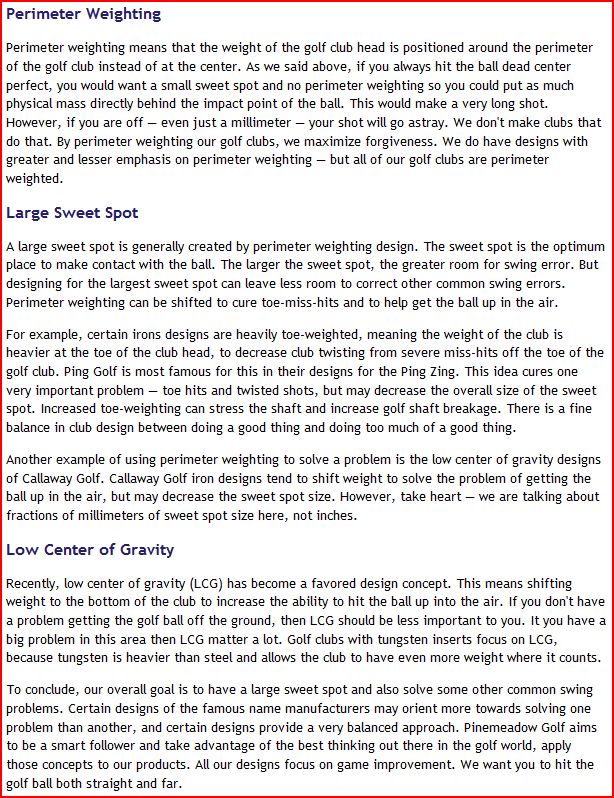
Here’s another article from a component club company:
they say it in black and white… a smaller blade with more mass directly behind provides a strong shot and a perimeter weighted club plays for your mishits—
so you will never improve in other words…just hit crappy mishits with a swing that deteriorates so that you feel better about yourself
I got my Apex PC’s bent today. They are at a C9 swingweight and I only had enough lead tape to get my 5-iron to a D6 swingweight.
There’s a lot of worry about losing yardage on the vintage irons. Today I hit the PC 5-iron just as far as my MP-62 5-iron, give or take 5 yards.
The Apex PC 5-iron measures at 37.75 inches and has a 30* loft.
The MP-62 5-iron measures at 38.5 inches and has a 27* loft.
I think the issue with yardage loss on the vintage irons is the shafts and the lofts. My IPT’s and Percussions have an old TT shaft in them and the 5-iron measures at 37.5" long. I also think the 5-iron loft on those clubs is around 31-32 degrees. My PC’s have TT DG S300 shafts that are pretty new. So it’s my assertion that if you’re afraid of the yardage loss versus some ‘player CB’s’ or some modern blades, you probably just need to get some new shafts and some lofts tweaked a tad.
3JACK
